John Y. Lawrence
Abstract
This article builds on my previous article, “Lyricist as Analyst,” claiming that rhyme schemes in lyrics written to pre-existing music have implications for formal analysis: they suggest where formal units begin and end, and what those units’ relationship is to each other. This article applies this model to two popular-song adaptations of Chopin’s Etude in E major, Op. 10/3: Jean Marietti and André Viaud’s “Reviens mon amour” and Sonny Miller’s supposed translation of that song as “So Deep is the Night.” The unconventional form of Chopin’s melody inspired the lyricists to write unconventional rhyme schemes, which sometimes reinforce how a listener likely would have analyzed the musical form anyway, and other times supplement, contradict, or override the results of a music-only analysis. I suggest that adaptations of classical works have much to teach us about the originals, because they capitalize on affordances that might otherwise have remained dormant.
Keywords and Phrases: text-music interaction, rhyme, Chopin, listener, Formenlehre
Introduction
This article is about the music of one of the great popular composers of the early twentieth century: Frédéric Chopin.1 Yes, twentieth century, not nineteenth century. After Joseph McCarthy and Harry Carroll adapted the middle section of Fantaisie-Impromptu into the smash hit “I’m Always Chasing Rainbows” in 1917, pop song adaptations of Chopin’s music seemed to spring up everywhere for the next few decades. The A-flat polonaise became “Till the End of Time” (adapted by Buddy Kaye and Ted Mossman), the D-flat nocturne became “My Promise to You” (adapted by Ervin Drake and Jimmy Shirl), and the E-flat nocturne became “My Twilight Dream” (adapted by Eddy Duchin and Lew Sherwood).
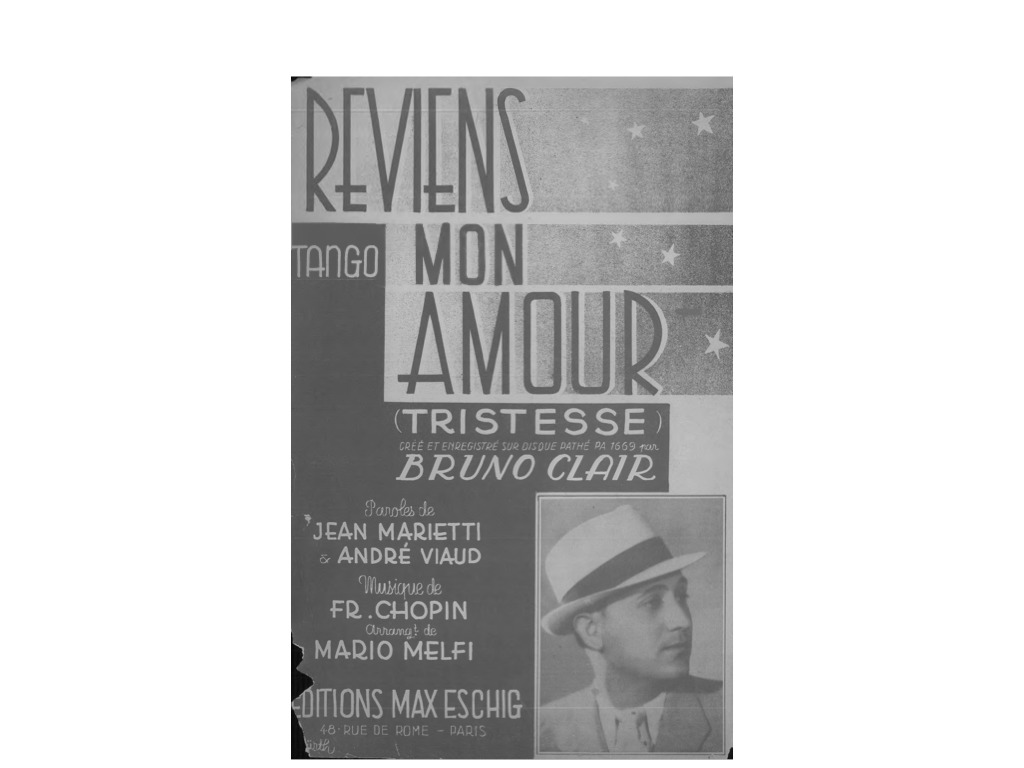
One of the most popular choices for this sort of adaptation was the main theme of Étude in E major, op. 10, no. 3, written in 1832. As of this publication, the website SecondHandSongs lists 20 pop songs in 11 languages based on this melody.2Although the melody is in a major key and is dominated by tonic and dominant harmonies, critics in Chopin’s time detected an undercurrent of melancholy in the music, and thus nicknamed the piece “Tristesse” (“sadness”) or “L’adieu” (“farewell”). Many lyrics that were written to this melody (knowingly or unknowingly) reflect these nicknames by depicting a protagonist pining for their absent love. One such adaptation was a 1939 French song with lyrics by Jean Marietti and André Viaud, sold sometimes under the title of the étude’s nickname, “Tristesse,” and other times under the title of the first line of the lyrics, “Reviens mon amour.” (For the sake of clarity, I will refer to it by the latter title in the remainder of this article.) Example 1 shows the cover of the published sheet music, which uses “Reviens mon amour” as the title and “Tristesse” as the subtitle. Although the song is marketed as a tango, the original rhythm of Chopin’s melody remains unchanged. Traces of tango—and rather faint ones at that—are detectable only in the accompaniment rhythms and instrumentation. Mario Melfi is the credited arranger on the sheet music. But “arranger” here does not primarily mean the person responsible for the instrumental arrangement, as Melfi remained credited in many subsequent recordings and versions that did not share the exact arrangement from either Bruno Clair’s original recording or the version released by Melfi himself the same year (with the mononymous Bernardi as the singer). Instead, Melfi appears to be credited as the arranger for the act of adapting the music from the original étude, although (as we shall see) this involved minimal recomposition or reharmonization.
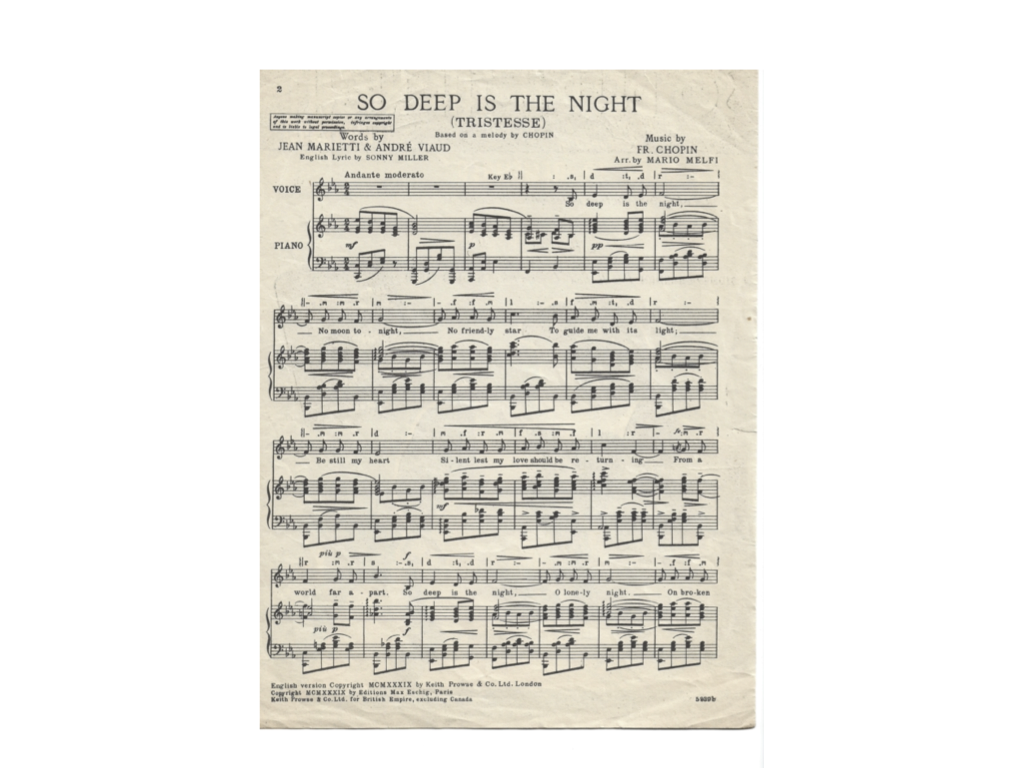
The same year, the French adaptation was released in the United Kingdom as “So Deep Is the Night” with new English lyrics by lyricist Sonny Miller, first recorded by Jack Hylton (a bandleader fond of “jazzing” classical music) and his orchestra with vocalist Sam Browne (1939).3 Although Marietti and Viaud retain lyricist credits in the published sheet music (Example 2), Miller’s lyrics are not a translation of the Marietti and Viaud’s words. Miller preserves neither the meaning nor (equally crucially, for this article) the rhyme scheme of the French lyrics.4 And the song is no longer advertised as a tango. Instead, Hylton’s record is marketed as a foxtrot and played at a much faster clip than most subsequent recordings of the song, which treat it as a slow-to-medium-tempo ballad.
It may be surprising that I propose to embark on analyses of these songs. Many listeners and scholars alike would find the lyrics to these songs so pedestrian as to be unworthy of academic attention.5 But this article is about these lyrics not merely as objects of analysis, but also as analyses themselves. I first made this perhaps unintuitive claim—that song lyrics can function as analyses of songs—in the article “Lyricist as Analyst: Rhyme Scheme as Music-Setting in the Great American Songbook” (Lawrence 2024a). The logic behind this analogy is as follows: When confronted with a pre-existing melody, lyricists have to decide where to place line breaks, which means determining where the melody’s internal units begin and end. They also have to place rhyme words at these line breaks, creating a rhyme scheme that establishes kinships and contrasts between units.6 These two tasks—determining the boundaries of and relationships between formal units—are also the main duties of a formal analyst.
In “Lyricist as Analyst,” I show that melodies in American popular songs of this era are frequently composed of eight-bar units that conform to standard sentence and period models, and each sentence and period type has a standard rhyme scheme that goes with it. Building on the work of David Temperley (2001), I treat such rhyme schemes as “descriptive”—that is, they are likely to reinforce (rather than challenge) the perception of musical form that one might have had when encountering the melody alone, without lyrics. However, when the form of the melody is ambiguous and/or departs from conventional models, rhyme schemes can play a more “suggestive” role: they can narrow the focus of listeners, making some interpretations of the music seem more viable, others less; or they can also broaden the focus of future analysts, introducing possible readings that would never have been salient from the music alone. As well shall see, the formal shape of the melody to Chopin’s “Tristesse” étude is anything but straightforward. Any rhyme scheme that attains a sense of “fit” with the music will necessarily need to function suggestively.7 This article operates under the assumption that insights can arise when we pay heed to such suggestions.
In the remainder of this article, I analyze the main melody of this étude three times. First, I look only at Chopin’s music, to identify the formal difficulties it poses. Second, I see what analytical implications are suggested by the French lyrics, including multiple versions of some passages. Third, I examine the later English lyrics, to see what was lost in translation and what was gained.8
The mode of analysis I employ in this article rests on an assumption I have defended in prior work (Lawrence 2020): namely that if formal analysis is meant to reflect real-time listening processes (including listening to a piece for the first time) rather than the out-of-time act of score analysis, it needs to consider a listener’s potential projections into the near future—their guesses about what might happen next based on what they have already heard.9 I adopt this approach not as a matter of aesthetic preference, but rather because I think it is more consonant with the picture of the human mind drawn by cognitive science and music psychology alike.10 According to this model, an experienced listener in any musical style will constantly predict the form of the second halves of themes after hearing their first halves (e.g. in Classical repertoire, by predicting continuations after hearing presentations and consequents after hearing antecedents). Analysis of this dimension requires attending to not only actual structures that emerge over the course of a piece but also the dialogue between the actual and expected structures. The idea of treating rhymes schemes as well in this manner has precedent in the work of Richard Plotkin (2023), who suggests that when listeners hear words at the ends of lines of lyrics, they develop preferences for which words will be rhymed later and when those rhymes will occur.11 The analyses in this article show some of the things that can happen in the listening process when musical form and rhyme scheme interact.
1. Chopin’s “Tristesse”
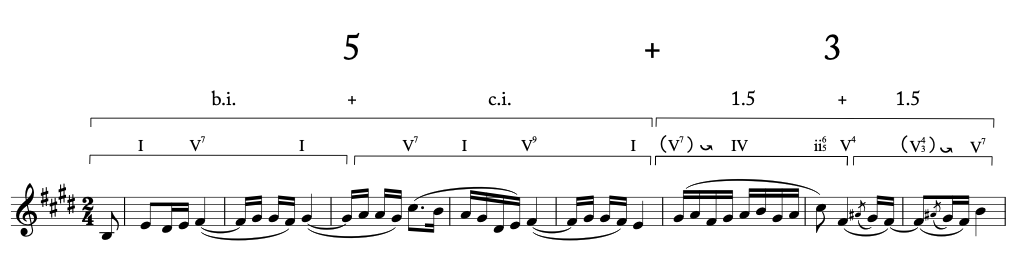
The main melody of Chopin’s étude immediately poses formal surprises (to a listener) or challenges (to an analyst) within the first eight bars of the theme, which divide into 5 + 3, instead of 4 + 4 (Example 3).12 There are two main ways of parsing the five-bar phrase: as 3 + 2 or 2 + 3. The first of these interpretations—most notably propounded by Heinrich Schenker (1979)—suggests that there is an underlying six-bar model whose second half has been compressed by one bar.13 I support the second of these interpretations, as shown in Example 3: a two-bar basic idea followed by a contrasting idea that has been stretched out to three bars rather than two. I would argue that this interpretation is likely truer to a listener’s first, real-time hearing of this melody. Experienced listeners of this repertoire tend to default to hearing duple units, absent strong evidence to the contrary that indicates that the basic idea is continuing (in line with Schenker’s reading). Such evidence in Schenker’s favor might include the G$$\sharp$$s that is held across bars two and three. Militating against this reading, however, is the fact that: (a) the sixteenth-note rhythm on beat two of bar three would be a very unusual way to end a formal unit; and (b) the figure beginning on beat two of bar three is slurred with beat one of bar four. Further support for a 2+3 reading comes from the fact that if bar three is understood as the start of a new unit, the use of the tail motive of the basic idea as the head motive of the contrasting idea would conform to the standard device of “linkage technique.”14
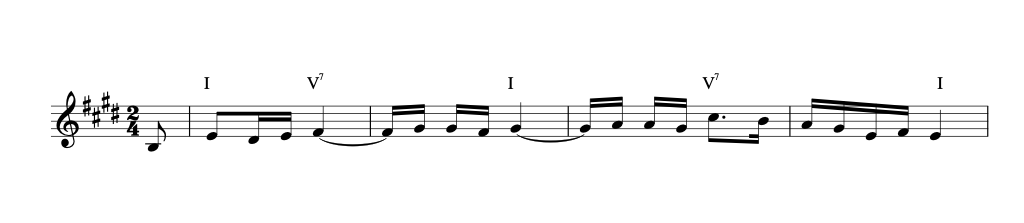
If one settles on 2+3 reading, an important additional question remains: how precisely did the two-bar contrasting idea become a three-bar idea? One option is that the idea has been stretched out, which William Caplin (1998) calls “expansion.” (Example 4 provides a potential four-bar model for what a pre-expanded form looks like, based on Dallin’s recomposition of this song for his version of “So Deep Is the Night.”) The other option is that an additional component has been tacked onto it, which Caplin calls “extension” (20). In this case, the answer to the question is determined by whether one hears mm. 3–5 as forming one cohesive unit (as if the goal was always tonic, and the dominant chord straddling mm. 4–5 stuck for too long) or they hear m. 5 as supplemental (as if the initial goal was the dominant chord in m. 4, and then m. 5 twists the music back to tonic after the fact).15
If a listener or an analyst finds both readings plausible (as indeed I do), their perception might be conditioned by the pianist’s decision. If the pianist breaks the phrase at m. 5, an impression of extension may be created; if the pianist phrases very fluidly, the music may feel expanded instead. Audio Example 1 provides samples of each of these from different recordings by Abbey Simon. In 1a, his Vox performance (1996 [recorded in 1976]), he dramatically alters the dynamics and his touch in m. 5, sharply differentiating it from m. 4, suggesting extension. By contrast, in 1b, his later Basilica recording (released in 2014, but no recording date specified), Simon exaggerates the break between beats one and two in both measures 2 and 3; this brings out a sense of continuity between mm. 4–5, since there is no corresponding break, which supports an expansion reading.
The new idea in mm. 6–8 seems less ambiguous. As shown in Example 3, this three-bar idea is composed of two units, each of which is one-and-a-half bars in length instead of two bars. This sort of compression is the counterpart of expansion not extension. The shorter length comes from shrinking the units, not from removing from one of them.
For a first-time listener, the strong modulation to V in m. 8—after much time spent dithering between tonic and dominant—may indicate that the theme has reached its midpoint. If so, they may form a hypothesis about what sort of theme this is and what is going to happen next. They might, perhaps, regard the basic idea and contrasting idea in the first five bars as forming some sort of compound basic idea, and therefore the next three as some sort of continuation (serving the same role in the compound antecedent that a contrasting idea would play in a four-bar antecedent). They might then understand this as a deformational compound antecedent of a possible compound period.16
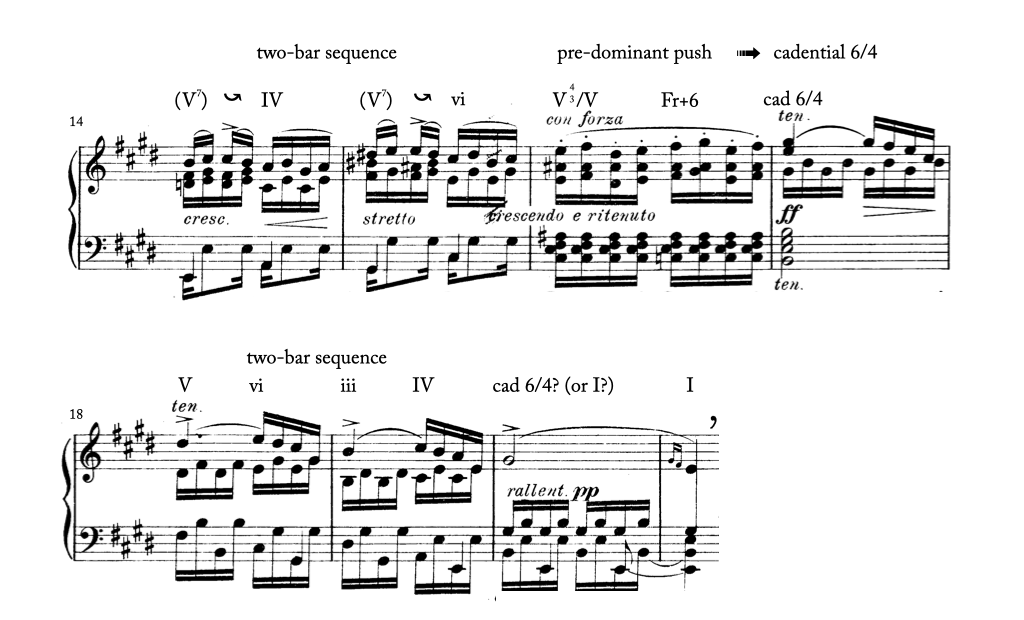
This hypothesis gains credence as soon as mm. 9–10 begin, for it immediately becomes evident that the opening material is returning. Thus, a listener might project that they are in the midst of a compound consequent, and that the ongoing unit will be five bars long again, as indeed it turns out to be. Example 5 shows the continuation of the compound consequent as it first appears in the étude’s A section. The events are as follows: First, a two-bar model sequence (mm. 14–15), then a pre-dominant push towards a cadence (m. 16), and the attainment of a cadential $$^{6}_{4}$$ (m. 17). This yields the ending’s first big twist: the dominant does not resolve. It is succeeded by a vi chord, but this is not even a deceptive cadence, because it is not a cadence at all. The vi chord is on a weak beat. Instead, this is the first leg of yet another two-bar sequence (mm. 18–19).
There are multiple ways to interpret what happens in mm. 20–21, of which I will consider three. The first and simplest reading is to interpret the chord in m. 20 as another cadential $$^{6}_{4}$$, which “resolves” back to a root-position tonic (m. 21). The theme’s final “cadence” is therefore really a non-cadence, with the role of the dominant fulfilled by that lowly $$^{6}_{4}$$ chord instead of by a bona fide V chord.17 The second reading is to interpret the chord in m. 20 as a (non-cadential) I$$^{6}_{4}$$ chord.18 Under this interpretation, mm. 20–21 form a tonic prolongation, rather than a dominant-to-tonic progression.19 The third reading also suggests that mm. 20–21 form a tonic prolongation, but suggests that the true bass of m. 20 is already $$\hat{1}$$, even though it occurs off the beat. This is made plausible by the precedent set in mm. 18–19, in which one is surely tempted to say the bass notes of the chords on the first beats are B and G$$\sharp$$s respectively, not F$$\sharp$$s and D$$\sharp$$s. Since m. 20 does not have a dominant function in readings two and three and is instead the onset of a tonic prolongation, someone subscribing to either of those readings would have to locate some non-tonic chord prior to m. 20 that resolves in m. 20. The nearest option, of course, is the IV chord ending m. 19, in which case the concluding progression is a plagal cadence. If one insists on a dominant chord instead, one has to go all the way back to the $$^{6}_{4}$$ chord leading to the V chord in mm. 17–18. It remains an open question whether either of these possibilities—a plagal cadence or a dominant separated from its tonic resolution by an intervening vi–iii–IV progression—provides a stronger sense of closure than the progression perceived in the first reading, which has direct motion $$\hat{5}$$-to-$$\hat{1}$$ in the bass although it lacks cadential content in the harmonization.
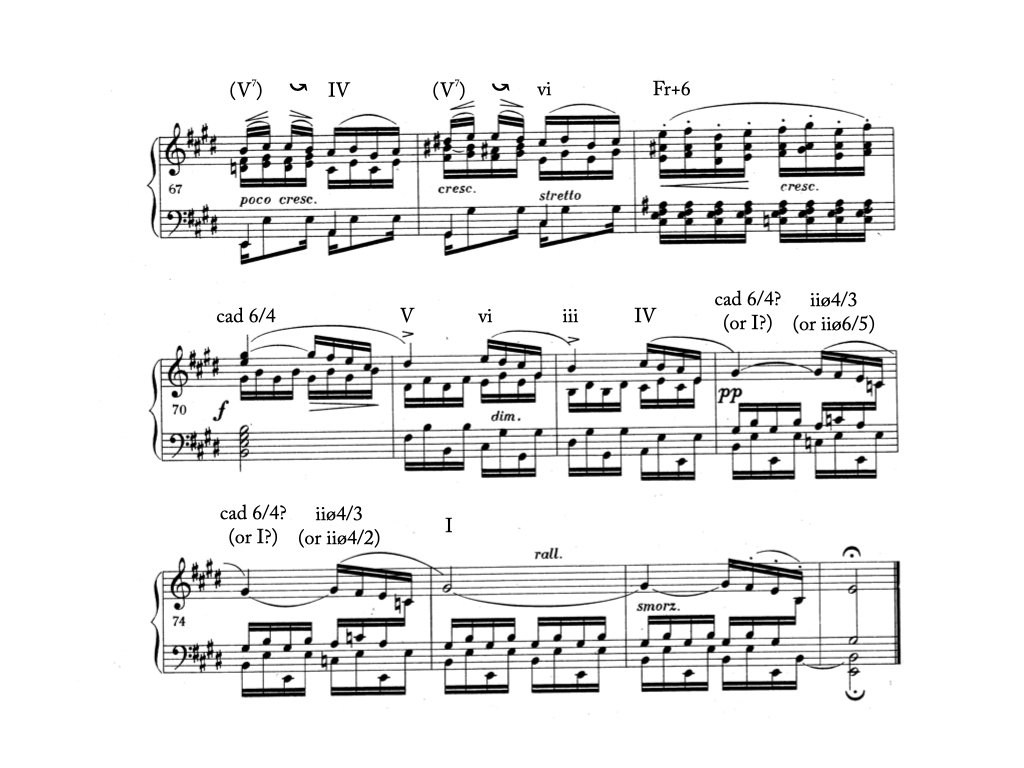
Someone ambivalent about these readings (more likely an analyst rather than a first-time listener) might seek assistance from the way these bars are altered in the closing bars of the étude (the A´ section), shown in Example 6, but the ambivalence is likely to remain. The role played by m. 20 is now filled by four bars (mm. 73–76), which oscillate between the $$^{6}_{4}$$ chord (or I chord, in the third reading, in which the E is treated as the true bass) and iiø$$^{4}_{3}$$ (or iiø$$^{4}_{2}$$, in the third reading) before the quasi-resolution to the root-position tonic chord in the final measure. This revised progression is easily malleable to all three competing interpretations of the prolongation. In the first reading, the wavering between these two chords is prolongation of the dominant-functioning $$^{6}_{4}$$. In the second reading, the half-diminished chord is likely interpreted as having subdominant function rather than predominant function, participating in a tonic prolongation. And in the third reading (in which E is the true bass), the half-diminished chord occurs over a tonic pedal, making it even more clearly an agent of tonic prolongation.
In sum, the main melody’s ending is awash with ambiguity. The ambiguity expressed by this ending is in keeping with the formal ambiguity manifest throughout the theme. Such formal ambiguity does not always survive the addition of lyrics, as the structural relationships between words are rarely as fuzzy. Whether one word rhymes with another is a much plainer matter than whether one musical idea derives from another, as long as one is operating in a genre such as this in which near rhymes and slant rhymes are never allowed to substitute for exact rhymes. And what constitutes a grammatical clause is usually less contentious than what constitutes a musical phrase. This grants two great powers to the proceeding lyrics: to adjudicate between already present possibilities and to introduce new ones.
2. “Reviens mon amour”
Before we leap into the lyrics of “Reviens mon amour,” we must first consider the differences that arise from Mario Melfi’s rearrangement of Chopin’s melody. Melfi hybridizes the A and A´ versions. He begins with the compound antecedent from mm. 1–8 of the étude, but instead of using the compound consequent from the A section (mm. 9–21), he uses the compound consequent from the A´ section (mm. 62–77). His arrangement is also unambiguous about what the true bass note is after the model sequence: it is $$\hat{1}$$. In the published sheet music and in both of the 1939 recordings (his and Bruno Clair’s), one can see/hear $$\hat{1}$$ in the bass on the downbeats. This fact will be reflected in the analyses in the rest of this article.
In the figures that follow, I make the following notational choices for ease of comparison between the three versions of the melody (Chopin, French, and English): (1) I do not include the instrumental intros added in the pop versions; nor do I count them in the measure numbers. (They are inconsistent across sheet music and recordings: the sheet music of “Reviens mon amour” and “So Deep Is the Night” have four-bar intros; both Bruno Clair and Mario Melfi’s recordings have much longer intros.) I treat the first measure of the vocal parts as the first measure of the song, so it aligns with the étude. (2) Although “Reviens mon amour” and “So Deep Is the Night” were both published in E-flat major, rather than E major, I maintain E major. (3) Although the published versions of “Reviens mon amour” and “So Deep Is the Night” double the note values of Chopin’s original (but not the meter, which remains $$^{2}_{4}$$), I have kept Chopin’s original values.
Example 7 shows the published lyrics of “Reviens mon amour” (side by side with an English translation by me) with the rhyme scheme indicated by letter labels.20 Example 8 shows the first three quarters of the melody (mm. 1–13) together with the French lyrics and the same letter labels and color-coding as in Example 7. I do not recommend beginning by listening to either of the premiere recordings of the song—Bruno Clair’s or Mario Melfi with Bernardi. Although the cover of the sheet music states “crée at enregistré sur disque Pathé PA 1669 par Bruno Clair” (“created and recorded on disc Pathé PA 1669 by Bruno Clair”)— therefore leading one to expect the sheet music and recording to match—the lyrics that Clair and Bernardi sing do, in fact, differ from the sheet music in places. To hear the printed lyrics for mm. 1–13, I recommend listening to Beniamino Gigli’s 1948 recording (Audio Example 2). (Even though Gigli’s French pronunciation is dubious at times, his most questionable pronunciations take place only within lines and do not affect the rhyme scheme.)
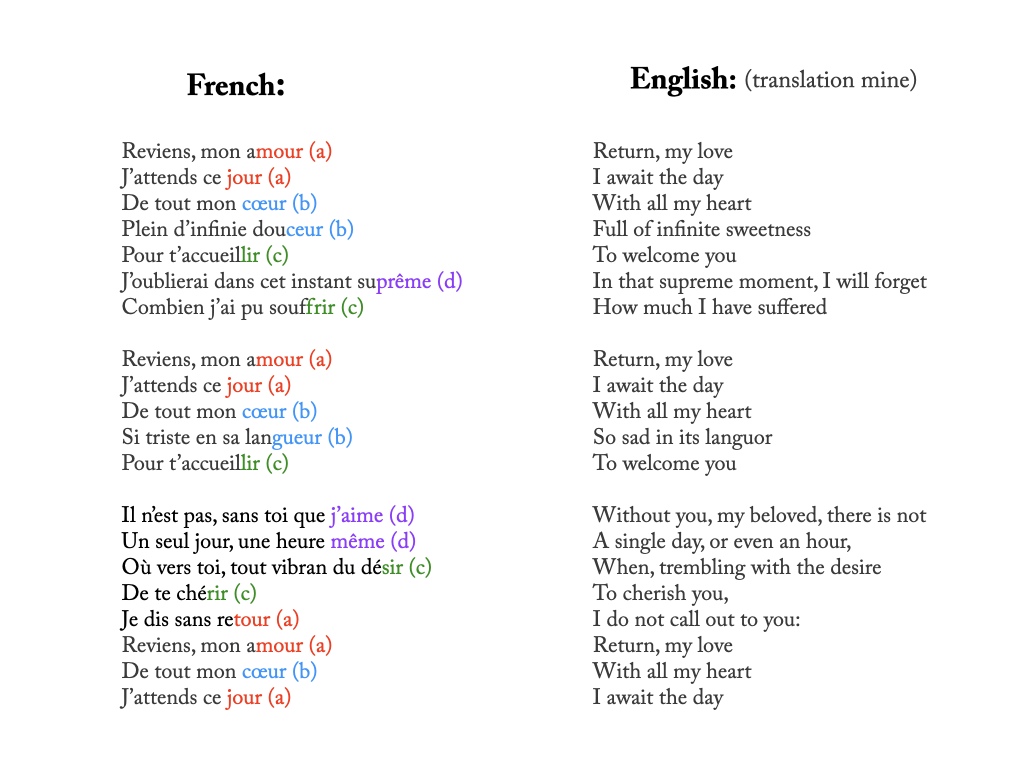
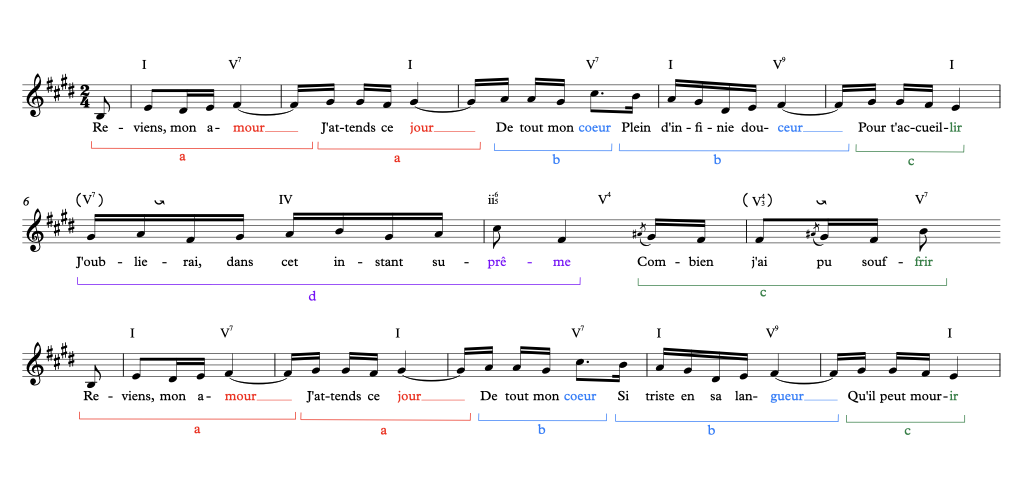
In the first five bars of the melody, Marietti and Viaud employ the rhyme scheme AABBC. When examining the music alone, expansion and extension both seemed like viable explanations for this phrase’s asymmetry. But these lyrics seem to endorse extension: because the rhyme words mark off regular one-bar intervals, none of the units feels expanded; and the rhyme scheme marks the fifth bar as an appendage because it does not match with anything that comes before. This sense of interloping is also reinforced by the syntax of this stanza (here, consulting Example 8 is clearest): the first four lines express a complete thought; removing the fifth line (“Pour t’accueillir” / “To welcome you”) would change the stanza’s meaning but would not produce an ungrammatical sentence (in either French or English). This isolation—sonic and grammatical—creates a need for the word “accueillir” to acquire a partner, which a listener might expect to occur at the end of the compound antecedent.21
That does indeed occur in m. 8. But now a different line-ending word has been left hanging: “suprême” (m. 7), which is marked as “D” in the rhyme scheme. Besides being unpaired, “suprême” is also notable for its placement. It comes one-and-a-half bars after the previous rhyme, thus breaking the pattern of one rhyme per bar. This disrupts the song’s “rhyme rhythm” (Lawrence 2024a): a phenomenon that is to lyrics as harmonic rhythm is to music—not the pace at which notes move, but the pace at which “events” occur. Squeezing together rhymes at one juncture can create tension, and spacing out rhymes can create relaxation, just as hastening or slackening harmonic rhythm respectively increases or decreases tension. In the case of these opening bars, broadening the space between C and D in the rhyme scheme relaxes the music, creating a bit of breathing room.
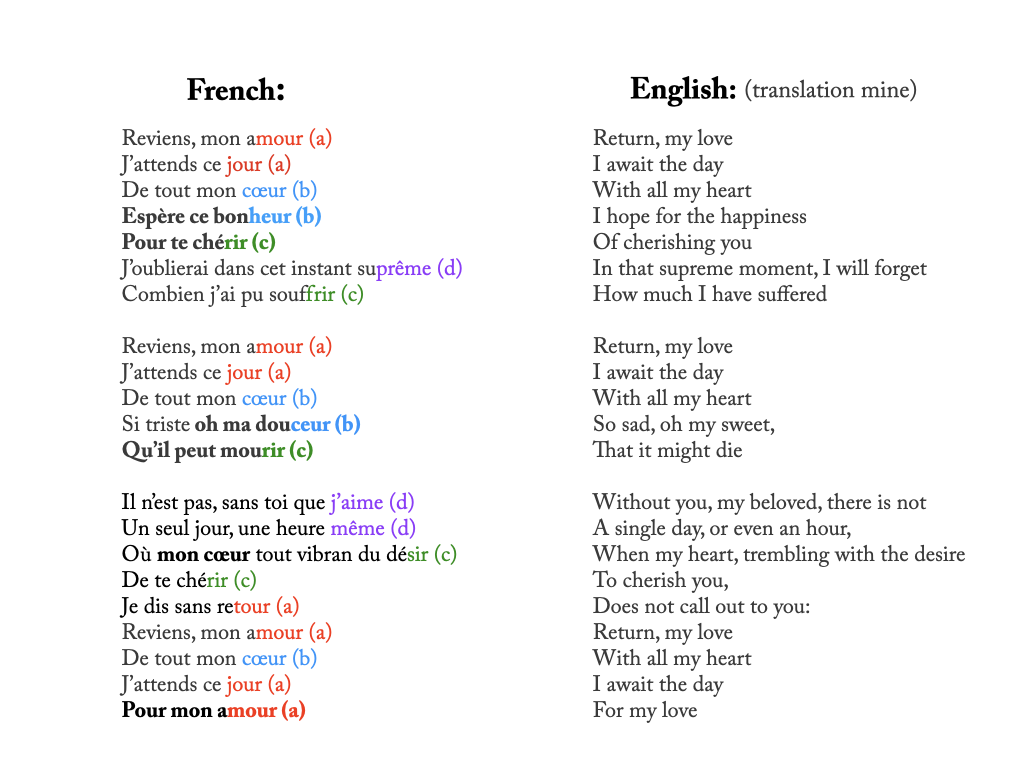
We might pause at this moment to consider the lyrics sung on the premiere recording by Bruno Clair.22 Example 9 presents my transcription of them, alongside a translation, with the changed lines bolded. The reader is invited to compare this with Example 8, which will allow them to see that the printed rhyme scheme has been preserved, further cementing this as a key feature of Marietti and Viaud’s analysis of Chopin’s melody. They can then listen to Bruno Clair sing these alternate lyrics in Audio Example 3. The point about how the grammar of this stanza abets a sense of extension (rather than expansion) in m. 5 remains supported by the alternate lyrics, as “Pour te chérir” (like “Pour t’accueillir”) is syntactically unnecessary for the first stanza, even if it is semantically significant.
As might be expected, the rhyme scheme of mm. 9–13 is a perfect copy of the one in mm. 1–4 (see Example 8). In fact, the first three bars have not merely the same scheme, but also the same lyrics. It is therefore mm. 14–24 that provide the most interest, as was the case in our formal analysis of Chopin’s two versions of the consequent’s continuation. Example 10 shows four versions of this phrase: the printed version, what is sung by Gigli (which differs only in the final four bars), and two different ways of construing what is sung by Clair, which differ from the printed version and Gigli’s in mm. 16 and then handles the final four bars as Gigli does). The performances of Gigli and Clair respectively may be found in Audio Example 4. I personally favor the reading in Example 10c over the one in Example 10d. That is, I do not think that the “coeur” in m. 15 was meant to be understood as part of the rhyme scheme, as the lyric variants have preserved the rhyme scheme (i.e. the analysis of the melody) in all other respects, and this granular level of internal rhyme seems out of keeping with the approach of the rest of the song. (Example 10d has one minor implication that I will consider in the closing paragraph of this section.)
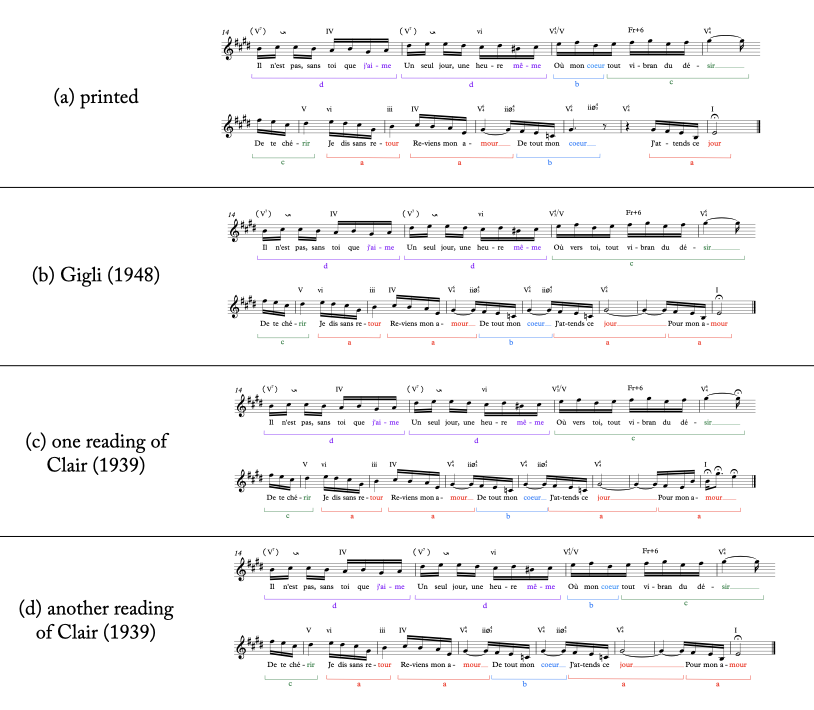
Let us start with what is consistent among them. The first two legs of the sequence (mm. 14–15) finally provide rhyming words (“j’aime” and “même”) for “suprême,” which had been suffering in seclusion since m. 7. We could think of this as merely a matter of economizing: why use a new sound for this double-syllable rhyme when we have a perfectly serviceable (as yet unrhymed) double-syllable word ready to hand? But the return of “-ême/-aime” (IPA: ɛ.mə), or sound D in the rhyme scheme, can also draw attention to the motivic connections between the current sequence and m. 7.
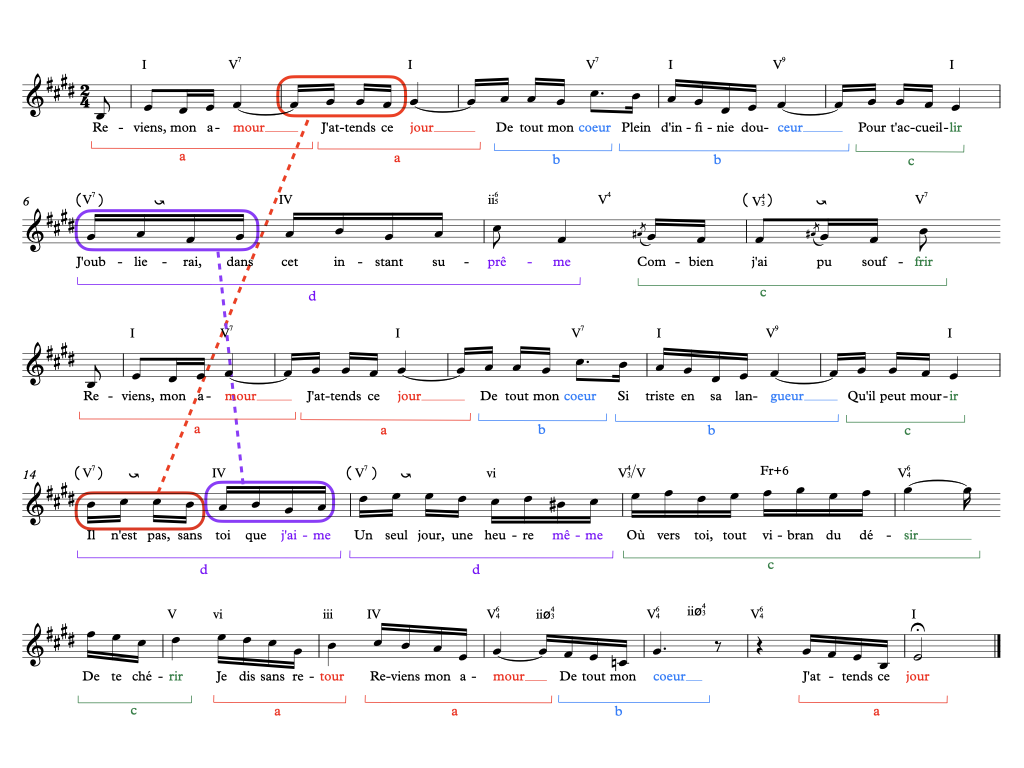
The formal analysis of Chopin’s melody in the previous section did not draw motivic connections among the various ideas contained within this theme. However, the motivic derivation of this sequential figure in m. 14 is evident (Example 11): the toggling figure on the first beat was introduced in m. 2 (shown by the dotted red line), and the double neighbor figure on the second beat was introduced in m. 6 (shown by the dotted violet line). We have not heard that double neighbor figure since the idea in mm. 6–7, and thus the reappearance of sound D (ɛ.mə) marks a sort of “double return”: of both the linguistic rhyme sound and the musical motive associated with those measures.
The next sound to return is “-ir” (IPA: iʁ), marked as sound C in the rhyme scheme. It crowns two crucial points of arrival in the push towards the cadence: the $$^{6}_{4}$$ chord in m. 17 (“désir”) and the V chord in m. 18 (“chérir”). This affords two analytical observations:
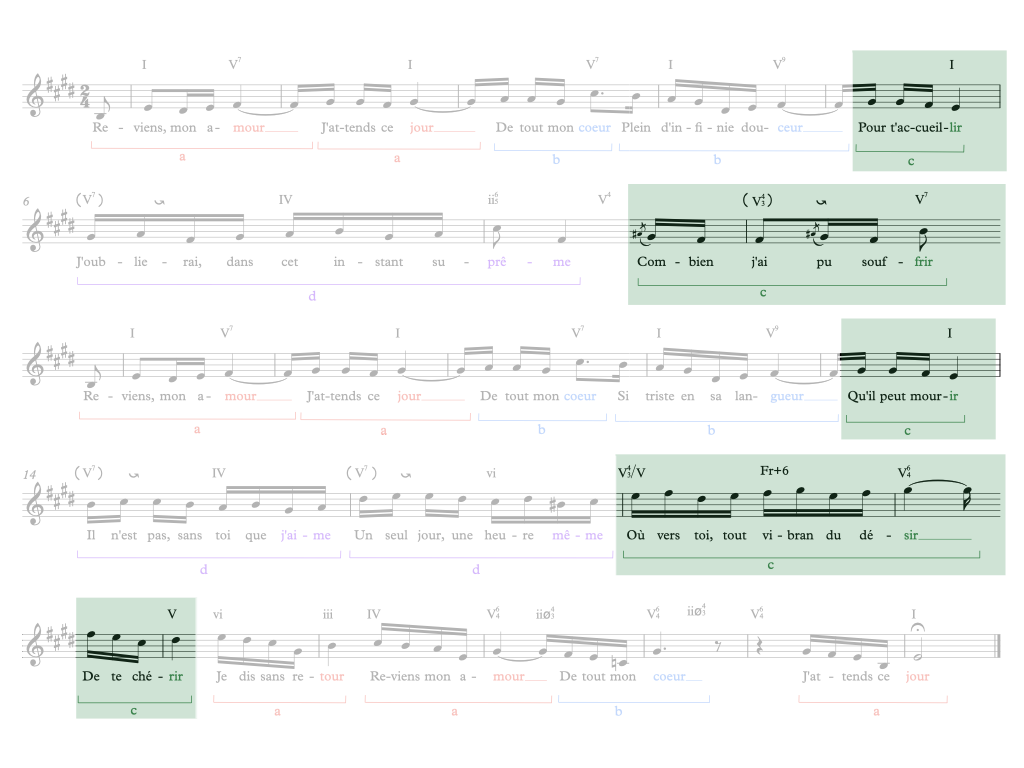
- Sound C has previously been associated only with the ends of formal units (Example 12). It previously ended the compound basic idea of the compound antecedent (“t’accueillir” in m. 5), the continuation of that same antecedent (“souffrir” in m. 8), and the compound basic idea of the compound consequent (“mourir” in m. 13) In carrying over this association, the rhyme word abets in the deception wrought by the chords: the false promise they make that the theme will imminently draw to a close.
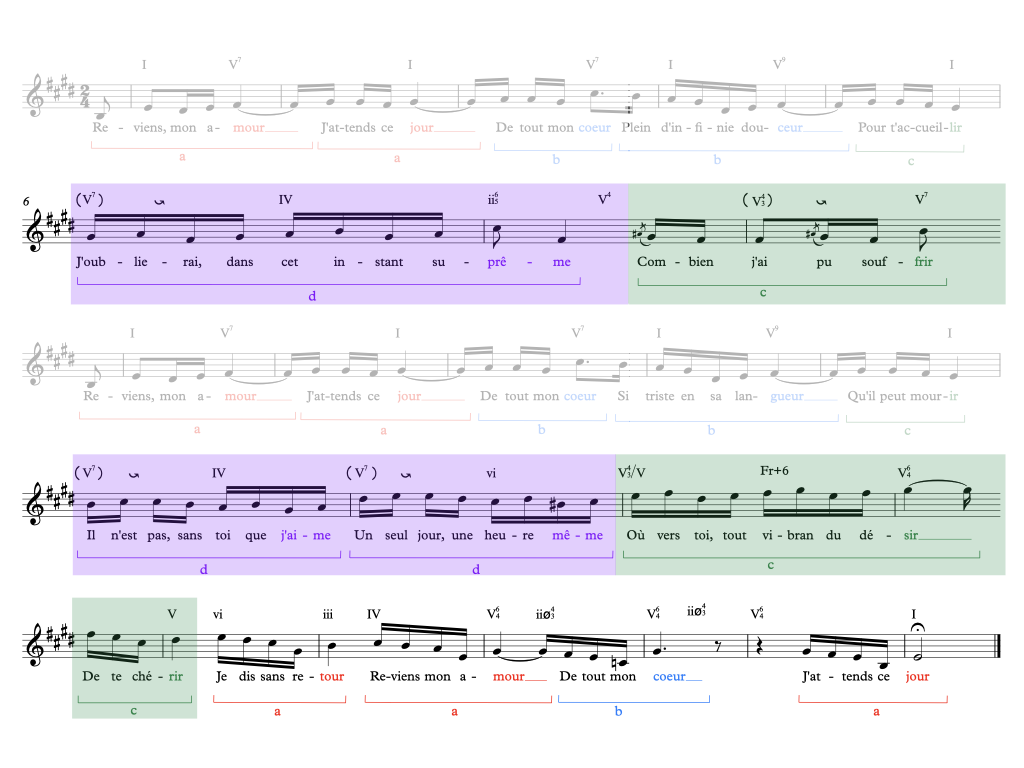
- This DDCC rhyme scheme can be understood as the same as the DC rhyme scheme that concludes the compound antecedent, except doubled (Example 13). Thus, although my initial analysis treated this entire sequential episode as a notable departure from all the music that came before, the lyrics suggest an alternate reading: that it is an expansion of the end of the compound antecedent.
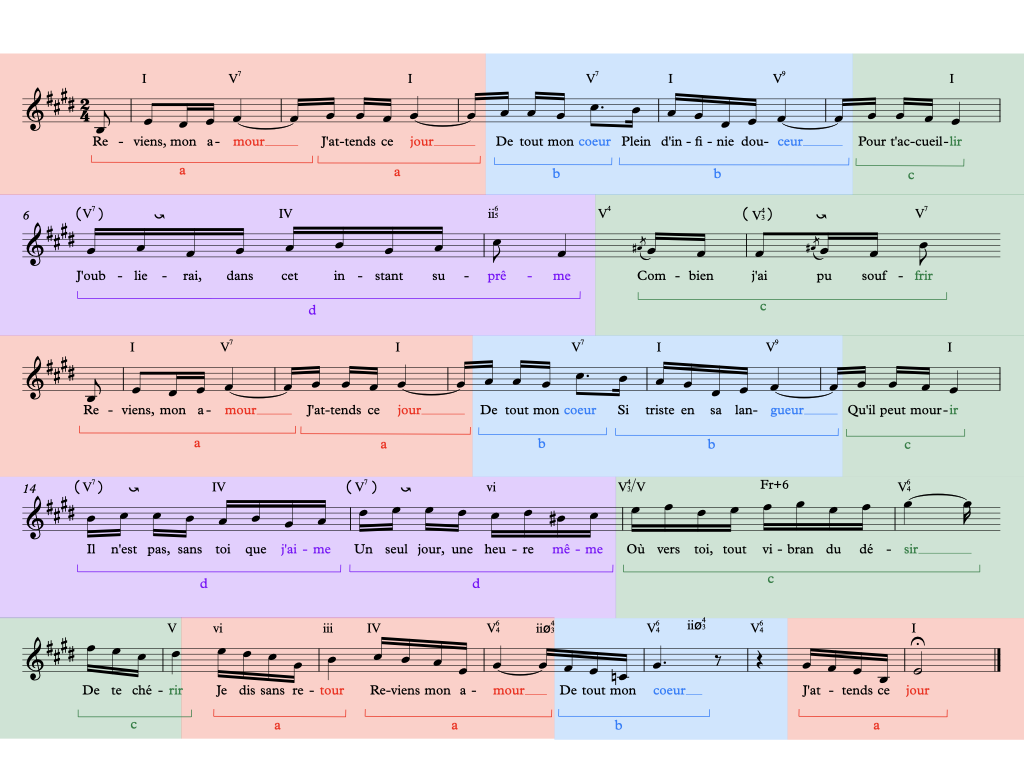
It is fitting that when the push towards the cadence is negated in m. 20, this comes at the hands of rhyme sound A (“-our” or IPA: uʁ), the sound that marked the song’s opening idea. Thus, this is a sort of “re-opening” of what should have been the close. It is also fitting that this remembrance of words past is triggered by the word “retour,” meaning “return.”
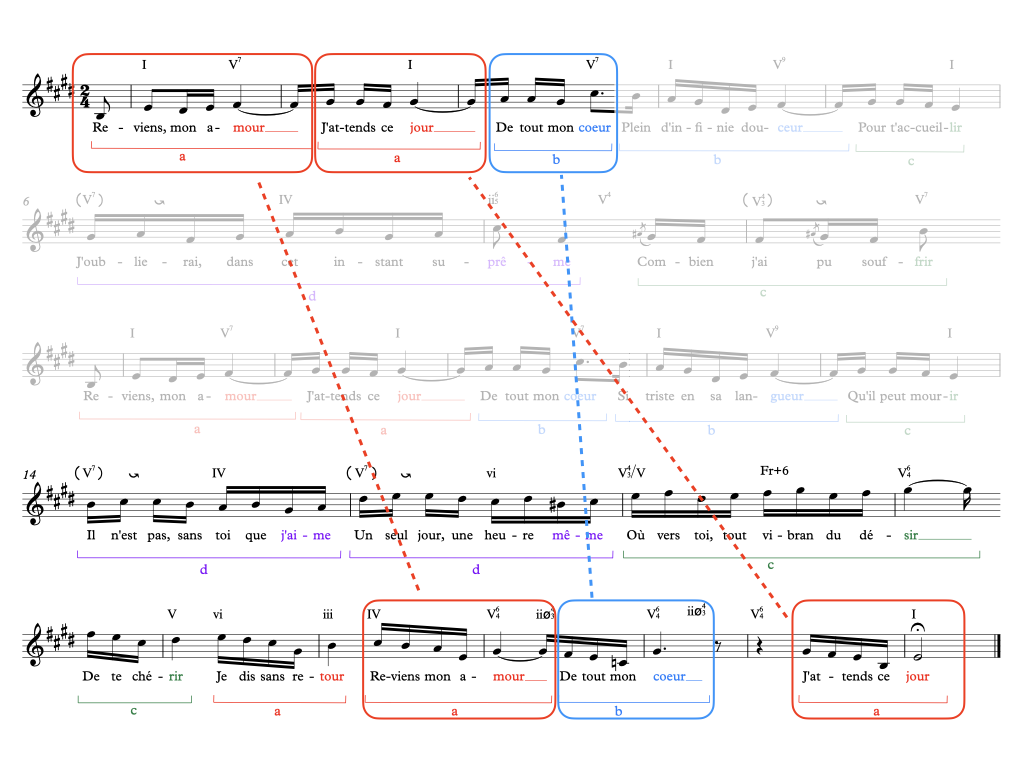
All of the remaining lines (except for the last one) are recollections of the song’s opening lyrics, except in a slightly scrambled up order (Example 14). “De tout mon coeur” (mm. 20–21) now comes before “J’attends ce jour” (mm. 21–22) instead of directly after it (as was the case in mm. 2–3). Because the former line ends with sound B (“-oeur” or IPA: œʁ), this creates the potential for an unpaired rhyme word. And this is precisely what happens: the word “coeur” (heart) never achieves “douceur” (sweetness), just as the singer’s actual heart never reaches the sweetness it longs for. (This feature of these bars is potentially heightened if one is listening to the Clair/Melfi version and interprets it as in Example 10d, in which there are two “coeurs” emitting unanswered cries for a rhyme.) Instead, the song ends with the singer describing themselves as still waiting. This waiting is sealed by the words “J’attends ce jour” in the printed sheet music and by “Pour mon amour” in the sung versions. The effect of the two is the same: the singer (as expressed through the lyrics) fails to achieve emotional closure just as the song fails to achieve the true tonal closure that would be granted by a perfect authentic cadence.
3. “So Deep Is the Night”
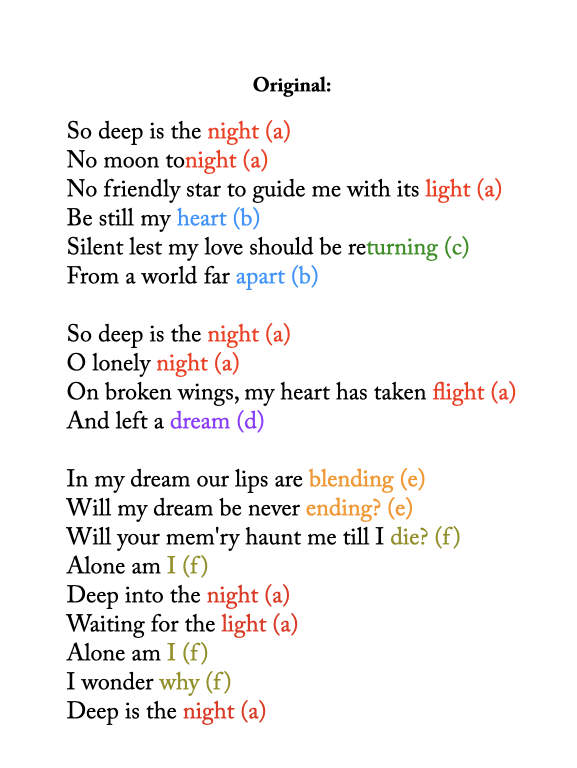
Example 15 shows Sonny Miller’s complete lyrics to “So Deep Is the Night,” with the rhymes labelled according to the same system as before. Because the primary purpose of this article is to show how different rhyme schemes create different analyses, which in turn capitalize on different affordances of the original music, our coverage of the English lyrics will focus on where they diverge from their French counterpart. The first such divergence already occurs in the opening five bars, shown in Example 16 and sung by John McCormack (1940) in Audio Example 5.23 In “Reviens mon amour,” the rhyme scheme was AABBC; in “So Deep Is the Night,” it is AAAB. The former has one more letter than the latter. This is because whereas the former unfolded at an even one rhyme word per bar, the latter has no rhyme word in m. 3. Thus, the effect of relaxation that comes from the slackening of rhyme rhythm starts earlier in the English lyrics, and this has the potential to makes m. 4 sound even more like a point of repose, to heighten the sense that m. 5 is just tacked on. It both breaks a chain of only A rhymes and undoes the effect of repose.
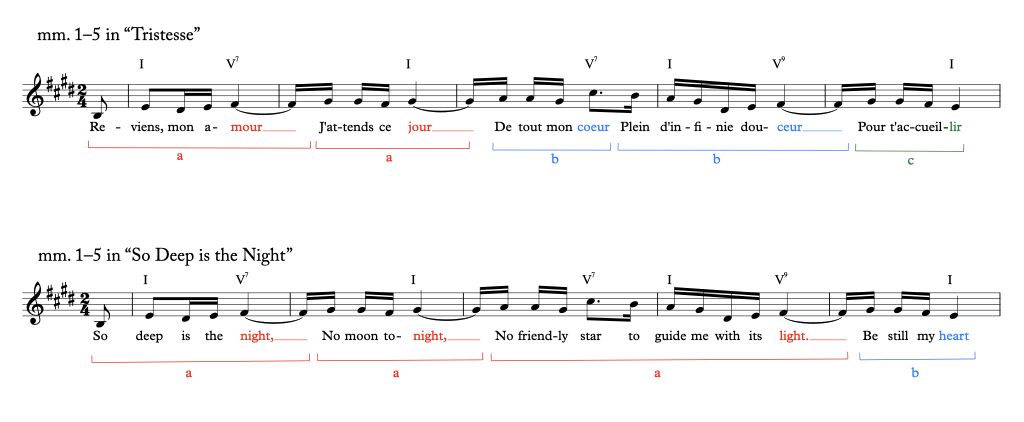
The next three bars more or less follow the model of “Reviens mon amour” (Example 17): an unpaired word sits on m. 7, and m. 8 closes off the antecedent with the same rhyme word that was used in m. 5. A more meaningful alteration occurs in the first five bars of the consequent. In “Tristesse” those bars had the exact same rhyme scheme and rhyme words as the first five bars of the antecedent. But that is not quite the case here in “So Deep Is the Night,” in which AAAB has been replaced with AAAD. The rhyme scheme remains the same, but the word “dream” introduces a new sound to the rhyme scheme. In “Reviens mon amour,” this moment projected both backwards and forwards: backwards to the other moments with the same rhyme word, and forwards to a potential future word to pair with. Here, the new sound projects only forward, towards the hopeful conclusion of the theme, where one might expect (or at least wish for) another word that will rhyme with “dream” and become another D in the rhyme scheme. There are thus two unpaired letters in the rhyme scheme: C and D.
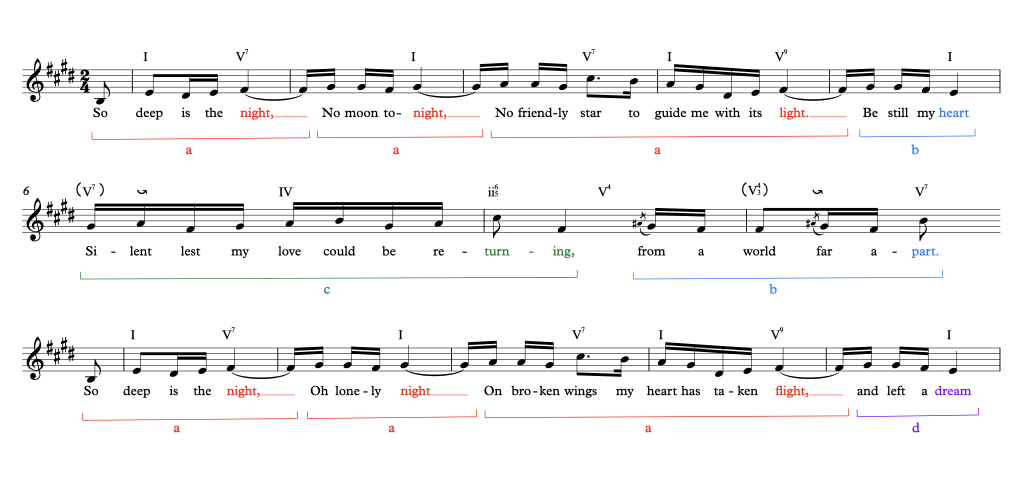
Examples 18 and 19 are color-coded scores for the complete melodies of “Reviens mon amour” and “So Deep Is the Night” respectively.24 These examples illustrate the stark differences between the song settings, when taken as a whole. First, consider the fate of sounds C and D in the rhyme scheme of “So Deep Is the Night”: nothing comes of them. Appropriately enough, nothing returns for “returning” and “dream” is unfulfilled, thus denying closure to both of those sentiments. Next, consider the sequence in mm. 14–15. (Audio Example 6 is McCormack’s performance of m. 14 to the end.) These measures in “Reviens mon amour” forged a connection with earlier music by using a sound already in the rhyme scheme (D). “So Deep Is the Night” introduces new sounds: the sequence forms the couplet EE in the rhyme scheme. This has the potential to suggest the opposite idea: that the sequence is a departure from everything that has come before. The sense that this music is pushing forward is heightened by the fact that the next three bars introduce yet another rhyme word pair (FF). And yet, the contents of these lines undo the effect of the E couplet. The E couplet burrowed deeper into the singer’s dream of being reunited, but the F couplet ends with the words “Alone am I” (mm. 17–18), pulling the singer back into their isolation in the present.
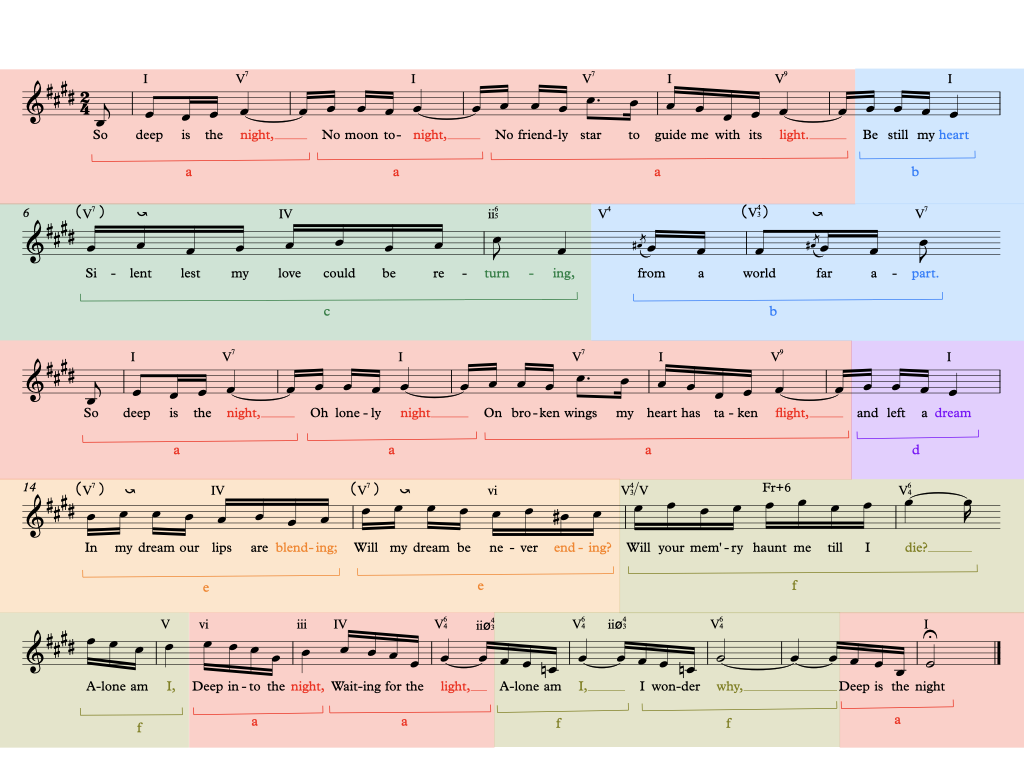
As in the French lyrics, we then get a recollection of the opening. But whereas the French lyrics provide an exact reiteration of parts of the opening, these English lyrics transform two phrases from the opening: “So deep is the night” becomes “Deep into the night” (mm. 18–19), and “No friendly star to guide me with his light” becomes “Waiting for the light” (mm. 19–20). In both of these cases, what once were descriptions of the night outside the singer have now become descriptions of the singer’s own state. In the final two lines, the singer says, “I wonder why,” but then doesn’t provide an answer, ending by merely repeating “Deep is the night.” This is a perfect lyrical illustration of the harmonic ambiguity in this passage, which features three returns: sonically to rhyme sound A, poetically to the night, and musically to the tonic. None of these returns feels like a true resolution, just a return. Like the French lyrics, this analogizes the absent or weak resolution to finding oneself where one started, except that the English lyrics emphasize a sense of isolation, rather than a sense of waiting.
Conclusion
Having completed our analyses of the étude’s theme, its two pop song adaptations, and lyrical variants of one of those songs, it is worth considering what lessons we might take from these songs that can be applied more generally in other analytical endeavors. I propose four: first, the form of Chopin’s theme (or of any theme, for that matter) is not one single shape, but is rather the sum of the many possible shapes that the music affords a listener. Second, some of these possible shapes become more perceptible than others, depending on how the music reaches the listener’s ears (through what medium, performance, arrangement, etc.). Third, adaptations of classical works therefore have much to teach us about the originals, because they capitalize on affordances that might otherwise have remained dormant. And last, when translations of lyrics alter the rhyme scheme of the original (as is often the case), this affects not only lyrical form but also musical form. Change the words and you change the music.
References
Books and Articles
Alegant, Brian, and Don McLean. 2007. “On the Nature of Structural Framing.” Nineteenth-Century Music Review 4 (1): 3–29.
BaileyShea, Matt. 2021. Lines and Lyrics: An Introduction to Poetry and Song. New Haven: Yale University Press.
Caplin, William E. 1998. Classical Form: A Theory of Formal Functions for the Instrumental Music of Haydn, Mozart, and Beethoven. New York: Oxford University Press.
———. 2018. “Beyond the Classical Cadence: Thematic Closure in Early Romantic Music.” Music Theory Spectrum 40 (1): 1–26.
———. 2024. Cadence: A Study of Closure in Tonal Music. New York: Oxford University Press.
Cone, Edward T. 1977. “Three Ways of Reading a Detective Story—Or a Brahms Intermezzo.” The Georgia Review 31 (3): 554–574.
Hatten, Robert S. 2004. Musical Meaning in Beethoven: Markedness, Correlation, and Interpretation. Bloomington: Indiana University Press.
Hepokoski, James A. 2009. “Sonata Theory and Dialogic Form” in Musical Form, Forms & Formenlehre: Three Methodological Reflections, edited by William E. Caplin, James Hepokoski, James Webster, and Pieter Bergé. Leuven: Leuven University Press.
Hepokoski, James A. and Warren Darcy. 2006. Elements of Sonata Theory: Norms, Types, and Deformations in the Late-eighteenth-century Sonata. New York: Oxford University Press.
Jones, Oswald. 1982. Introduction to the Theory of Heinrich Schenker. Translated and edited by John Rothgeb. New York: Longman.
Lawrence, John Y. 2020. “Toward a Predictive Theory of Theme Types.” Journal of Music Theory 64 (1): 1–36.
———. 2024a. “Lyricist as Analyst: Rhyme Scheme as Music-Setting in the Great American Songbook.” Music Theory Spectrum 46 (1): 1–16
———. 2024b. Review of Here for the Hearing: Analyzing the Music in Musical Theater, ed. Michael Buchler and Gregory J. Decker. Music Theory Online 30 (4).
Lee, Ji Yeon. 2023. “The Arrival 6/4 Chord in Wagner’s Die Walküre: Types, Function, and Dramatic Meanings.” Music Analysis 42 (3): 363–411.
Maler, Anabel. 2026. “How Sign Language Analyzes Musical Form.” Music Theory Spectrum 48 (1): 1–18.
Mawer, Deborah. 2014. French Music and Jazz in Conversation. Cambridge: Cambridge University Press.
Osborn, Brad. 2013. “Subverting the Verse-Chorus Paradigm: Terminally Climactic Forms in Recent Rock Music.” Music Theory Spectrum 35 (1): 23–47.
Plotkin, Richard. 2023. “A Phenomenological Approach to Music Theater Rhyme” in Here for the Hearing: Analyzing the Music in Musical Theater, ed. Michael Buchler and Gregory J. Decker, 88–112. Ann Arbor: University of Michigan Press.
Raykoff, Ivan. 2014. Dreams of Love: Playing the Romantic Pianist. New York: Oxford University Press.
Richards, Mark. 2016. “Film Music Themes: Analysis and Corpus Study.” Music Theory Online 22 (1).
Rink, John. 2015. “Chopin’s Study in Syncopation” in Bach to Brahms: Essays on Musical Design and Structure, ed. David Beach and Yosef Goldenberg. Rochester: University of Rochester Press, 132–142.
Rothgeb, John. 1983. “Thematic Content: A Schenkerian View” in Aspects of Schenkerian Theory, ed. David Beach, 39–60. New Haven: Yale University Press.
Schenker, Heinrich. 1979. Free Composition (Der freie Satz). Translated and edited by Ernst Oster. 2 vols. New York: Longman.
Tymoczko, Dmitri. 2023. Tonality: An Owner’s Manual. New York: Oxford University Press.
Temperley, David. 2001. “The Question of Purpose in Music Theory: Description, Suggestion, and Explanation.” Current Musicology 66: 66–85.
———. 2008. “Hypermetrical Transitions.” Music Theory Spectrum 30 (2): 305–325.
———. 2017. “The Six-Four as Tonic Harmony, Tonal Emissary, and Structural Cue.” Intégral 31: 1–25.
Scores
Chopin, Frédéric. 1915. Etüden für Pianoforte (Instruktive Ausgabe von Ignaz Friedman). Leipzig: Breitkopf und Härtel.
Chopin, Fryderyk. 1949. Complete Works, Vol. 2: Studies for Piano (ed. Narodowy Instytut Fryderyka Chopina, 12th edition). Warsaw: Polskie Wydawnictwo Muzyczne.
Marietti, Jean, André Viaud, and Mario Melfi. 1939. “Reviens, Mon Amour (Tristesse), Tango.” Lyrics by Jean Marietti and André Viaud. Arrangment by Mario Melfi. Paris: M. Eschig.
Melfi, Mario, Jean Marietti, André. Viand, Sonny Miller, and Frédéric Chopin. 1939. “So Deep Is the Night: Tristesse.” London: Keith Prowse & Co. Ltd.
Recordings
Clair, Bruno. 1939. “Reviens mon amour sur la ‘Tristesse’ de Chopin.” Lyrics by André Viaud [sic]. Music by Frédéric Chopin. Arrangement by Mario Melfi. Pathé PA 1669, 78 rpm.
Cool, Harry with Dick Jurgens and His Orchestra. 1940. “So Deep Is the Night (Tristesse) Fox Trot.” Lyrics by Al Stillman. Music by Frédéric Chopin. Arrangement by Jacques Dallin. OKeh 5759.
Gigli, Beniamino. 1948. “Reviens mon amour (So deep is the night).” Lyrics by Jean Marietti and André Viaud. Music by Frédéric Chopin. Arrangement by Mario Melfi. His Master’s Voice D.A. 1892.
Hylton, Jack and His Orchestra (Vocal Refrain by Sam Browne). 1939. “So Deep Is the Night – Fox-Trot.” Lyrics by Jean Marietti and André Viaud. Music by Frédéric Chopin. Arrangement by Mario Melfi. Master’s Voice B.D. 5554.
McCormack, John. 1940. “So Deep Is the Night” (Tristesse). Lyrics by Sonny Miller. Music by Frédéric Chopin. Arrangement by Mario Melfi. D.A. 1730.
Melfi, Mario and His Tango Orchestra (with Vocal Refrain). 1939. “Tristesse – Tango” (So Deep Is the Night). Music by Frédéric Chopin. Arrangement by Mario Melfi. His Master’s Voice B.D. 752.
Simon, Abbey. 1996. Abbey Simon Plays Chopin: Etudes and Waltzes (Complete). VoxBox – CDX 5167.
Simon, Abbey. 2014. Frédéric Chopin: Etudes, Nocturnes, & Waltzes Performed by Abbey Simon. Basilica Music.
Notes
- My thanks to George Adams, Poundie Burstein, and Julianne Grasso for their comments on an earlier form of this material, to Jess Peritz for learning these songs together with me when we performed them, to Alden Thompson for his help in tracking down the score of “Reviens mon amour,” and to this journal’s readers and editorial board for their helpful suggestions, which substantially transformed the article.
- https://secondhandsongs.com/work/179407/all. Note that although there are more than 20 entries, some of these are duplicates. For more on popular songs adapted from this étude, see Raykoff (2014, 165–167; 266, n. 55).
- For more on Hylton’s penchant for playing adaptations of classical music, see Mawer 2014 (165–192).
- It is also not to be confused with a different English-language adaptation of the étude, also titled “So Deep is the Night,” with lyrics by Al Stillman, which was released on recording in 1940. That song’s musical adaptation by Jacques Dallin is much more radical.
- Mawer (2014, 177–180) is the only scholar I know of who has treated this song as an object of study, but she is primarily interested in the “added sociocultural meanings” accrued by Chopin’s original through its transformation into a popular song and doesn’t analyze any individual lines of the song.
- Matthew BaileyShea likewise makes the case that rhyme can play a role in musical segmentation writing, “Rhymes in music help delineate cadences, subphrases, and syncopations by segmenting the language into smaller groups, whether regular, in the case of balanced phrases and subphrases” (2021, 83). For more on this, see BaileyShea 2021, Chapter 3. His orientation towards the lyrics-music relationship in Chapter 4 of that book, especially pp. 104–118, forms the obverse of mine: his concern is with how musical settings interact with a pre-existing sense of poetic form created by line breaks; mine is with how adding a text with line breaks interacts with a pre-existing sense of musical form.
- For more on the notion of “fit,” see Lawrence 2024a (3–4).
- The idea of extending my approach to understand the differences created by translation across languages has precedent in Anabel Maler’s (2026) analysis of sign language covers of popular songs.
- For more on how first-time listening differs from later listenings, see Cone 1977.
- For more explanation of this, see Lawrence 2020 (1–4).
- Although I share with Plotkin (1) the belief that listeners will predict future rhymes in this manner and (2) the goal of modeling those predictions, I do not adopt his preference rules in this article, due to the problems I identified in Lawrence 2024b, [1.15–1.19].
- In this analysis, I consider only the challenges posed by grouping structure at the phrase/theme level. For problems created by the underlying syncopation, see Rink 2015 and Temperley 2008 (316–319).
- Heinrich Schenker’s rather elliptical explanation is that the five-bar phrase “results from a rhythmic shift” and that “[w]ithout the eighth-note acceleration in m. 4, answered in parallelistic fashion in m. 5, six measures would have been required” (1979, 12). William Rothstein interprets Schenker as meaning that there is a two-step process going on here: first, there is an unsyncopated four-bar model for this phrase that one transforms into a six-bar phrase by “lengthen[ing] all but the first and last of the principal tones”; then, one compresses the last three bars of the six-bar version into two bars to arrive at a five-bar phrase (1989, 221).
- For an introduction to this concept, see Jones 1982 (7–9, 134–135) and Rothgeb 1983 (42–45). For a more contemporary view on this device, connecting it explicitly to the rhetorical technique of anadiplosis, see Alegant and McLean 2008 (5–6). This technique can be found in the theme type that Mark Richards (2016) calls a “periodic clause” and Dmitri Tymoczko (2023, 437–442) calls “tail-development form.”
- Although I’ve used this to illustrate expansion, Stillman-Dallin version of “So Deep Is the Night” certainly operates under the assumption that the core compound basic idea has been completed afterfour bars, which supports an extension-based reading. This is clear because Dallin cuts mm. 5–8 and launches directly into the consequent phrase, making an eight-bar period! See Harry Cool’s recording (1940).
- Although James Hepokoski and Warren Darcy developed the idea of deformation for discussions of large-scale form (2006), Hepokoski has endorsed the idea that dialogic approach to analyzing musical form (of which the idea of deformation is a part) should apply to small-scale form as well as large-scale form (2009), and the idea has already been applied to small-scale metric structures by Brad Osborn (2013).
- This non-cadence could perhaps be understood as an example of what Caplin calls “prolongational closure” (2018, 14–26; 2024, 346–348). I write “perhaps” because the examples of prolongational closure that Caplin provides are ones in which the penultimate chord is a dominant- functioning chord that has $$\hat{7}$$ or $$\hat{2}$$, but not necessarily $$\hat{5}$$ (in the bass or inner voices), whereas this is a case where there is indeed $$\hat{5}$$, but no $$\hat{7}$$ or $$\hat{2}$$ in the inner voices.
- For more on the phenomenon of the non-cadential tonic $$^{6}_{4}$$, see Temperley 2017 (2–11). It should be noted, however, that none of his examples have this sort of progression (i.e. a I$$^{6}_{4}$$ resolving to a I$$^{5}_{3}$$). Potentially more apropos is Robert Hatten’s (1994) idea of an “arrival $$^{6}_{4}$$,” as adapted by Ji Yeon Lee to apply specifically to cases where the chord “[a]ppears as V$$^{6}_{4}$$, but turns into I$$^{6}_{4}$$ by abandoning the assumed cadential agenda” (2023, 370).
- This is Rothstein’s (1989, 224–226) reading, although he takes it even further by interpreting mm. 17–21 as one long tonic prolongation.
- The annotations mark only exact rhymes, not near rhymes or slant rhymes. Consequently, the “-our” (or IPA: uʁ) sound that ends (e.g.) “amour” is treated as entirely distinct from the “-oeur” (or IPA: œʁ) sound that ends (e.g.) “coeur,” even though these sounds are the most similar pair of rhyming sounds in the song. While a listener or analyst might exploit this similarity to reach additional hermeneutic conclusions, I have chosen not to do this for the sake of limiting the scope of this analysis and because the difference in these sounds is likely to be less distinct to a non-native speaker of French than to a native speaker. (Failing to tell apart French’s various subtly different vowels is one of the characteristic markers of an outsider.)
- In their comments on an earlier version of this article, an anonymous reader for this journal came to a different conclusion. They suggested that although the rhyme scheme supports an extension-based reading (as I have suggested), the syntax better supports an expansion-based reading. Their logic is that even though the first four lines could stand alone syntactically (if the fifth line did not exist), the addition of the fifth line produces a new syntactic structure in which all five lines are syntactically necessary. Because the added fifth line is now integral, it feels like part of an expansion rather than an optional extension. Even if I do not personally agree with this logic, I nonetheless embrace this as a way of integrating the parameters of rhyme and poetic syntax into the analysis of musical syntax.
- These are also sung by Bernardi on Melfi’s recording, although he sings only the compound consequent.
- I have eschewed using the Hylton/Browne recording of “So Deep Is the Night” since (as mentioned before) its tempo and style are out of keeping with the ballad genre that the song became a part of—indeed, the same ballad genre to which “Reviens mon amour” already belonged.
- Once again, I have omitted a consideration of near and slant rhyme. The prohibition in letting these “count” as rhymes is particularly strong in English-language popular song that operates within the songbook tradition, carrying over to musical theater. As Plotkin puts it, “we should treat the primacy of proper rhyme as axiomatic” (2023, 92). One of the readers for this journal has pointed that there is a possibility of hearing an additional rhyme that I have not marked in my color-coding: the repetition of “dream” in mm. 13–15 could be interpreted as an example of “linkage technique” / anadiplosis, since the same musical figure and the same word ends the compound consequent’s c.b.i. and begins its continuation. This would be an echo of the purely musical use of linkage technique in mm. 2–3, which I noted in Footnote 13 of this article. Although this is an interesting reading, I believe that the unusual locations of the appearances of the word “dream” in mm. 14–15 suggest that they were not intended to be heard as part of the overall rhyme scheme.