Nancy Murphy
Abstract
In 1960s singer-songwriter music, several well-known artists demonstrated a version of strophic form in which each verse contains a single line of music that repeats with different lyrics. This article proposes the concept of freewheeling strophic form to analyze such verses with a three-part construction: opening lines, a variable number of repeating lines, and a refrain. The “freewheeling” nature of this form results from a local sense of narrative motion and musical stasis in the repeating lines and a larger-scale flexibility in verse lengths depending on the number of repetitions. I begin the article by exploring how freewheeling strophic form relates to srdc song structure and possible sources in cumulative and enumerative songs. Then, I analyze music by Bob Dylan, Paul Simon, and Buffy Sainte-Marie to illustrate how freewheeling strophic form and its verse-chorus and AABA variants add interest and aliveness to singer-songwriter songs with repeating formal units.
Keywords and Phrases: Popular music, form, strophic form, singer-songwriter, 1960s
He’s taught in his school
From the start by the rule
That the laws are with him
To protect his white skin
To keep up his hate
So he never thinks straight
‘Bout the shape that he’s in
But it ain’t him to blame
He’s only a pawn in their game
Bob Dylan, “Only a Pawn in Their Game” (1964), excerpt from Verse 3
Introduction
When reading Bob Dylan’s lyrics, those who know the song “Only a Pawn in Their Game” can likely hear the repeating melody in their heads that sets Dylan’s text. Even those who are not familiar with the recording could find themselves attending to a pattern of rhyme and stress: each line has two strong syllables (“He’s taught in his school / From the start by the rule,” etc.) with end rhymes pairing into couplets.1 This structure continues until the end of the stanza at which point the two-beat pattern is disrupted by the three strong beats of the final line: “He’s on-ly a pawn in their game.” The overall result is a series of two-beat segments that culminate in a three-beat refrain.
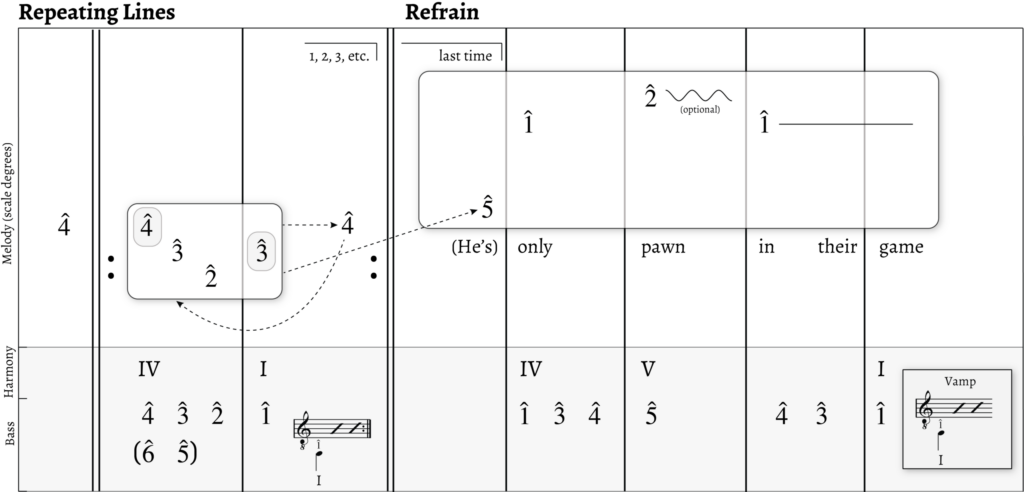
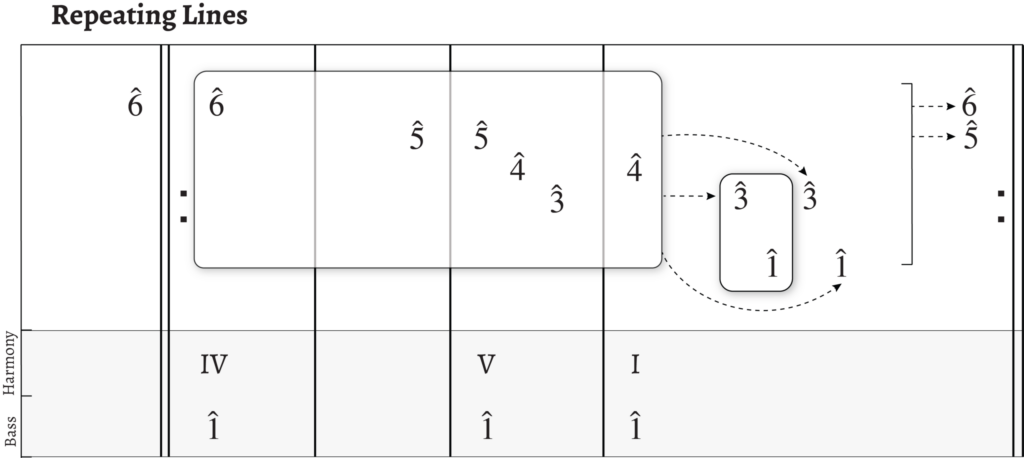
The melodic pattern in Dylan’s song reinforces the structure established in the lyrics, with repeating lines—featuring two-beat units cycling through a melodic pattern spanning $$\hat{4}$$–$$\hat{3}$$—followed by a refrain. In Example 1,2 I map out the melody of Dylan’s repeating lines and refrain. The top half of the diagram (with the white background) shows the pitch structure in scale degrees where placement on the y-axis represents pitch height. The bottom half of the diagram (with the gray background) includes the chord progression in Roman numerals with bass scale degrees below.3 This notation style intentionally avoids notated pitches and rhythms to focus on melodic and harmonic patterns, with vertical lines indicating measures. Dylan cycles through his repeating line (within the repeat signs around the first two bars of Example 1) eight times in Verse 3 before exiting to the different melodic and harmonic structure of his refrain. Video Example 1 shows the trajectory of Dylan’s repeating lines (green) and refrain (pink) for Verse 3, with lyrics included below the diagram as they arise in the song.
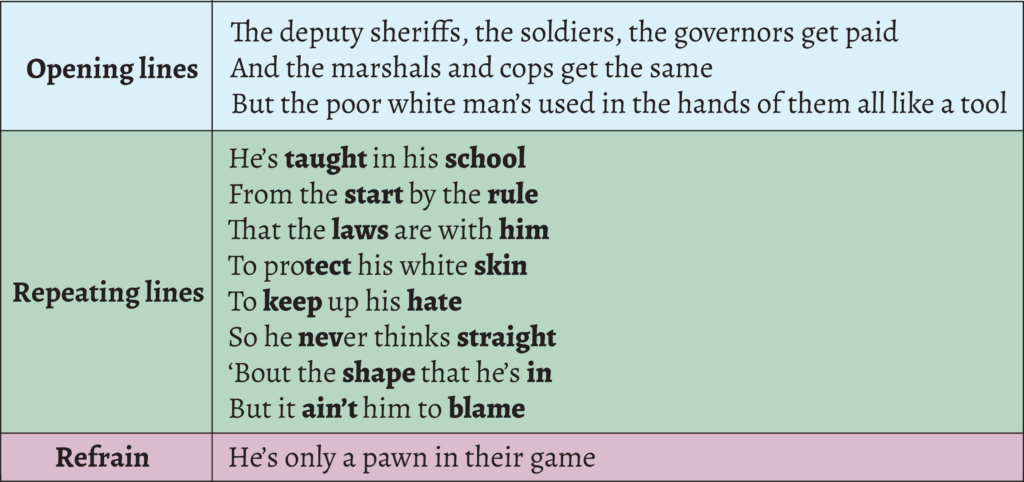
The entire verse has a three-part organization (Example 2) in which Dylan presents three opening lines (in blue), then falls into a pattern of melodic and harmonic material (green) in his repeating lines, and finally releases to the refrain (pink). Stressed syllables in Dylan’s performance for the repeating lines are highlighted in boldface. Looking more broadly at the entire song shows a similar three-part structure in each strophe of “Only a Pawn” (Example 3), with opening lines progressing to repeating lines and then a refrain. But Dylan, being the type of singer who avoids predictability, adds further interest, cycling through the melodic pattern of his repeating lines a different number of times for each verse. This creates an interesting formal flexibility in which the verses of his strophic form are different lengths.
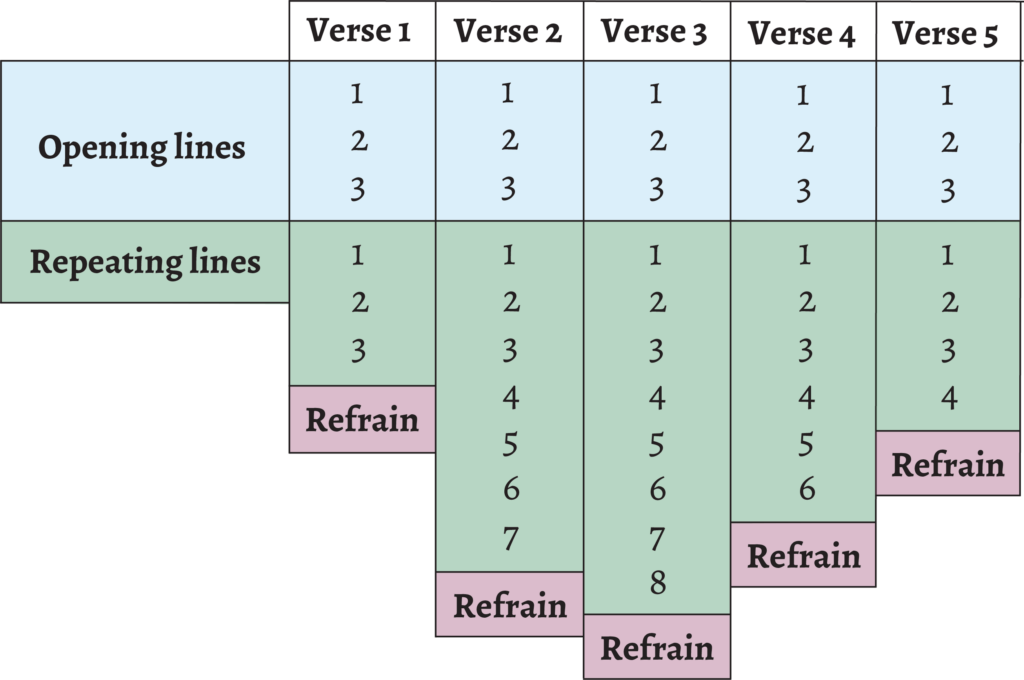
If this flexibility was unique to “Only a Pawn,” it would merely be an interesting quirk of this one Dylan song. However, this flexible form also occurs elsewhere. First, it appears in folk sources—such as turn-of-the-century traditional folk songs and songs by folk singers like Pete Seeger whose careers began in the 1940s and overlapped with the 1960s folk revival—that influenced Dylan and his fellow singer-songwriters. Second, this formal flexibility also occurs in several Dylan songs, a few of which have lyrics on topics of political significance in the 1960s. And third, it arises in strophic and AABA songs by Dylan’s 1960s contemporaries, Paul Simon and Buffy Sainte-Marie, suggesting it was a songwriting possibility that permeated the singer-songwriter genre, available to artists in this (primarily) solo performance practice as a method of variation, adding interest to songs with repeating formal units.
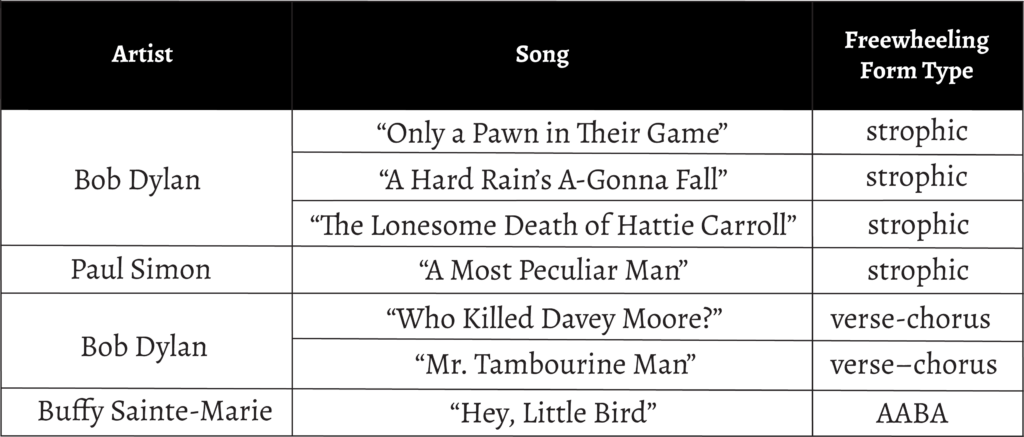
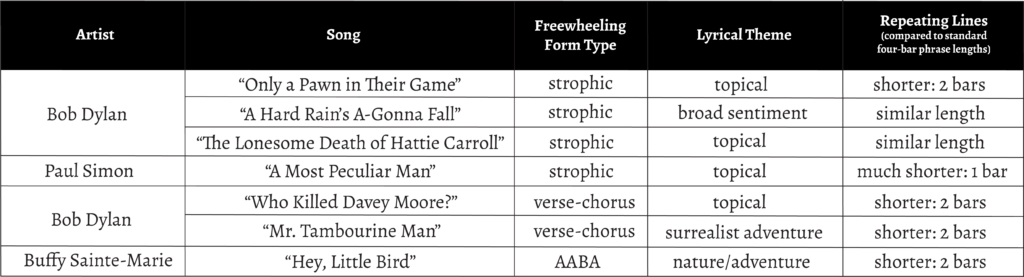
In this article I draw on my previous studies of singer-songwriter music to analyze this flexible formal structure as freewheeling strophic form. As I explore below, this form seems to arise from strophic sources but also occurs in singer-songwriter songs with repeating verse units, like verse-chorus form and AABA. In this study I analyze the seven extant examples in this repertoire that contain verses that expand or contract depending on the number of internal repeating lines.4 Example 4 summarizes the seven songs in this study. Three are from Dylan and model freewheeling strophic form: “Only a Pawn in Their Game” (1964), “A Hard Rain’s A-Gonna Fall” (1963), and “The Lonesome Death of Hattie Carroll” (1964). Two others from his repertoire—“Who Killed Davey Moore” (written in 1963) and “Mr. Tambourine Man” (1965)—demonstrate how a freewheeling formal structure maps onto verse-chorus form. Two examples outside of Dylan’s repertoire show how other artists adapted freewheeling structures to their own songwriting styles. Paul Simon’s “A Most Peculiar Man” (1965) explores his own modifications to freewheeling strophic form while Buffy Sainte-Marie’s song “Hey, Little Bird” (1967) demonstrates how a freewheeling structure can arise in AABA form.
I begin this study by briefly summarizing the expectations for strophic form analysis, particularly for structures in which verses are varied with each repetition. I then explore the origins of freewheeling strophic form in the cumulative and enumerative strophic forms from early twentieth-century traditional song sources. After this I briefly analyze several of Pete Seeger’s songs for children that employ cumulative or enumerative strophic form. Finally, I analyze how freewheeling strophic form and its variants arise in 1960s singer-songwriter music as a storytelling method, tied in some cases to topical protest songwriting. Through these analyses I illustrate how freewheeling strophic forms take the principles of cumulative and enumerative songs further, creating flexibility of melody, phrase, and form in ways that convey the creative songwriting approaches of each of these three artists within their broader tradition of musical practice.5
1.1 Strophic Form
In popular music, the term “strophic form” refers to the repetition of a formal unit that has the same harmonic and melodic material but different lyrics each iteration. John Covach (2005, 73) uses the term “simple verse” to describe strophic form, as does Jeffrey Ensign (2015, 33), referencing the repeating units as “verses.” Drew Nobile (2020, 125–147) refers to this as strophic form, acknowledging “simple verse form” is a synonymous term. Walter Everett (2008, 141) notes that structures with “only a single formal section” are common in folk songs.
The terms “verse” and “strophe” are used interchangeably in analysis of strophic song forms. In this study I follow Nobile (2020) and others with a preference for the term “verse” rather than “strophe” for ease of comparing freewheeling strophic form with its verse–chorus variants. In strophic form and AABA form, the verses (or “A sections”) typically end with a lyrically and melodically invariant unit called a refrain that acts as the final line of the verse.6
Popular music scholars also observe a possible “statement–restatement–departure–conclusion” (srdc) structure for the verses of strophic form (Everett 1999; Summach 2011; Nobile 2020). In such cases, the “statement” and “restatement” lines could map onto the opening lines, the “departure” as the repeating line, and “conclusion” mapping onto the refrain.7 Though the verse structures have some similarities, I prefer not to use srdc in this study because it foregrounds an immediate repetition of melodic material at the beginning of a verse, which does not always occur in singer-songwriter strophic form. Additionally, the songs in this study vary in the number of opening lines, sometimes using entirely different melodic material for each. As a result, I prefer the category of “opening lines,” which offers more possibilities for verse beginnings without the expectations for immediate content repetition suggested by the srdc paradigm.
There is, however, a strong correlation between the “repeating line” unit of freewheeling strophic form and the possibilities for repetition in the “departure” lines of the srdc structure. Jay Summach (2011, 15) explores such repetition in his analysis of “Sugar Shack” by Jimmy Gilmer and the Fireballs, in which the “d” section of the srdc is extended to six bars through an “extra” repetition of two-bar units in this passage. The fragmentation within “d” repeats harmonic and melodic material, in this case one too many times, to create momentum and delay the “c” refrain.8 The use of the term “fragmentation” here intentionally references sentential structure, where shorter units build energy toward the cadence. We will see a similar effect from the repeating lines of freewheeling strophic form.
Mid-century popular music is not the only place that modifications to strophic form arise. Victoria Malawey (2015, 8), for example, explores the possibilities for modified strophic form in Amy Beach songs. On a spectrum of formal possibilities from strophic (“maximal recurring material”) to through-composed (“minimal recurring material”), Malawey includes two categories between these poles: “Minor Modified Strophic,” which has recurring material with some minor changes, and “Major Modified Strophic,” which has recurring material with some significant changes.9 Beach’s songs in the former category retain melodic structure between strophes, with slight alterations to texture, harmony, and/or rhythm. Malawey distinguishes this from the latter category, in which more “major” changes occur to features such as melody, rhythm, and/or harmony, replacing or adding to strophic design. Similar ideas arise in studies of developing variation, though I would argue that change is expected in these cases, and therefore not as noteworthy as a modified strophic form.10
1.2 “Freewheeling” Strophic Form
It could certainly be possible to describe the 1960s songs in this study as examples of modified strophic form. Following Malawey’s categorizations, the features of songs like “Only a Pawn” demonstrate alterations to harmony and rhythm, sometimes also to melodies, that would classify as either minor or major modified strophic. However, it is important to distinguish between the two types of variation at play in this study. On the one hand, there’s the natural variation that occurs between verses resulting from the self-accompanied singer-songwriter performance practice. On the other, there is the formal variation that results from the changing number of repeating lines.
The term “modified” does not quite capture the formal features of the strophic forms in this study, nor does it account for the quality of aliveness that results from the expansion and contraction of strophes in this music and how that impacts storytelling. The concept of freewheeling strophic form attempts to get closer to the structure and sensations offered by such songs. The term “freewheeling” is an clear reference to the title of Dylan’s 1963 album, The Freewheelin’ Bob Dylan, an album on which one of this study’s examples (“A Hard Rain’s A-Gonna Fall”) was released. It’s also a reference to the duality of action and inaction that arises in activities like cycling, when riders can coast without needing to move the pedals. The analogue here is musical motion—in the sense of sounds unfolding over time—without progression through formal units. As I demonstrate with the video examples in this study, a song can progress narratively, with new information arising each time a lyrical line is added, but also be inactive due to the repetitive melodic material that extended the verse, preventing movement through the larger form. This technique creates both motion and pause, which has the effect of building tension that desires release. Much like the fragmentation in sentence structures and the repeating “d” sections of srdc structures, the repeating lines of freewheeling strophic form build up expectation for closure and, as we shall see in the 1960s songs, sometimes do so in unpredictable ways, often in service of lyrical narratives.
2.1 Cumulative and Enumerative Strophic Songs
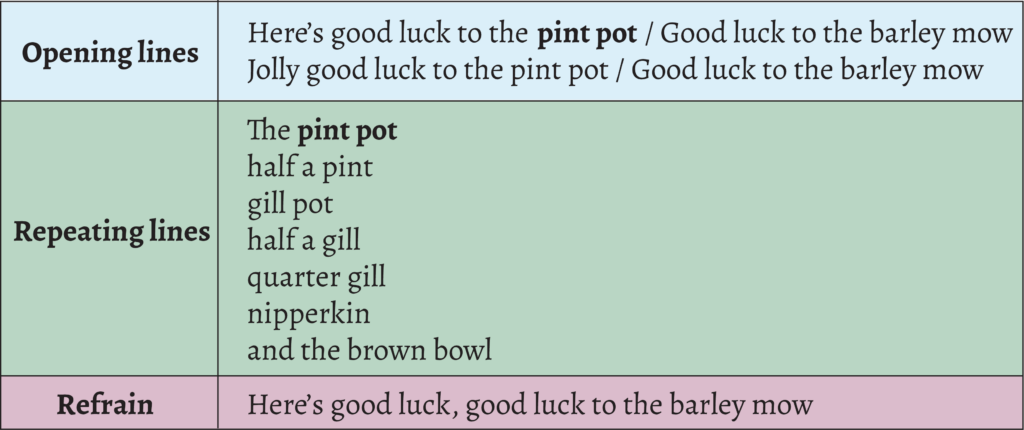
Freewheeling strophic songs are related to sources in traditional and folk music from the early twentieth century that are classified as cumulative (strophic songs in which a line of lyric is added to each subsequent strophe) or enumerative (cumulative strophic songs with a counting element in the lyrics).11 A simple example of a cumulative song is “The Barley Mow” (Roud, index number 944), a traditional drinking song from the British Isles that gradually adds lyrics as the song progresses.12 The number of verses in the song can vary depending on the singer’s desire, and the song is occasionally sung alternating between the soloist and a group (typically fellow drinkers). The first verse (Example 5) begins with several predetermined repeating lines; the singer adds a “pint pot” (in boldface) to the list of drinking vessels and progresses through the rest, ending with the refrain. In each subsequent verse, further items are added, sometimes progressing beyond vessels to wish good luck to the landlord, the bookie, and other figures, accumulating repeating lines until the song concludes.
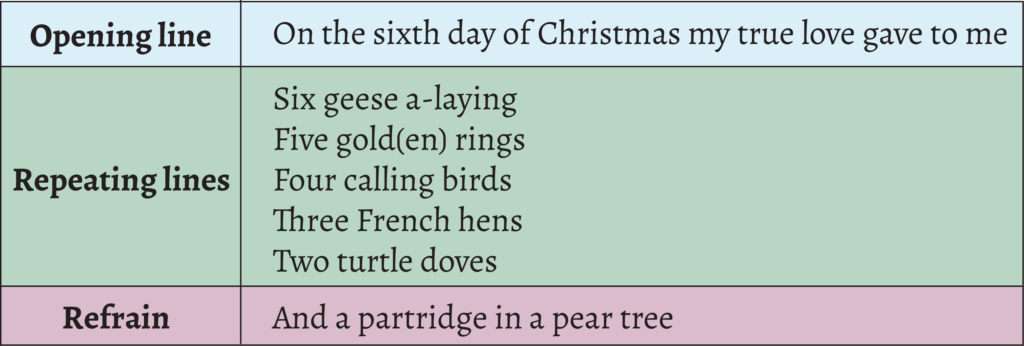
Enumerative songs differ from cumulative songs only in that the verses accumulate numerically as well as lyrically. “The Twelve Days of Christmas” (Roud, index number 68) is often cited as a prototypical example of an enumerative cumulative song. In terms of its lyrical structure, this is absolutely the case. Each verse progresses through a three-part lyrical organization (Example 6) consisting of a single opening line, a specific number of repeating lines corresponding to the number of days of Christmas, and a refrain that references the gift given on the first day of Christmas: “(And) a partridge in a pear tree.”
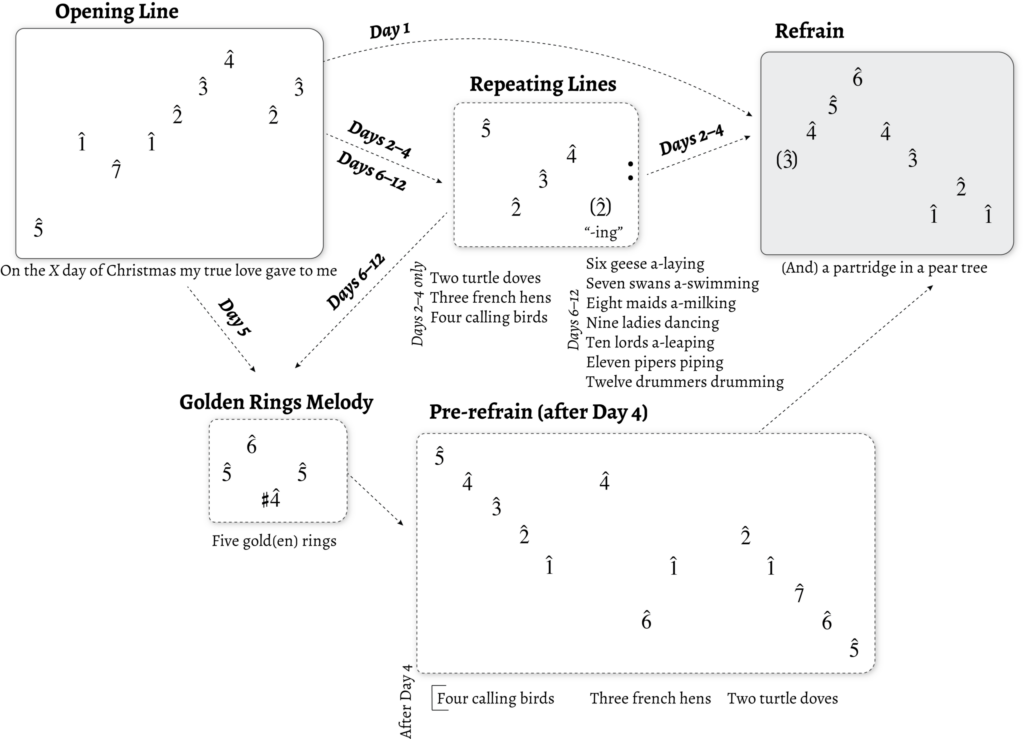
Melodically, however, the song is not as simple as the lyrics suggest. When the fifth day adds the melody for “Five gold(en) rings,” this triggers a change of melody for the “Four calling birds,” “Three French hens,” and “Two turtle doves” melodies that is retained for the remainder of the song. Example 7 maps out the melodic trajectory for the whole song; Video Example 2 tracks the path of the verse for the eighth day of Christmas through this trajectory. As the video illustrates, the verse begins with the opening line and progresses through the repeating line three times (to get from days eight to six). The melody then proceeds through what I’ve called the “Golden Rings Melody,” which is introduced on the fifth day and triggers a new melody for the countdown of the gifts for days four, three, and two. When we first heard days two, three, and four, they were set to the repeating line. But from the sixth day onward, they are instead set to what I call the pre-refrain content, which is no longer repeating. This is a surprisingly complicated structure for what could have been a simple enumerative version of a cumulative song form.
Many other examples of cumulative form arise in folk songs; they are listed in popular folk song sources like Cecil Sharp’s (1919) collection, English Folk Songs, among others.13 Indeed, it is associated so strongly with folk sources that when cumulative form arises in Gilbert and Sullivan’s “I Have a Song to Sing, O!” from Yeoman of the Guard (1888), it acts almost like a folk topic.14 It follows, then, that the song appears on the Peter, Paul and Mary album, Peter, Paul and Mommy (1969), fitting seamlessly into their folk style.15
2.2 Pete Seeger’s Cumulative Children’s Songs
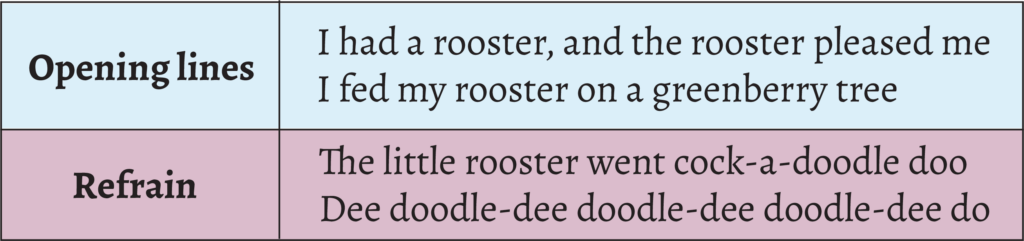
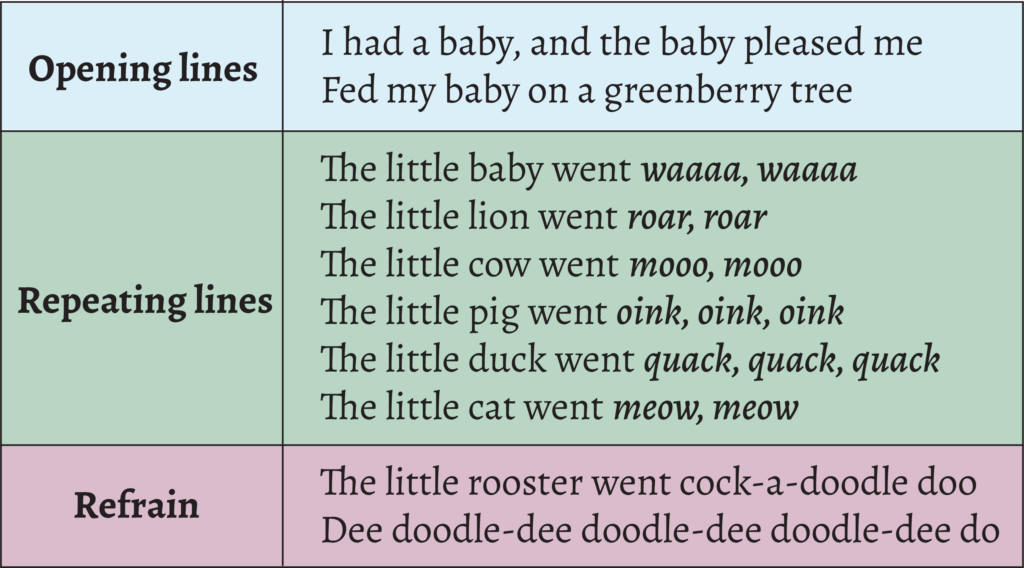
Mid-century folk singer Pete Seeger released several cumulative songs on his albums for children in the 1950s and 1960s. His version of “I Had a Rooster” (from Birds, Beasts, Bugs and Little Fishes, 1955), typifies the use of this flexible form for humorous purposes. Seeger showcases a three-part structure with accumulating repeating lines and includes comedic impressions of animal sounds within those repeating lines. The first verse (Example 8) leaves out the repeating lines and the impressions therein—the rooster sings during the refrain, playing a musical role rather than an impression. Seeger saves his first animal impression for the second verse so that by Verse 7 (Example 9) he is mimicking five animals and a baby, with timing flexibility arising in his performance as he delivers the imitations.
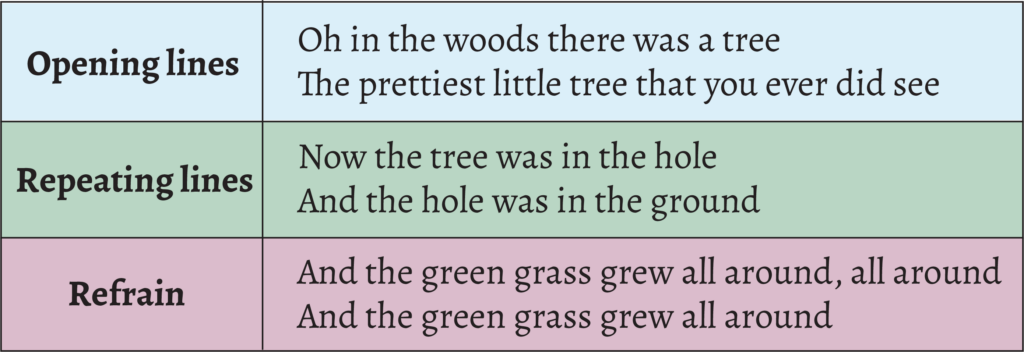
All the examples I could find where Seeger uses cumulative form are in songs for children, but not all of these are as humorous as “I Had a Rooster.” His version of “Green Grass Grows All Around” (Sleep-Time: Songs & Stories, 1958) is a less comedic example that focuses on accumulating descriptors of a nature scene, without a clear intention to make his audiences laugh. His first verse (Example 10) establishes the three-part structure for his strophes, with accumulation creating drama that culminates in the eleventh verse, which cycles through the repeating line twelve times (Example 11). Comparing this final verse with the first illustrates that the final verse is significantly longer than it was at the beginning of the song after gradually accumulating repeating lines in each verse.
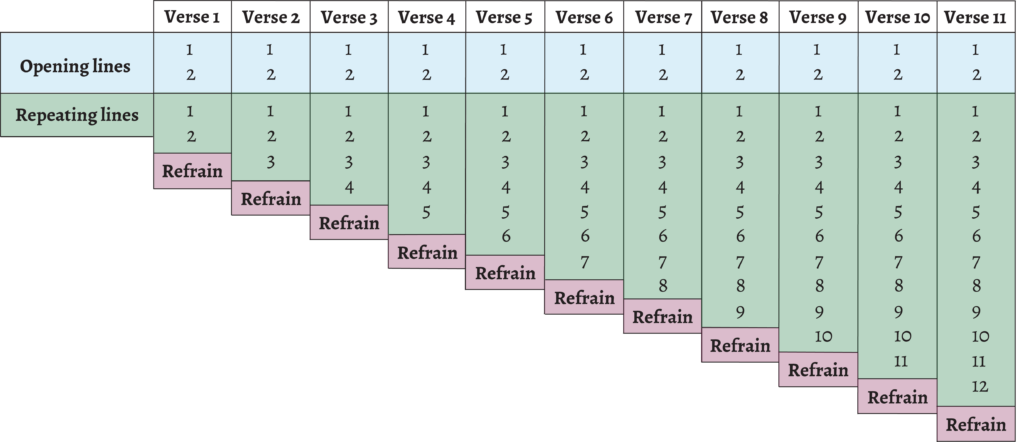
The goal of cumulative and enumerative songs is adding a single line each verse as part of a specific type of storytelling in song. Some examples are drinking songs, challenging an increasingly inebriated singer to remember all the accumulating lyrics; some examples are designed to teach kids about animals in a delightfully silly way. While strophic form itself is simple, the cumulative technique of gradually adding new lyrics with each repetition provides a slight challenge, adding a level of play and interest to otherwise straightforward song components.
3.1 Freewheeling Strophic Form in 1960s Singer-Songwriter Songs
One of the hallmark features of 1960s singer-songwriter music was its connections to precedents in earlier traditions. Seeger’s own career began in the 1940s with the emergence of the folk revival period that peaked in the mid-1960s. The 1960s singer-songwriters found inspiration in earlier sources, initially offering cover versions of existing blues songs and ballads and then eventually contributing original compositions to the folk canon.16 Given this focus on traditional sources, and the general positioning of artists like Pete Seeger and Woody Guthrie as central figures in the folk songwriting canon, it seems reasonable to assume that singers like Bob Dylan would have encountered Seeger’s songs for children and the cumulative strophic forms some of them employed.17
Dylan’s original 1960s songwriting drew on the tradition set by Seeger to use simple song structures and communal topics to reach his audiences.18 Dylan wrote topical songs, referencing specific events, and general lyrical themes that reflected public sentiment in the 1960s. He used the pared-down texture of voice and guitar (occasionally adding harmonica) to highlight the lyrics that were of personal and political significance to his listeners. Using strophic form for his songs offered the option to keep the form simple to highlight the meaning of his lyrics.
That freewheeling strophic form arises in some of Dylan’s topical protest songs is no surprise, given his tendency to add improvisatory qualities to songs that disrupted expected formal and metric structures.19 As I explore in other research on singer-songwriter music (Murphy 2023), Dylan’s influence permeated the flexible performance practice of 1960s protest songs and 1970s confessional songwriting. Three of Dylan’s five freewheeling strophic songs can be categorized as topical protest songs, referencing specific cultural events.20 In “Only a Pawn,” his lyrics reference an important event in the 1960s Civil Rights Movement: the 1963 murder of NAACP leader and civil rights activist Medgar Evers. Dylan offers a unique perspective in his lyrics that differs from that of his 1960s songwriting contemporaries.21 Rather than focusing on Evers as the victim of violence, as his musical peers do, Dylan’s lyrics explore the broader sociopolitical structure in which Evers’s murderer (the “poor white man,” Byron De La Beckwith, whose name is not mentioned in the lyrics) was taught by broader systems of power to focus on racism and acts of racial violence rather than his own “poor” standing in society.22
Dylan’s first verse (Example 12) initiates this lyrical perspective and offers the template for his freewheeling strophic structure. The three opening lines set the stage for Evers’s murder. The repeating lines then shorten the phrase lengths to two bars while describing the shooter’s eyes and then plainly stating “he can’t be blamed.”23 The refrain lengthens the phrase back to four bars and offers Dylan’s perspective: De La Beckwith murdered Evers and did so by societal design. In Dylan’s telling of the story, De La Beckwith, a white man, held little upward social mobility because of his poverty. Instead of directing anger towards the politicians who did nothing to improve his poor sociopolitical standing, their rhetoric baited him to transform that anger into racism. As historian Sean Wilentz (2013) summarizes for NPR, in Dylan’s account the “poor white man’s at the caboose of the train, but it’s the system—the rich, the powerful, everyone from the cops on up and down—they’re the ones who are twisting this guy’s head around with racism in order to keep him down.”24 Video Example 3 shows how Dylan navigates the melodic and harmonic trajectory of Verse 1, with shortened phrases in the repeating lines. As the video demonstrates, the musical scaffolding is retained in the repeating line while Dylan sings through different lines of his lyrics. There is narrative momentum but no motion through the form.
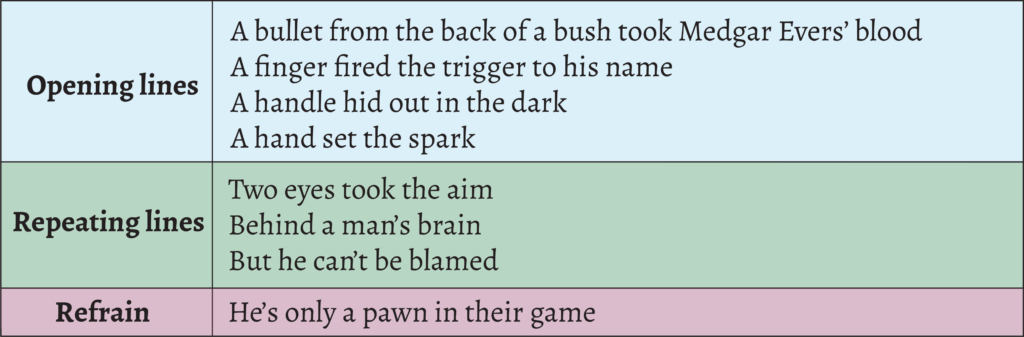
The repeating lines section of the freewheeling strophic form of “Only a Pawn” creates an engaging method of storytelling through its unpredictable structure that stretches and reduces the number of repeated lines in each verse. Example 13 (which reproduces Example 3) illustrates Dylan’s freewheeling form that begins with three repeating lines, then seven, eight, six, and finally four.25
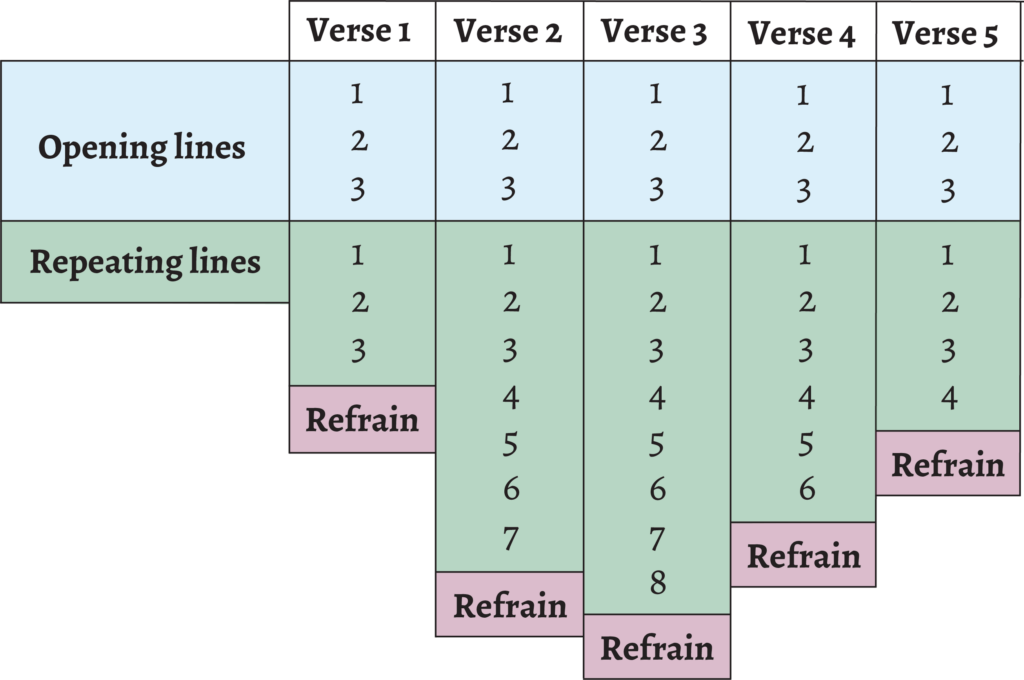
The structure is unpredictable in a way that differs from the cumulative and enumerative songs of the previous section. Rather than gradually lengthening his verses one line at a time, Dylan cycles through as many repeating lines as necessary to tell a part of his story in each verse. The version of strophic form that results is not cumulative like Seeger’s examples that grow with each verse iteration, it is freewheeling, expanding and contracting as Dylan’s narrative unfolds.
Though I’ve begun this study with “Only a Pawn,” it is not the first instance of freewheeling strophic song in Dylan’s output—“A Hard Rain’s A-Gonna Fall” (1963) predates it and provides a possible origin for this form. The structure of the “Hard Rain” lyrics is based on the Child Ballad (No. 12) “Lord Randal,” which begins with a few questions followed by a series of answers.26
Rings (2025, 239) maps a three-part structure of “Questions–Answers–Refrain” onto Dylan’s verses in “Hard Rain.” Rings proposes that the middle “Answers” section arose as the musical solution to complexities in Dylan’s initial lyrical poetry (written in 1962). The poetry’s “Answers” phrases created “visual bulges, causing each verse to swell vertically as the surreal images pile up, one on top of another” (243). Rings also explains the musical response.
Dylan’s solution—to devise a rotating melodic and harmonic figure that he could repeat as much as necessary in a given verse—was one of his novel formal strategies as a songwriter. He may say he never invents his own melodies, but this technique, which I will call the “iterative core,” is an exception, an invention borne of necessity. It was a musical response to lyrical pressure, specifically in those songs that fall into “chains of flashing images” or otherwise drop into lists that can expand and contract, accordion-style. (243)
In other words, the repeating lines that are a feature of freewheeling strophic form may have arisen out of musical needs to set the lyrical ideas for “Hard Rain.”
Dylan’s opening lines to the song (Example 14) correspond with the verse’s “Questions” and the repeating lines are his “Answers.” Example 15 shows the mapping of Dylan’s repeating lines, where he often pauses to expand the final notated measure to multiple bars. Video Example 4 maps the trajectory of repeating lines and refrain Dylan’s first verse. In “Only a Pawn” we saw a shortening of the phrase unit lengths for the repeating lines; Dylan keeps longer units for his repeating lines in “Hard Rain” that each span four strong beats in the opening lines and repeating lines.27
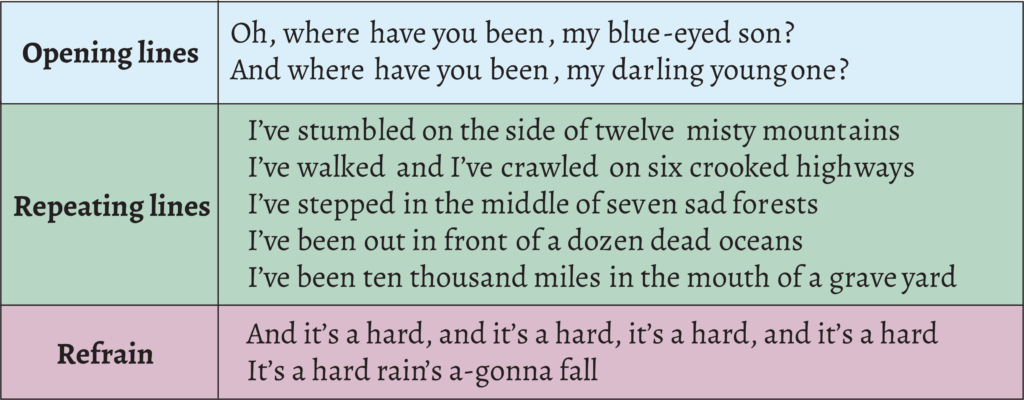
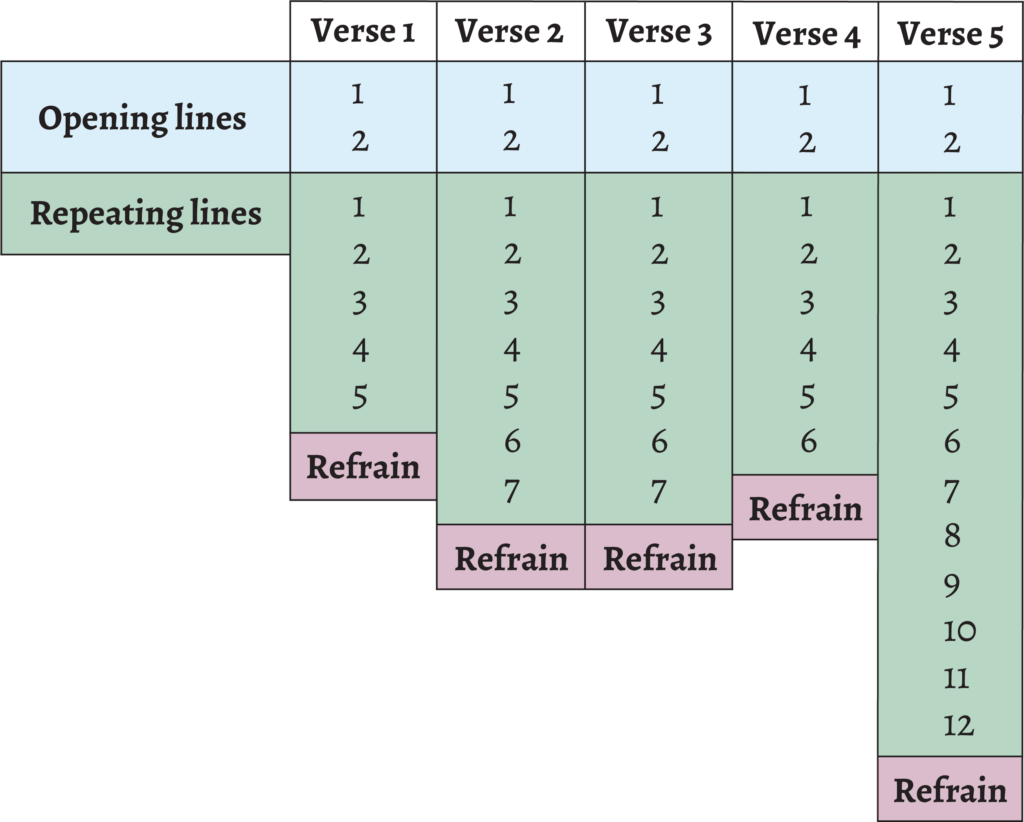
Comparing the five verses of “Hard Rain” (Example 16), Dylan’s verse lengths peak in the final verse, with twelve iterations of his repeating line. His freewheeling strophic form allows for the expansion and contraction of the middle of his three-part form, culminating in the longest “chain of flashing images” in the song.
Unlike “Only a Pawn,” which references a specific event, the lyrics of “Hard Rain” broadly comment on suffering and injustice, both personal and environmental, that are associated with the cultural feelings around the time of the Cuban Missile Crisis in 1962, even though the song was written before the events of the crisis occurred (Scorsese 2005). Dylan (2004, 85) himself describes “Hard Rain” as “one long funeral song” for humanity. The song has an improvisatory quality resulting from the freewheeling strophic form. The varying size of Dylan’s verses, due to the changing number of repeating lines, matches the in-the-moment qualities of his lyrics.
The final prototypical example of freewheeling strophic form in Dylan’s repertoire returns to his style of topical protest songwriting. In “The Lonesome Death of Hattie Carroll” (1964), Dylan’s lyrics make use of the personal pronouns “you” and “your” (rather than the third person “he” and “their” from “Only a Pawn”) to renounce the racist inequalities evident in the justice system.28 The lyrics dramatize the death of Hattie Carroll, a 51-year-old Black server who was killed by 24-year-old William Zantzinger, the white son of her employer, after he attacked her with his cane. This song is Dylan’s response to the event after reading a newspaper article about Zantzinger’s murderous actions and subsequent light sentencing.29 He paints Zantzinger as a drunken, aggressive son of well-connected rich parents, whose wealth and social positioning benefitted their son. In Dylan’s tale, the parents used their resources to manipulate the trial judge to hand out a shockingly short six-month sentence for the murder. The narrative here echoes that of “Only a Pawn” in framing racial violence within larger systems of oppressive white supremacy.30
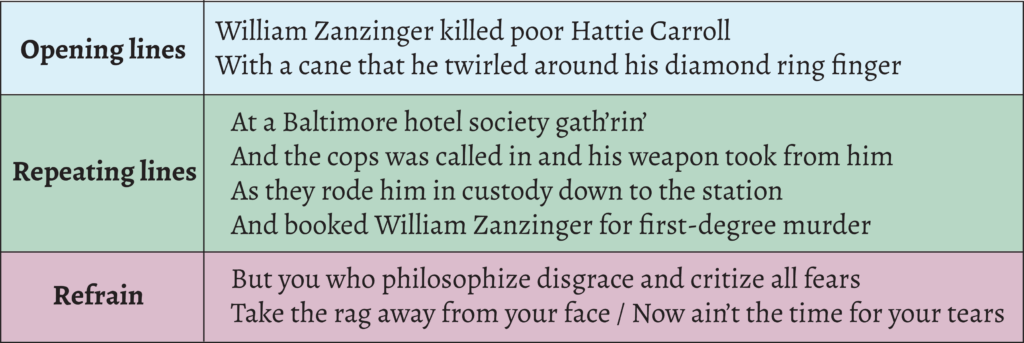
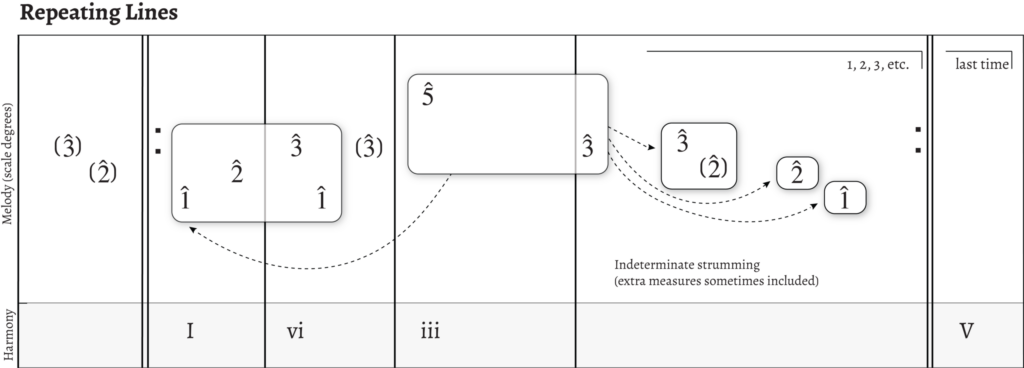
Dylan’s verses (e.g., Verse 1, Example 17) follow the three-part structure of freewheeling strophic form, with two opening lines, repeating lines, and a two-line refrain. As the mapping of the repeating lines (Example 18) demonstrates, Dylan’s phrase units are around four bars in length, though some indeterminate strumming results in longer phrase units in some cases. Like “Hard Rain,” the repeating lines in “Hattie Carroll” are not shorter than the surrounding phrase units, but they still offer the sense of suspended formal progress associated with the repeating lines of freewheeling strophic form.
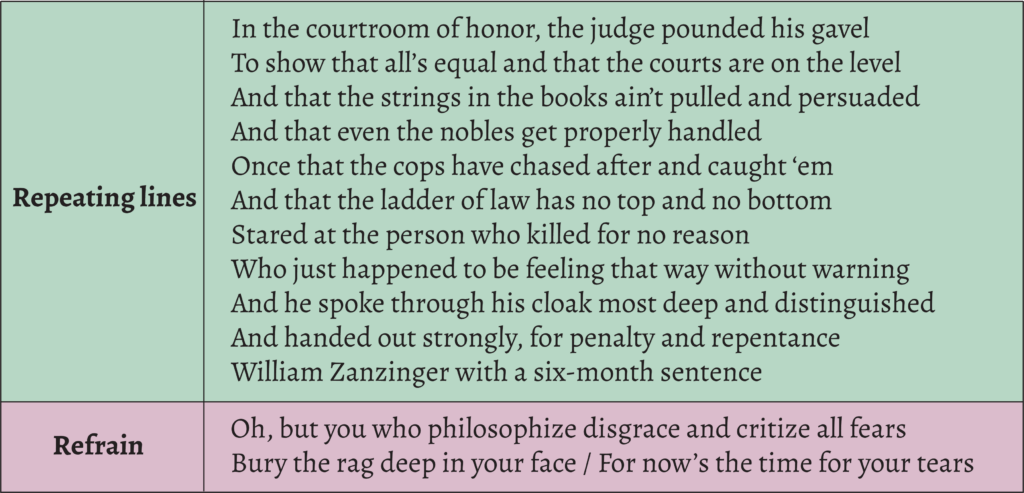
Comparing the song’s verses (Example 19) shows more of a cumulative structure—with four repetitions increasing to five in Verse 2, then nine in Verse 3 and finally eleven in Verse 4—than Dylan’s other freewheeling strophic forms. Verse 4, then, has the most repeating lines and features a change in the typical three-part format. Dylan removes the opening lines which results in a two-part structure (Example 20) that begins with the repeating lines and ends with the final refrain. In this final verse, he changes the refrain lyrics slightly. Instead of ending “Take the rag away from your face / Now ain’t the time for your tears,” Dylan intensifies the last statement: “Bury the rag deep in your face / For now’s the time for your tears.”
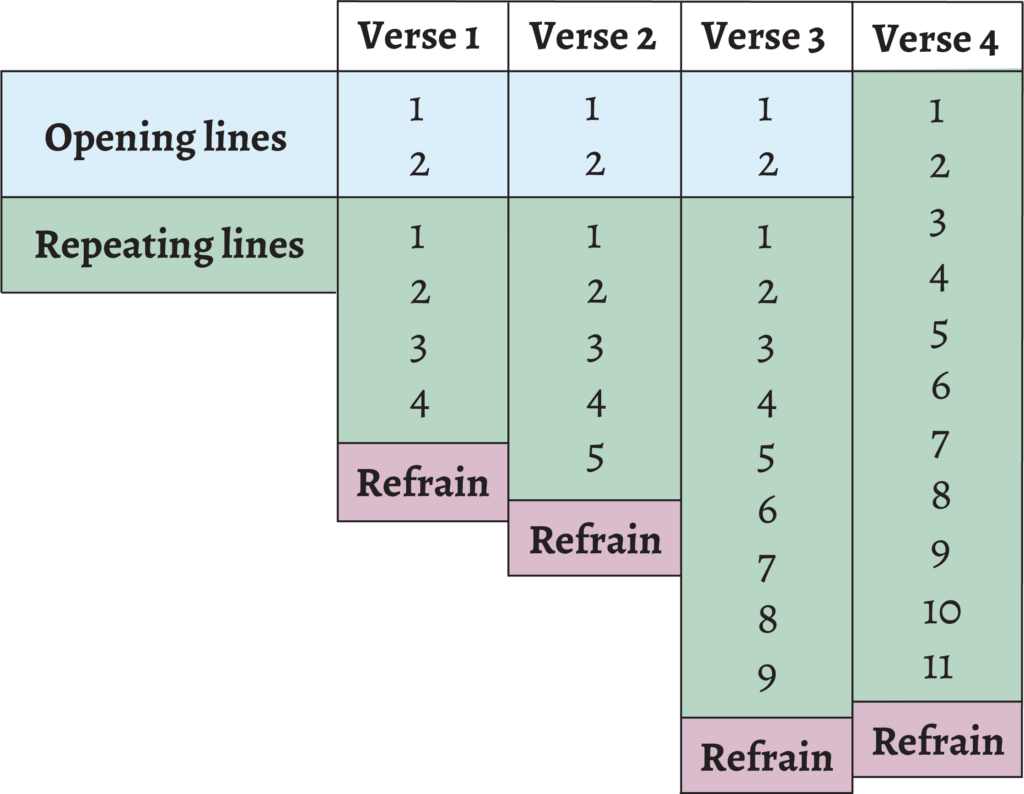
It’s critical that Dylan differentiate this final verse somehow, since it is where the sentencing occurs. There’s an irony to this choice as well, since the number of repeating lines in the verse far exceeds the number of months of Zantzinger’s sentence. Further, Dylan also uses the rhetorical device of anaphora, repeating the same words at the beginning of multiple phrases to increase the emotional impact of his lyrics.31 In Verse 4 (Example 20 and Video Example 5) Dylan begins his third, fourth, and sixth repeated lines with “And that,” interrupted in the fifth line by “Once that,” a variation on the anaphora word pair, and followed later by lines beginning with a truncated “And.” These repetitions build suspense toward the final line that reveals to listeners that Zantzinger received a mere six-month sentence for committing murder. This casts Dylan’s previous lyrics such as “nobles get properly handled” as sarcasm. All’s not, in fact, “equal.”
Like “Only a Pawn,” “Hattie Carroll” shows a correlation between Dylan’s topical protest songwriting and use of freewheeling strophic form. This is made even more evident by the chronological alignment of the two within Dylan’s songwriting canon: Harvey (2001, 64) positions “Hattie Carroll” at the apex of Dylan’s topical protest songwriting; after this, Dylan rarely based his song lyrics on current events. (The song is also the second-to-last iteration of freewheeling form in Dylan’s repertoire; the last is “Mr. Tambourine Man,” which does not have protest lyrics and uses a verse-chorus freewheeling variant.) The three songs in this section (“Only a Pawn,” “Hard Rain,” and “Hattie Carroll”) suggest that freewheeling strophic form may have been a preference for Dylan to set his lyrics on themes of import to his 1960s audiences.
3.2 Paul Simon’s Experimentation with Freewheeling Strophic Form
Within the aesthetic environment of the mid-1960s singer-songwriter style, Paul Simon found fertile ground for nurturing his songwriting talent during a break from his duo work with Art Garfunkel.32 Simon took advantage of the “urban folk” sound of the 1960s alongside the opportunities for musical and lyrical trends to complement his songwriting ideas, particularly the possibilities for expanding the “literary potential” of his lyrical craft (Bennighof 2007, xxi).33
The form of Simon’s song “A Most Peculiar Man” is evidence of his awareness of songwriting trends stemming from Dylan.34 The solo version of this song was released on The Paul Simon Songbook (1965) followed by a duet version with Garfunkel on their 1966 album Sounds of Silence. Simon wrote the song as a response to a two-line obituary he saw in a newspaper while living in London in the mid-1960s (Bennighof 2007, 17). While the first verse’s lyrics introduce the man, the second and third verses illustrate the insular nature of his existence (“all alone”), social dynamics (“he wasn’t like them”), and tendency to keep to himself (“he seldom spoke”).
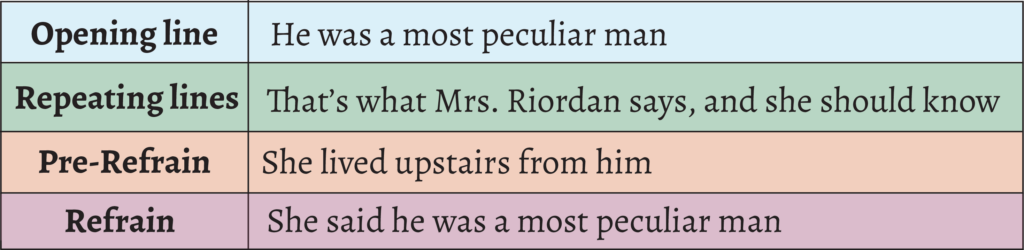
Simon begins his first verse (Example 21) with a modified version of the three-part structure of freewheeling strophic form. First, he includes a single four-bar opening line, which contrasts the two or three opening lines of the Dylan examples above. Second, Simon creates three repeating melodic lines out of one lyrical line (“That’s what Mrs. Riordon says, and she should know”), creating additional disorientation in ignoring his own line breaks.35 Third, Simon includes an added pre-refrain line that moves melodically upward to $$\hat{5}$$ (seen later in Video Example 6) and sets up the melodic descent of the refrain line.
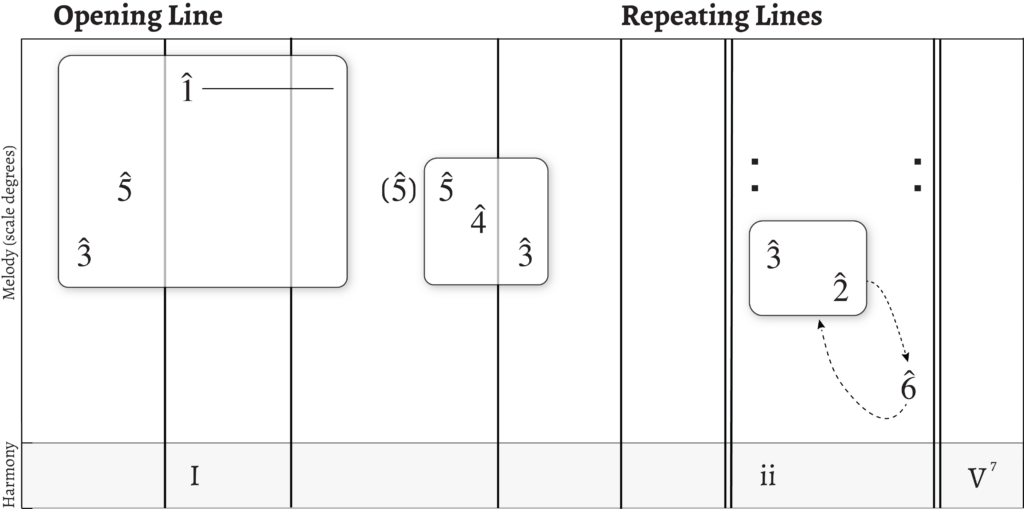
Simon’s version of freewheeling strophic form also features a much shorter phrase unit for the repeating line: here it is set to a single bar (shown in Example 22) rotating quickly through the $$\hat{3}$$–$$\hat{2}$$ melody (with occasional dips to the submediant) before releasing to dominant harmony and proceeding through the rest of the verse. This shorter unit contrasts the surrounding four-bar phrases causing Simon’s repeating lines to feel intensely tight and contained, mirroring the insularity of the “most peculiar man.”
Like Dylan’s freewheeling strophic structure for “Hattie Carroll,” Simon’s increases the number of repeating lines over the course of the song (Example 23), but not in the systematic manner of a true cumulative song. His second and third verses have four repeating lines, increasing by one in comparison to the first, and his final verse doubles in length.
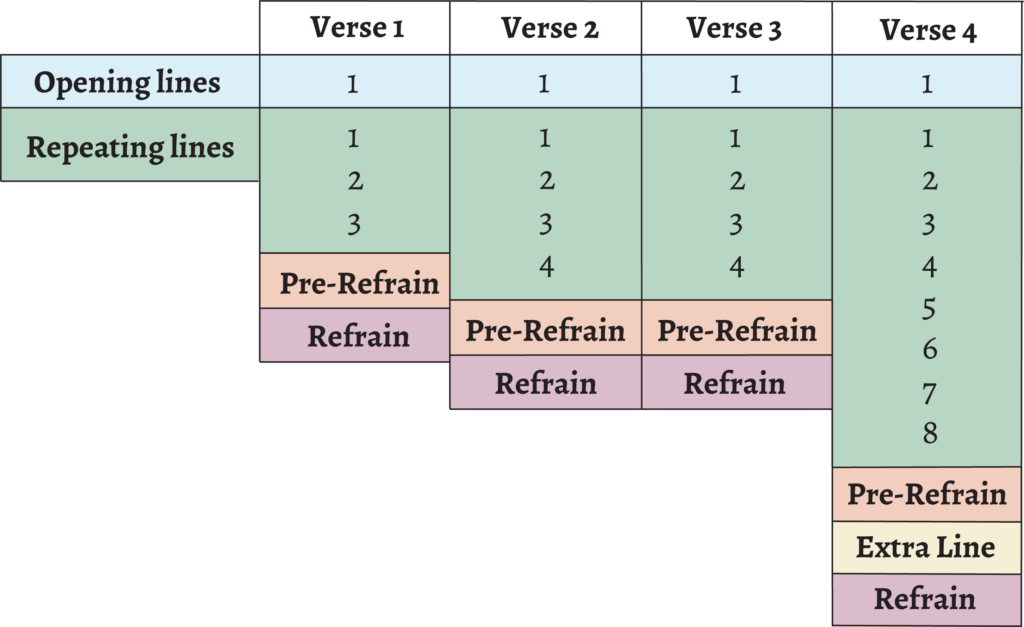
Example 23: Simon, “A Most Peculiar Man,” modified freewheeling strophic form verse comparisons.
Verse 4 (Example 24) also has a peculiar structure that echoes the peculiarity of the song’s subject. Like the previous verses, Simon continues to ignore his own line breaks with the placement of his descending $$\hat{3}$$–$$\hat{2}$$ melody as he describes the death. The character’s suicide is upsetting, to be sure, but one that is rather methodical and undramatic, a slow drift into endless sleep.36 The pre-refrain occurs as expected, but then Simon adds an extra line (“And all the people said, ‘What a shame that he’s dead’”) before the final refrain. He “wasn’t like them,” his isolation and peculiarity means the death is viewed as a “shame” rather than a tragedy. This extra material helps reinforce the reaction to his death, highlighting the apparent apathy from his neighbors whose inaction may have contributed to the outcome. Video Example 6 traces Simon’s melody through these modifications to his form; here there’s a discernable contrast between the motion/stasis of the repeating lines and their eventual release to the content of the pre-refrain, extra line, and refrain.
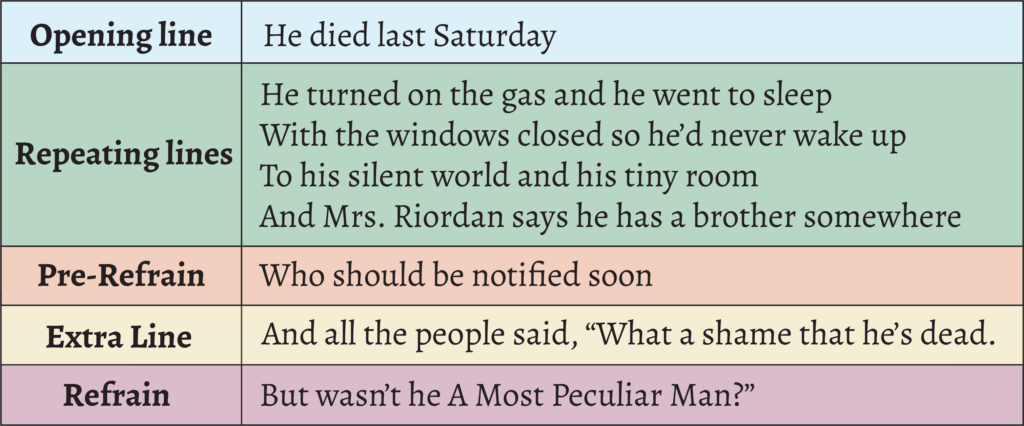
Simon’s use of freewheeling strophic form for “A Most Peculiar Man” shows his awareness of Dylan’s topical songwriting, both in content (responding to a specific obituary in the newspaper and commenting on human behavior) and flexibility of form. The changes he made illustrate Simon’s own artistic voice as a songwriter, exploring musical formats alongside his craft of lyric writing.
4. Verse–Chorus Variants of Freewheeling Strophic Form
All four preceding examples explore the way that Bob Dylan and Paul Simon set their songs to a freewheeling strophic form structure rather than a typical strophic form with repeating strophes of identical length. Two Dylan songs also map features of freewheeling strophic form onto a verse–chorus structure: “Who Killed Davey Moore?” (written in 1963) and “Mr. Tambourine Man” (released in 1965). In these, the verses contain the repeating line structure, and the choruses act as opening line and/or refrain sections.
Dylan’s song “Who Killed Davey Moore?” was written in 1963 but never released on a studio album.38 I’ll be exploring the 1964 Philharmonic Hall recording that was included on the 2004 album The Bootleg Series Vol 6: Bob Dylan Live 1964, Concert at Philharmonic Hall. The lyrics present Dylan’s take on the death of Davey Moore, a boxer who was knocked out in a fight with Sugar Ramos in 1963 and died after being in a coma (Harvey 2001, 120). Written several days after Moore’s death, Dylan’s topical song offers commentary on the people involved in the boxing event, none of whom accepted responsibility for Moore’s death.39
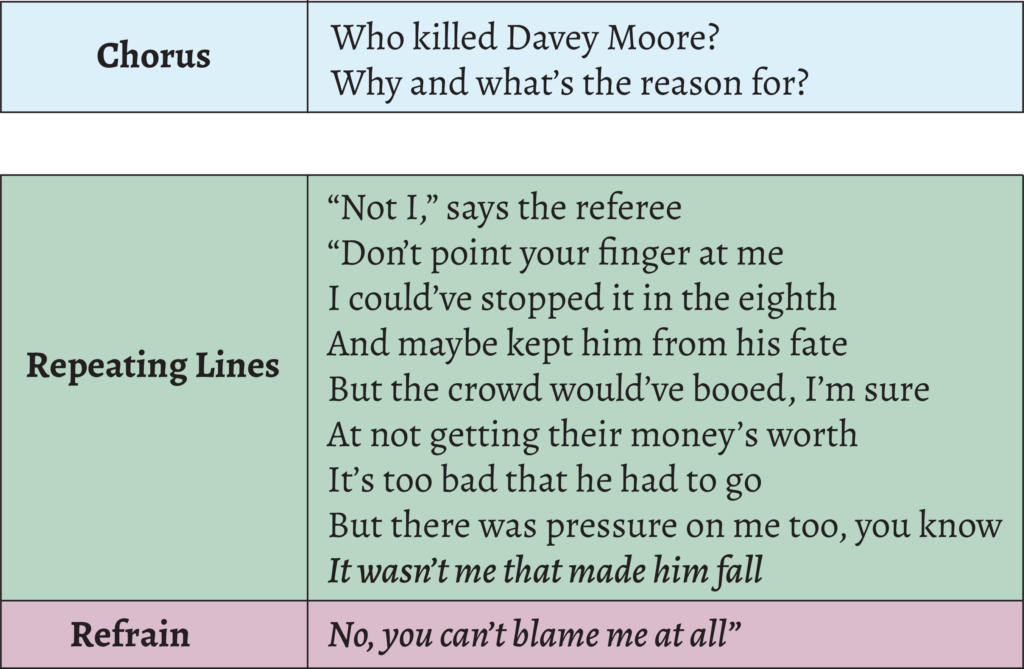
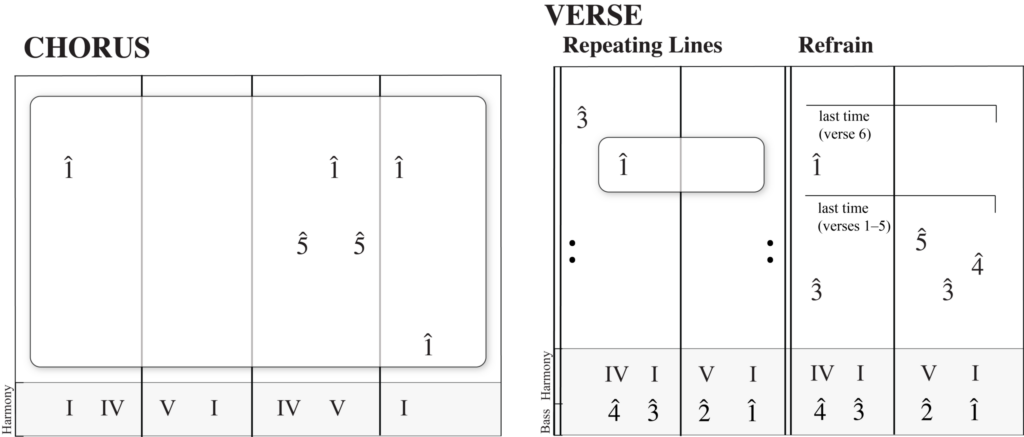
Not being in strophic form, the formal structure for “Davey Moore” differs from that of the preceding examples of freewheeling strophic form. Dylan’s chorus functions as the opening lines, echoing the structure and function of the “Questions” in Rings’s three-part structure for “Hard Rain.” In the first verse (Example 25) the repeating lines recount how the referee thinks he should not be blamed for Moore’s death. The number of repeating lines is harder to parse here than other songs, since the melody is a reciting tone on the tonic (shown on the right side of Example 26), so for this study I’m counting Dylan’s lyrical lines and repetitive bassline instead of pathways through a repeating melody.40 Each verse ends with the refrain “No, you can’t blame me at all” that is repeated with identical melodic and harmonic structure at the end of each verse. Since the lyrics “It wasn’t me that made him fall / No, you can’t blame me at all” (or a close variant) occur each verse, I’ve italicized both lines, with the former set to the repeating line melody and the latter to its own refrain melody. Video Example 7 traces Dylan’s path through the first verse.
“Davey Moore” shows a modification of freewheeling strophic form to a verse–chorus variant. Example 27 compares the verses of “Davey Moore,” plotting the initial chorus in an opening line position, since it is the first thing we hear in the song. But after this verse, Dylan’s performance places the chorus immediately after each refrain and follows it with a pause before the next verse, suggesting the chorus is a post-refrain event. The repeated lines themselves are reduced to two bars within the verses, shorter than the surrounding unit lengths. The freewheeling nature of the song’s structure becomes more evident when comparing the verses. Verse 1 has the most repeating lines at nine. The song then adopts a decremental rather than cumulative process, with the number of repeating lines decreasing to eight in Verse 2 and seven in Verses 3–5. The song ends up with a predictable outcome in its three-part structure, decreasing by the same amount across the repeating lines sections and then eventually settling on seven repetitions rather than continuing to vary.
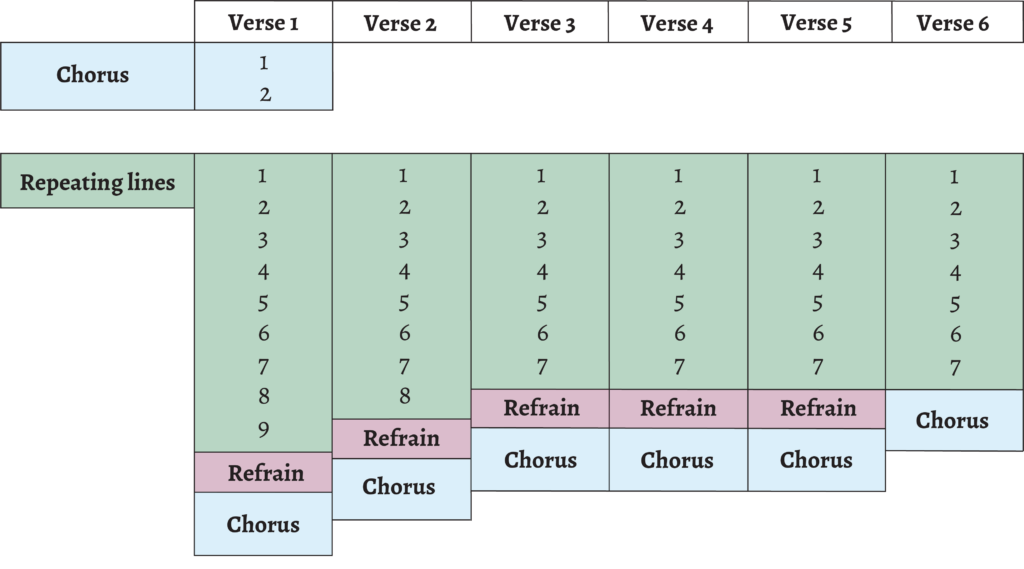
Formally, Dylan’s song “Mr. Tambourine Man” takes the verse-chorus variant one step further, offering two three-part structures within each of his freewheeling verses. There’s also a change to the function of the chorus here: now it serves as the refrain rather than either as opening lines or a post-refrain event. This adds another layer of variety to the freewheeling form, with the function of the chorus not revealed until after the first verse.
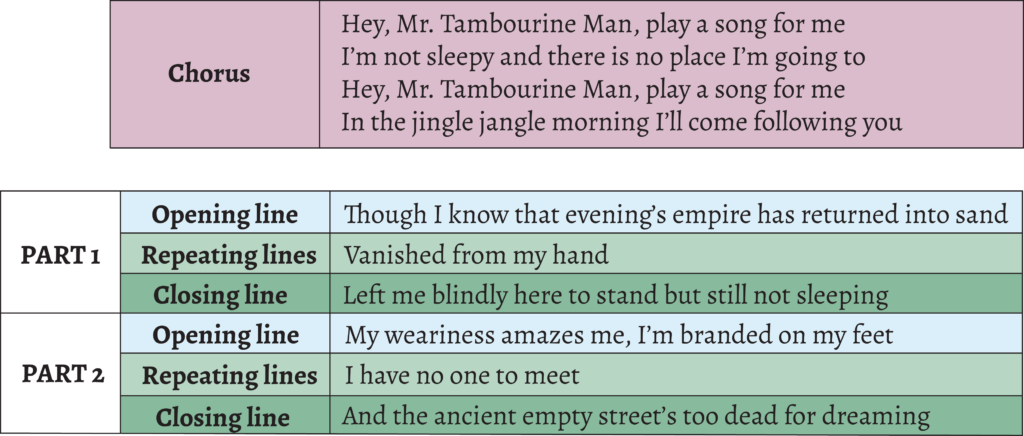
The structure of the first verse-chorus pair (Example 28) sets the template for Dylan’s subsequent verses. We first hear the chorus, with its abac melodic construction. When the verse begins, Dylan includes three melodic units: an opening line that is similar to the a melody of the chorus, repeating lines derived from the end of the opening line melody (though not yet repeated in this verse), and a closing line that shows similarity to the c line of the chorus. I’ve chosen here to call these “closing lines” because the text changes with each version so they’re not acting like true refrains. After the closing line we again hear the chorus, which functions like the refrain.
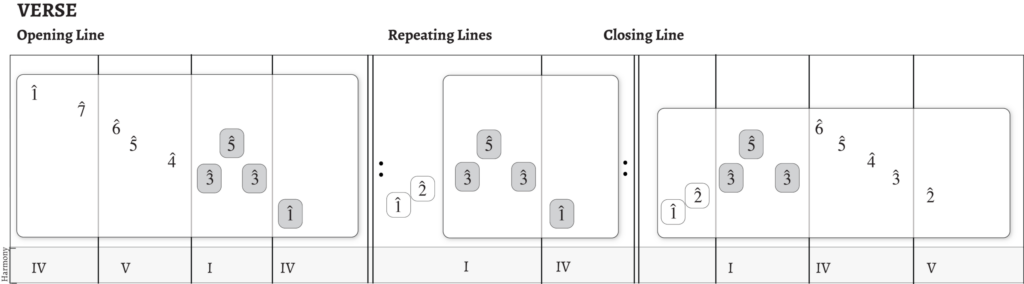
Example 29 maps the melodic and harmonic trajectory for the verses. Like some other freewheeling forms, the repeating lines are reduced to two-bar units, creating a fragmentation function that releases to the closing line of each part of the verse. The fragmentation is underscored by the melodic similarity between the end of the opening line and the repeating lines (highlighted in gray in the mapping) and between the repeating lines and the closing line (the individual scale-degrees are enclosed in boxes, which overlap with the $$\hat{3}$$–$$\hat{5}$$–$$\hat{3}$$ motive in gray). These parallelisms create potential for repetition and blur the boundaries between the initial sections. The possibility for cycling through the repeating lines is clearer in later verses, like Verse 4 (Example 30), illustrated in Video Example 8.
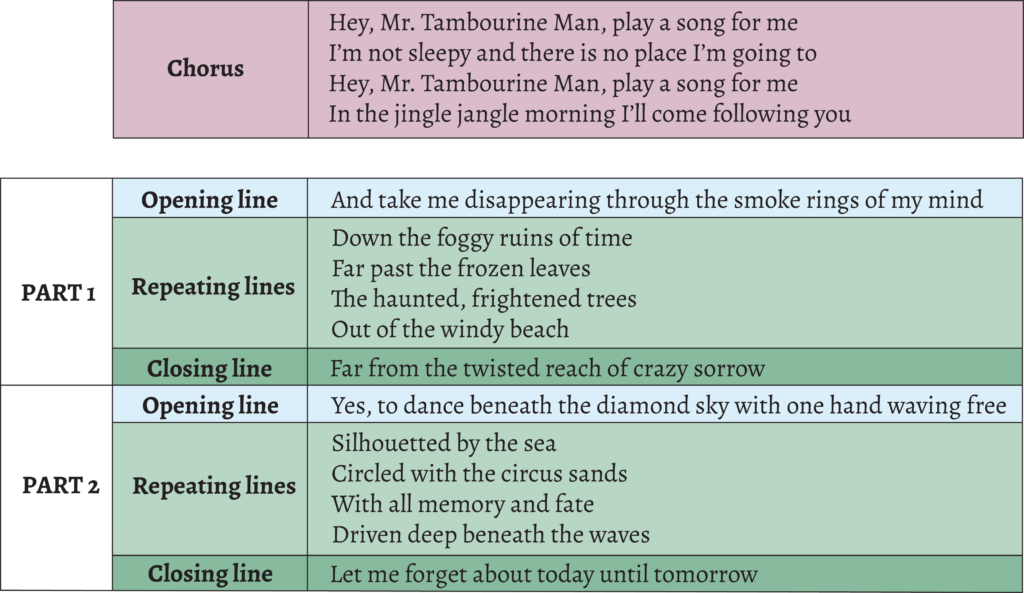
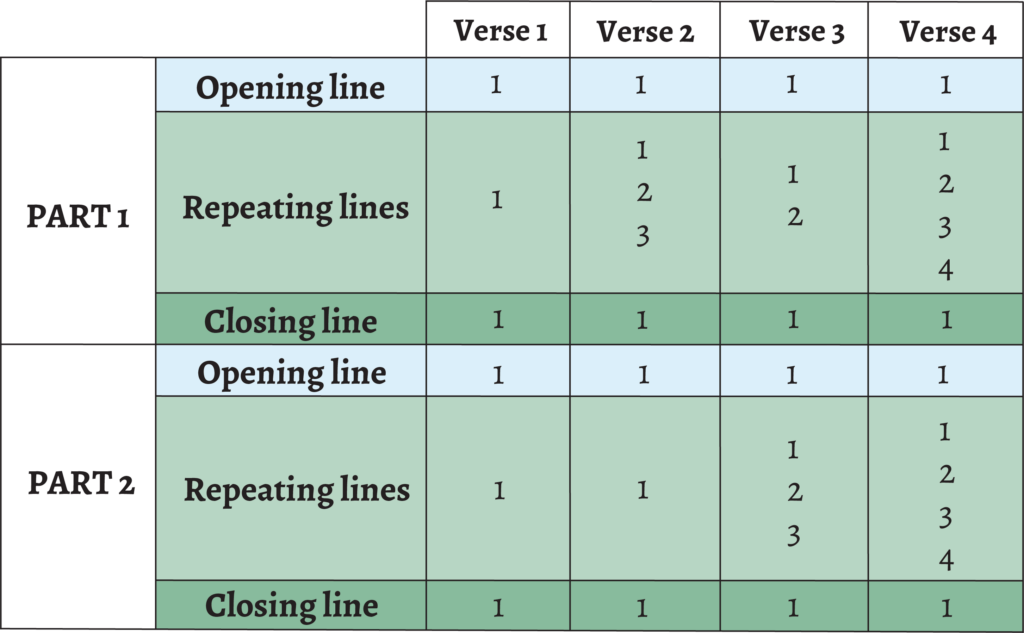
Comparing the verses (Example 31), the total number of repeating lines within each verse increases as the song progresses. Taking the outer verses as models, this cumulative process seems evenly distributed across the two parts of the verses: Dylan’s initial verse has a single iteration of the repeating line in each part whereas his final verse has four repetitions each. But comparing each part of the middle verses dispels any notion that this form is internally cumulative or experienced as such. Verse 2 has three repeating lines in part 1 and only one iteration in part 2. Verse 3 cycles through two repeating lines in the first part and three in the second. So rather than choosing to add repeating lines one at a time to progress from one statement to four over the four verses, Dylan instead chooses a path of unpredictability—a freewheeling approach, if you will—for “Mr. Tambourine Man” in a verse-chorus context. This fits better with the enigmatic nature of the titular Tambourine Man, who does not himself seem systematic, preferring instead to follow flights of artistic and nature-based inspiration.
5. Freewheeling AABA Form
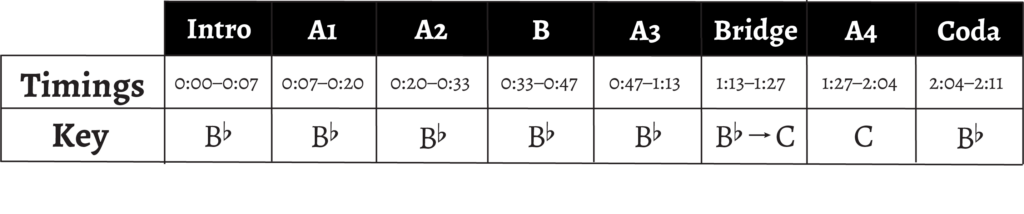
The final example in this study, Buffy Sainte-Marie’s song “Hey, Little Bird” further modifies two central features of the freewheeling singer-songwriter forms explored thus far. First, it breaks from the voice-and-guitar texture commonly associated with singer-songwriters to offer more complex, orchestral accompaniment.41 Alongside typical rock instruments like piano, guitar, bass, and drums, the song’s setting also includes glockenspiel and high-register woodwinds in dissonant harmonies that help convey the energy and timbre of this quirky bird song. Second, Sainte-Marie’s song explores how a freewheeling structure can map onto AABA form (Example 32).42 Her lyrics, rather than focusing on topical protest music, are instead concerned with the growth, flights, and dreams of the titular, “little bird.”
Buffy Sainte-Marie is an artist who navigated the same musical and stylistic circles as Bob Dylan during the Greenwich Village coffeehouse scene. She is best known as a singer who contributed protest songs to the singer-songwriter canon, including the Native American protest songs “Now That the Buffalo’s Gone” and “Bury My Heart at Wounded Knee” as well as the anti-war song “Universal Soldier.”43 Her first three albums are in a folk genre, including mostly strophic songs that either adapt existing songs from her contemporaries or folk revival sources, or offer original contributions within 1960s folk styles like blues and ballad traditions. Her fourth studio album, Fire & Fleet & Candlelight (1967), mostly continues with this trend, but a few outliers are original songs that push beyond folk-revivalist influences. “Hey, Little Bird” is one such example.
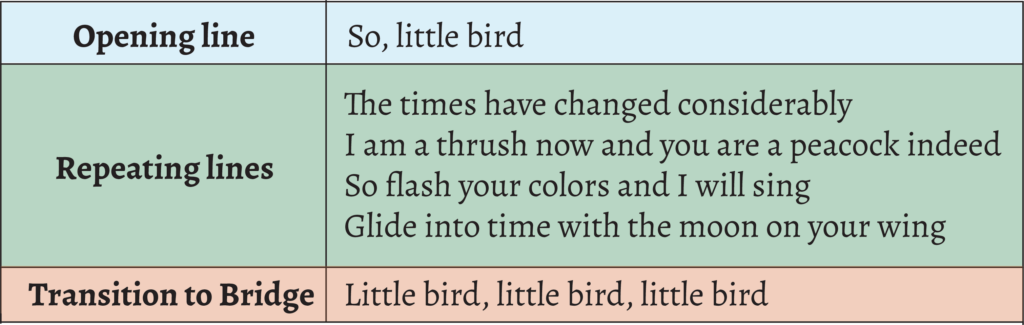
The song’s first A section (Example 33) provides a prototypical three-part structure that forms the scaffolding of the subsequent A sections, with only one statement of the repeating line. This prototype is repeated in A2, which also has one repeating line. It is only in A3 (Example 34) that the freewheeling structure begins to emerge, with four iterations of the repeating melody. The first of these is two bars, which emerges as a possible prototype, but the second (which sets the text “I am a thrush now and you are a peacock indeed”) extends the unit to four bars. After this, Sainte-Marie returns to two-bar units for the final two melodic cycles. She adds further formal confusion by proceeding from the repeating lines to a transition to the bridge rather than the refrain.

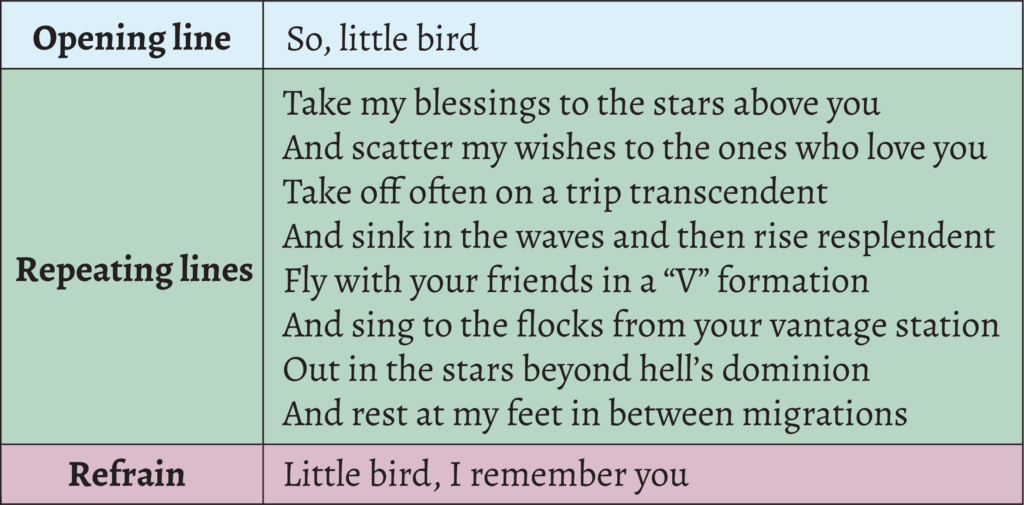
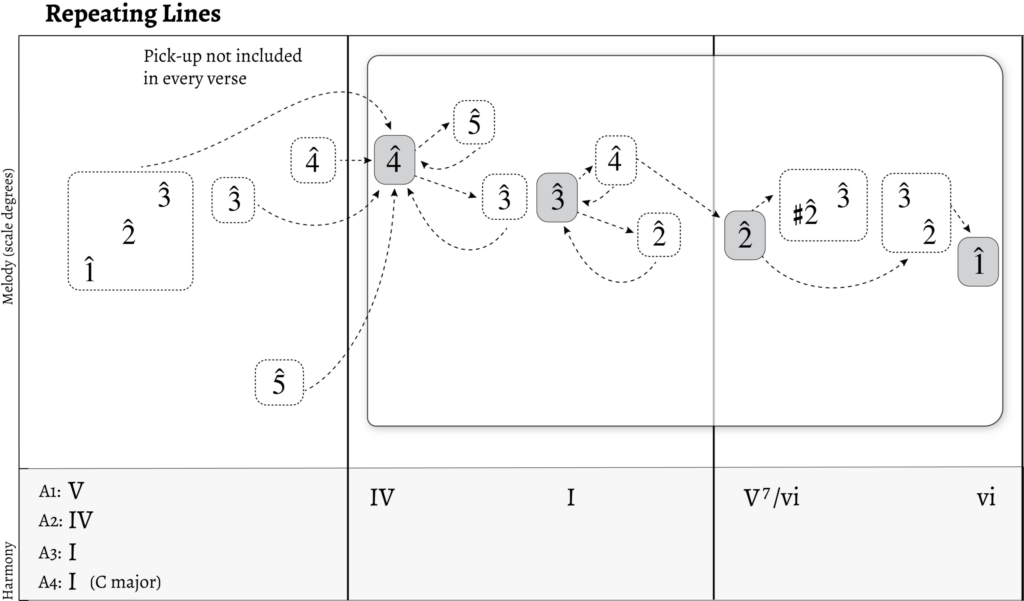
The final A section, A4 (Example 35), is a culmination of the freewheeling AABA form’s potential as set up by the previous A sections. It features the single two-bar opening line (shortening the four-bar templates of the opening lines for the A1 and A2 sections), eight two-bar repeating lines, and a statement of the four-bar refrain. Video Example 9 illustrates Sainte-Marie’s path through the repeating lines in A4. The mapping (Example 36) shows a variety of melodic trajectories for the underlying $$\hat{4}$$–$$\hat{3}$$–$$\hat{2}$$–$$\hat{1}$$ melodic descent (shown in gray) of the repeating lines in the A sections. Her florid melodic paths musically illustrate the paths of the little bird’s “transcendent” travels.
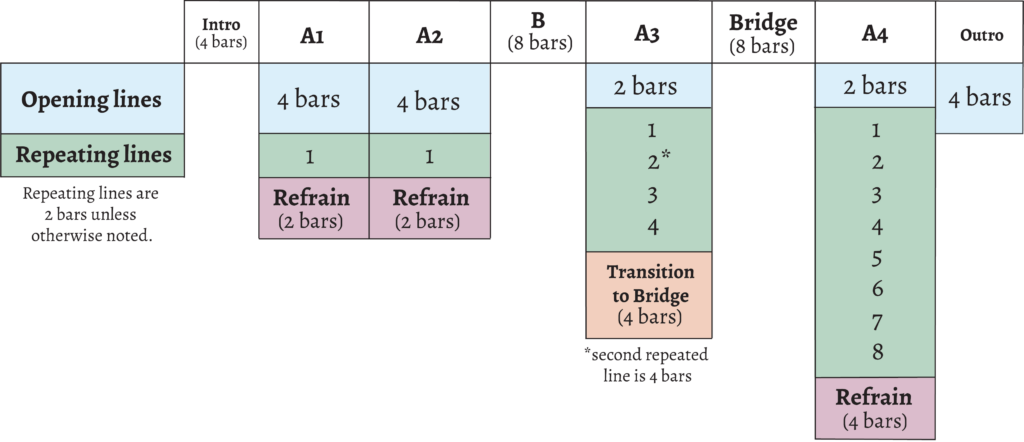
Like the cumulative form examples explored earlier, “Hey, Little Bird” does have verses of increasing length, but Sainte-Marie’s approach is more dramatic than adding a single line each strophe. In Example 37, I compare the A sections within the context of the song’s overall form. After a short introduction, Sainte-Marie begins A1 and A2 with four-bar opening lines followed by a single two-bar repeating line unit and a two-bar refrain. She’s initially concealing the potential for these lines to repeat. After an eight-bar B section, A3 includes a two-bar opening line, four repeating lines (the second of which is four measures), and then omits the refrain to include a four-bar transition to the song’s bridge. Following the eight-bar bridge, Sainte-Marie achieves the full freewheeling potential of her three-part A section structure in A4, which begins with a two-bar opening line, followed by eight iterations of the repeating line and a four-bar refrain. To round out the form, Sainte-Marie brings back the four-bar version of her opening lines (first heard in A1) as an outro. As the repeating lines cycle through the A4 section, the text is expansive as if echoing the ever more sprawling view of the titular bird as it flies further from its source, reinforced by the modulation up to C major for this section. Returning to the opening lines in her outro offers the promise of the bird returning and continuing the cycle of migrations anew. Sainte-Marie’s use of freewheeling AABA form adds to the song’s quirky character. Further, it showcases how this formal technique can be applied to forms beyond strophic and verse-chorus contexts.
Conclusion
The preceding examples illustrate the ways that freewheeling strophic form and its variants arose in 1960s singer-songwriter music to enliven formal structures and highlight lyrical meaning. Building on Example 4, Example 38 summarizes the findings from the seven singer-songwriter tracks in this study. Four of the seven songs are in freewheeling strophic form, and four have topical protest themes. The repeating line phrase units are typically shorter than the surrounding material, creating momentum in this penultimate section that is similar to the fragmentation units of sentence structures before a cadence. While freewheeling strophic form is the clear formal prototype, its “freewheeling” characteristics can also arise in other forms with repeating units, like the verses of verse-chorus form and the A sections of AABA form. As the examples in this study have demonstrated, the prototypical freewheeling strophic form is a three-part structure with an internal repeating line. Like its precedent in cumulative and enumerative songs, the length of each verse can vary. But rather than gradually increase in size, one added line at a time, the “freewheeling” quality of this form arises in the expansion and contraction of strophes, with lines being added and removed in an improvisatory manner. The singer offers as much of the story as needed each verse regardless of how much was told in the previous verse. The repeating lines of these freewheeling forms offer a unique storytelling opportunity for these songwriters, and became a vehicle for poetic imagery, clever rhetorical devices, and formal structures imbued with the qualities of aliveness and creativity associated with this period of singer-songwriter music.
References
Baker, Ben. 2025. “Themes and (Improvised) Variations in Modern Jazz Palimpsests.” In The Oxford Handbook of Musical Variation, edited by Jeffrey Swinkin, 860–884. Oxford University Press.
“The Barley Mow.” 2026. English Folk Dance & Song Society. Accessed February 13, 2026. https://www.efdss.org/?view=article&id=2540:efdss-resource-bank-chorus-barley-mow&catid=55&highlight=WyJjdW11bGF0aXZlIiwic29uZ3MiXQ==.
“Bob Dylan’s Tribute to Medgar Evers Took On the Big Picture.” NPR. 2026. Accessed July 3, 2026. https://www.npr.org/2013/06/12/190743651/bob-dylans-tribute-to-medgar-evers-took-on-the-big-picture.
“English Folk Song — Types of Folk Song.” 2025. English Folk Dance & Song Society. Accessed February 13, 2026. https://www.efdss.org/learning/resources/beginners-guides/52-english-folk-song/15410-efdss-types-of-folk-song.
Bennighof, James. 2007. The Words and Music of Paul Simon. The Praeger Singer-Songwriter Collection. Praeger.
Bentley, Christa Anne. 2016. “Los Angeles Troubadours: The Politics of the Singer-Songwriter Movement, 1968–1975.” PhD diss., University of North Carolina at Chapel Hill.
Brackett, David. 1995. Interpreting Popular Music. Cambridge University Press.
Brown, Sheila MacKenzie. 2014. “Same Form, Slightly Different Function: Senegalese Cumulative Songs as Contrasted to their Canadian and European Counterparts.” The Phenomenon of Singing International Symposium VIII 8.
Burkholder, J. Peter. 1995a. All Made of Tunes: Charles Ives and the Uses of Musical Borrowing. Yale University Press.
_______. 1995b. “Cumulative Form in Ives and Others.” Paper presented at the Annual Meeting of the American Musicological Society, New York.
Covach, John. 2005. “Form in Rock Music: A Primer.” In Engaging Music: Essays in Music Analysis, edited by Deborah Stein, 65–76. Oxford University Press.
Ensign, Jeffrey S. 2015. “Form in Popular Song, 1990–2009,” PhD diss., University of North Texas.
Everett, Walter. 1999. The Beatles as Musicians: Revolver Through the Anthology. Oxford University Press.
_______. 2008. The Foundations of Rock: From “Blue Suede Shoes” to “Suite: Judy Blue Eyes.” Oxford University Press.
Frisch, Walter. 1984. Brahms and the Principle of Developing Variation. University of California Press.
Guerriero, Linda, dir. 2023. Making an Icon. The Fifth Estate. CBC.
Hudson, Stephen S. 2021. “Compound AABA Form and Style Distinction in Heavy Metal.” Music Theory Online 27 (1).
Harvey, Todd. 2001. The Formative Dylan: Transmission and Stylistic Influences, 1961–1963. The Scarecrow Press, Inc.
Karpeles, Maud, ed. 1974. Cecil Sharp’s Collection of English Folk Songs. Oxford University Press.
Krebs, Harald. 2025. “Expressive Functions of Variation in the German Lied.” In The Oxford Handbook of Musical Variation, edited by Jeffrey Swinkin: 434–451. Oxford University Press.
Lerner, Murray. 2007. Bob Dylan: The Other Side of the Mirror. Sony Legacy.
Malawey, Victoria. 2014. “Strophic Modification in Songs by Amy Beach.” Music Theory Online 20 (4).
Monk, Ray. 2021. “Bob Dylan at 80: Why ‘The Lonesome Death of Hattie Carroll’ Is His Greatest Protest Song.” Accessed February 17, 2026. https://www.prospectmagazine.co.uk/culture/37642/bob-dylan-at-80-why-the-lonesome-death-of-hattie-carroll-is-his-greatest-protest-song.
Murphy, Nancy. 2023. Times A-Changin’: Flexible Meter as Self-Expression in Singer-Songwriter Music. Oxford University Press.
_______. 2024–25. “The Performed-Out Fermata from the 1920s to Bob Dylan.” Theory and Practice, 49–50.
Nobile, Drew. 2020. Form as Harmony in Rock Music. Oxford University Press.
Pennebaker, D. A. 2011. Bob Dylan: Don’t Look Back. Docudrama.
Rings, Steven. 2013. “A Foreign Sound to Your Ear: Bob Dylan Performs ‘It’s Alright, Ma (I’m Only Bleeding,’ 1964–2009.” Music Theory Online 19 (4).
_______. 2025. What Did You Hear? The Music of Bob Dylan. University of Chicago Press.
Russel, Craig. 1997. “The Idiom of Simon and the Image of Dylan: When Do Stars Cast Shadows?” In Music in Performance and Society: Essays in Honor of Roland Jackson, edited by Malcolm Cole and John Koegel, 289–297. Harmonie Park Press.
Scorsese, Martin. 2005. No Direction Home. Hollywood: Paramount.
Sharp, Cecil. 1919. English Folk Songs: Collected and Arranged with Pianoforte Accompaniment. Novello.
Smith, John A. 2000. “Singing and Songwriting Support Early Literacy Instruction.” The Reading Teacher 53 (8): 646–649.
Snyder, John L. 2025. “Samuel Coleridge-Taylor’s Symphonic Variations on an African Air: Structure, Narrative, Meaning.” In The Oxford Handbook of Musical Variation, edited by Jeffrey Swinkin, 369–402. Oxford University Press.
“Songs & Lyrics: A Most Peculiar Man.” 2026. Accessed July 6, 2026. https://www.paulsimon.com/song/most-peculiar-man/.
Spicer, Mark. 2004. “(Ac)cumulative Form in Pop-Rock Music.” Twentieth-Century Music 1 (1): 29–64.
Stephan-Robinson, Anna. 2009. “Form in Paul Simon’s Music.” PhD diss., University of Rochester, Eastman School of Music.
Summach, Jay. 2011. “The Structure, Function, and Genesis of the Prechorus.” Music Theory Online 17 (3).
Discography
Denver, John, and the Muppets. 1979. John Denver and the Muppets: A Christmas Together. RCA Victor AFL1-3451.
Dylan, Bob. 1963. The Freewheelin’ Bob Dylan. Columbia CL 1986.
_______. 1964. The Times They Are A-Changin’. Columbia CL 2105.
_______. 1965. Bringing It All Back Home. Columbia CS 9128.
_______. 2004. The Bootleg Series Vol. 6: Bob Dylan Live 1964, Concert at Philharmonic Hall. Columbia 512358 2.
_____. 2013. 50th Anniversary Collection 1963.
Sainte-Marie, Buffy. 1967. Fire & Fleet & Candlelight. Vanguard VSD-9250.
Seeger, Pete. 1955. Birds, Beasts, Bugs and Little Fishes. Folkways FC 7010.
_______. 1958. Sleep-Time: Songs & Stories. Folkways FC 7525.
Simon, Paul. 1965. The Paul Simon Songbook. Columbia EL 111.
Notes
- The lyrical line “So he never thinks straight” has several possibilities for more than two text stresses. But at this point in the stanza, the prevailing two-beat pattern is established enough to suggest stresses on the first syllable of “nev-er” and on “straight,” which matches how Dylan sings it on his studio recording.
- Unless otherwise noted, I am using studio recordings for the analyses in this study.
- In this song, I also include a “vamp” pattern in the guitar on tonic harmony (following Rings 2013) that Dylan uses to fill in space between phrases and verses. This notation style resembles Nashville Number System scores in that the diagram for an entire song could fit on a single page, allowing for ease of comparing repeated formal sections. In all instances in this study, the diagrams illustrate the structural details of only one particular performance, usually the studio recording. Though it could be possible to compare different recordings of the same song, singers like Bob Dylan usually make (sometimes significant) changes to their songs between performances.
- For this project I surveyed the music of the singer-songwriters who demonstrate flexible meter, as explored in Murphy (2023). My determination was that the performance practice of these artists made them more likely to include flexible features like freewheeling strophic form in their songs. Because this form is so closely tied to strophic form, its use diminishes as 1960s popular songwriting trends toward verse-chorus forms.
- Throughout this article I use the term “freewheeling strophic form(s)” as a placeholder for forms with repeating sections that expand and contract the way the strophic versions of this structure do. Though the formal types discussed in this article are all “freewheeling” forms, freewheeling strophic form serves as a sort of progenitor from which the other formal variants–verse-chorus and AABA–arise.
- In mid-century folk songs this most often occurs as a “tail refrain” at the end of each strophe.
- The srdc structure was first introduced in Everett (1999); for more on srdc in strophic form, see Summach (2011) and Nobile (2020, 39–69).
- Summach (2011, 15) also notes a “lull in activity” during this section in which “subdued instrumentation” also serves to build expectation, which is fulfilled once the “active texture of sr is repeated in c, along with the opening harmonic progression.”
- Malawey’s study also references earlier work on modified strophic songs, which includes J. H. Thomas’s 1973 study of Schubert’s explorations of this form, particularly in Schwanengesang.
- There are many examples of music-theoretical explorations of developing variation including but not limited to studies of Brahms (Frisch 1984) and more recent publications on Samuel Coleridge-Taylor (Snyder 2025), German Lied (Krebs 2025), and modern jazz (Baker 2025).
- Sharp (1919, vi) also lists “Accumulative” as a category of songs that have cumulative strophic form. My use of the terms cumulative and accumulative in this study differs from Spicer (2004) and from Burkholder (1995a, 1995b). Spicer’s study shows the way themes from previous song sections accumulate and layer in a final cumulative section. Burkholder’s definition of “cumulative form” arises in his study of Ives’s music and other late nineteenth-century pieces. His cumulative form features a reverse of the typical thematic order where a main theme is stated at the beginning. Instead, as Spicer (2004, 29) summarizes, “thematic fragments are gradually introduced and developed, only to crystallize into a full-fledged presentation of the main theme in a climactic pay-off at the end of the piece.”
- The Roud Folk Song Index is a database of over 240,000 traditional English language songs, compiled and maintained by Steve Roud. For more on “The Barley Mow,” the recording used in Example 5, and its inclusion in the Roud Folk Song Index, see “Barley Mow,” English Folk Dance & Song Society, accessed February 13, 2026, https://www.efdss.org/?view=article&id=2540:efdss-resource-bank-chorus-barley-mow&catid=55&highlight=WyJjdW11bGF0aXZlIiwic29uZ3MiXQ==. The lyrics of Example 5 follow their transcription, the melody of which shows a repeating tonic pitch for the repeating lines with a stepwise descent to the dominant for the text “and the brown bowl” at the end of the repeating lines.
- Karpeles (1974), a well-known folk song source, includes 12 songs under the category of “Cumulative and Enumerative Songs.” “Beginners’ Guides: English Folk Song – Types of Folk Song” (2025) lists three cumulative songs: “The Tree in the Wood” (Roud, 129), “The Barley Mow” (Roud, 944), and “The Twelve Days of Christmas” (Roud, 68). Research on this topic is sparse but includes studies like Brown (2014), which compares Senegalese versions of cumulative songs with English counterparts, and Smith (2000), who cites cumulative songs (like “Green Grass Grew All Around” and “There Was an Old Lady Who Swallowed a Fly”) as good models for teaching literacy to children. In my research for this article, I also encountered other Christmas songs that are cumulative (e.g., “Must Be Santa”) and many examples of cumulative songs in other languages, including the German song “Drunten in der grünen Au,” which is very similar to Seeger’s “Green Grass Grows All Around.” Thanks to Barbara Dietlinger for pointing out the use of cumulative form in German folk songs.
- Thanks to John Y. Lawrence for bringing this example to my attention.
- Peter, Paul and Mary’s version of “I Have a Song to Sing, O!” is identical to the Gilbert and Sullivan source and both are straightforward cumulative songs like Seeger’s, so I have not included a detailed analysis here.
- Christa Bentley (2016, 417) proposes that singer-songwriters grew out of the folk revival as they explored ways to make original contributions to the folk music canon. Murphy (2023, 74–101) explores the rise of topical songwriting and the individual styles of Dylan, Simon, and Sainte-Marie.
- There’s evidence to suggest that Dylan was on the lookout for ways to add irregularities to his performances. Rings (2013, 24) recounts the singer’s use of a Guthrie songbook, From California to the New York Island, that had an introduction by Seeger advocating for “irregularity” in strophic song performances. For more on techniques of such irregularities, see Murphy (2024–25).
- Bentley (2016, 48) suggests that Seeger’s penchant for group singing resulted in simple songs; his communal songwriting created a “class solidarity” that was “essential to the labor movement.”
- Murphy (2024–25) explores how performed-out fermatas add interest to Dylan’s strophic song performances, disrupting metric and hypermetric structures.
- As explored below, the remaining two songs— “A Hard Rain’s A-Gonna Fall” and “Mr. Tambourine Man”—have more general themes. Dylan disliked the term “protest songs” and refuted his status as a protest singer, instead preferring to refer to himself as a composer of “contemporary songs” (Scorsese 2005).
- Murphy (2023, 87) lists several other 1960s songs written on the topic of Evers’s murder including Nina Simone’s “Mississippi Goddam” (1964) and two songs by Phil Ochs: “Love Me, I’m a Liberal” (1966) and “Too Many Martyrs” (also titled “The Ballad of Medgar Evers”) (1964).
- Todd Harvey (2001, 82) describes this perspective in “Only a Pawn” as support for the common man “even excusing a racist because he is a hapless pawn” and focusing instead on the corrupt officials who encourage acts of racial violence.
- In Murphy (2023, 87–99) I explore the varying phrase structure lengths of Dylan’s opening verse, which begin with a five-bar opening line and vary due to Dylan’s expressive timing.
- For more on “Only a Pawn” and its historical context, see “Bob Dylan’s Tribute to Medgar Evers Took On the Big Picture,” NPR, accessed July 3, 2026, https://www.npr.org/2013/06/12/190743651/bob-dylans-tribute-to-medgar-evers-took-on-the-big-picture.
- I also notice similarities in formal structure across several live performances of “Only a Pawn,” discussed in Murphy (2023, 19–20). There I reference a July 6, 1963 performance at Silas Magee’s Farm (Pennebaker 2011), a July 26 performance at the Newport Folk Festival (Lerner 2007), Dylan’s July 30 recording for the Songs of Freedom television program (Dylan 2013), and his August 28 performance at the March on Washington as four performances that present identical lyrical and formal flexibility to his 1964 studio recording.
- Rings (2025, 231–249) devotes a chapter to the musical sources of “Hard Rain,” comparing Dylan’s melody and prosodic structure to possible precedents in folk-revival versions.
- The precise structure of Dylan’s hypermeter in “Hard Rain” is illustrated in Rings (2025, 257) who shows the irregular 3+4 hypermetric organization for the opening and repeating lines. (He interprets the refrain as shifting to a 4+4 organization.) The mapping in Example 14 illustrates that Dylan’s repeating lines span four downbeats, the fourth of which corresponds to a hyperdownbeat in Rings’s interpretation.
- Harvey (2001, 63) says the song “reaches beyond a simple recitation of the facts, instead invoking a broader issue.” Though Carroll’s race is not mentioned in the lyrics, Harvey argues that her race is clear from the lyrics and Dylan “implies that had their positions been reversed (Carroll beating Zantzinger) the sentence would have been more severe.”
- Throughout the lyrics, Dylan misspells his name as Zanzinger.
- Monk (2021) finds Dylan’s clearer stance against Zantzinger in “Hattie Carroll” to be an improvement over his more neutral tone in “Only a Pawn;” he allows listeners to be outraged by Carroll’s murder and the subsequent light sentence handed out to Zantzinger.
- Many thanks to an anonymous reviewer of this article who pointed out the use of anaphora in the lyrics for “Hattie Carroll.” Rings (2025, 244) also notes repetitions elsewhere, pointing out Dylan’s use of the word “table” arising multiple times in the third verse to emphasize the “dreary litany of tasks” that is then “suddenly interrupted by an account of Carroll’s murder.”
- Simon & Garfunkel released their debut, Wednesday Morning, 3 A.M., in 1964 to limited success. Murphy (2023, 12 n28) recounts that the album only found success after an overdubbed “folk rock” version of their song “The Sound of Silence” was released without their knowledge in 1965, while Simon was in England. For more on the history of this song and its impact on Simon & Garfunkel’s success, see Stephan-Robinson (2009, 4).
- Simon’s studies in English literature were reportedly a major influence on his songwriting. For more on Simon’s influences, literary and musical, see Bennighof (2007) and Stephan-Robinson (2009).
- Scholars like Craig Russell (1997, 595) credit the influence of folk revivalists, particularly “Bob Dylan’s poetic invention and social commentary,” with a shift in Simon’s songwriting from “bouncy pop music” of his early songs to covering the “troubling events of the civil rights movement.” Simon’s parody song “A Simple Desultory Philippic (or How I Was Lyndon Johnson’d into Submission)” imitates Dylan’s early style, featuring a “rapid-fire succession of ultra-short rhyming phrases” (Brackett 1995, 166).
- This is how it is formatted on Simon’s official website: “Songs & Lyrics: A Most Peculiar Man,” accessed July 6, 2026, https://www.paulsimon.com/song/most-peculiar-man/.
- Many thanks to a reviewer of this article for their suggestion about viewing Simon’s lyrics reflecting the methodical and mundane nature of the man’s suicide.
- Simon’s melodic setting breaks up the syntax of his lyrical lines, resulting in shorter fragments like “He turned on the gas,” “and he went to sleep,” “with the windows closed,” “so he’d never wake up,” etc.
- The song was included on The Bootleg Series Volumes 1–3 (Rare & Unreleased) 1961–1991 (1991) and The Bootleg Series Vol. 6: Bob Dylan Live 1964, Concert at Philharmonic Hall (2004).
- Harvey (2001, 121–122) suggests that Dylan supported an abolition of boxing as a sport and that what concerned the singer was “that no one connected with the incident would accept responsibility.”
- For more on Dylan’s reciting tones, see Rings (2013, 31; 2025, 106–113).
- Peter Schickele (also known as P.D.Q. Bach) is cited as providing orchestration for three songs on the album, including “Hey Little Bird.”
- It is common in popular music for AABA forms to include a repetition of BA at the end of the song, as discussed Hudson (2021) and Nobile (2020, 125–147). Sainte-Marie’s song does a variation of this which includes a new contrasting section, which I’ve called a Bridge, though this could just as easily be classified as B2.
- Sainte-Marie was initially promoted in the 1960s as a Cree folk singer, born on the Piapot First Nations Reserve in the Canadian province of Saskatchewan. A 2023 investigation from the Canadian Broadcasting Corporation (the CBC) has found no evidence of Cree ancestry in Sainte-Marie’s heritage (Guerriero 2023).