Reviewed works: Stephan Hammel, Toward a Materialist Conception of Music History, Haymarket Books, 2024, and Brian Kane, Hearing Double: Jazz, Ontology, Auditory Culture, Oxford University Press, 2024.
Bryan J. Parkhurst
Introduction
Before I say anything evaluative about Stephan Hammel’s Toward a Materialist Conception of Music History (henceforth MCMH) and Brian Kane’s Hearing Double: Jazz, Ontology, Auditory Culture (henceforth HD), let me say something descriptive about the discipline of philosophy. It is standard in Anglophone analytic philosophy to draw a distinction between normative ethics and applied ethics. “Roughly, normative ethics involves the attempt to state and defend the basic principles of morality. . . . Similarly, it might be said to treat the basic moral rights, duties, virtues, and so on” (Kagan 1992, 223). Also roughly, applied ethics “seeks to apply the general moral truths uncovered in normative ethics to particular actions, practices, or institutions” (Archard and Lippert Rasmussen 2013, 320). Even more roughly: normative ethics figures out what the ethical norms are, and applied ethics figures out how those norms apply in some ethical predicament. In what follows, I want to draw a distinction that is somewhat, but only somewhat, analogous. This is the distinction between what I hereby dub normative historical materialism and applied historical materialism.1 The job of the former is, roughly, to set forth the rules of the road, the investigatory and expository principles, that constitute and regulate a mode of sociohistorical inquiry and explanation, one associated above all with the writings of Karl Marx;2 whereas the job of the latter is, also roughly, to follow those norms in making inquiries into and constructing explanations of particular historical events, episodes, states of affairs, situations, tendencies, or whatever. Even more roughly: normative historical materialism says how to do history, and applied historical materialism does history that way. Of course, in actual historiographic practice, including Marx’s, this idealized division of normative and applied intellectual labor is rarely even aimed at, let alone rigorously maintained. Actually, in Marx, the methodological (Marx’s prescriptions about how to give historical explanations) is nigh on impossible to distinguish from the methodical (Marx’s explanations), so seamlessly are they interwoven, or, less politely, so messily are they muddled. And Marx’s work is not unique in this respect. Still, when reading Das Kapital, or the texts of Marx’s followers—or, really, any historical writing that has any genuinely explanatory, supra-descriptive ambitions whatsoever—it can be a useful exercise in exegetical bookkeeping to try to keep track of what should get entered on the normative side of the ledger and what on the applied side.
Now I will say something evaluative about MCMH and HD, something that keeps exegetical accounts in the way just mentioned. Hammel has written a fascinating, fun, and feisty book whose overall genre I deem to be that of normative historical materialism.3 And Kane has put together a masterly synthesis of social theory, conceptual anthropology (by which I mean: the cultural anthropology of concept-use), and music analysis whose overall genre I deem to be that of applied historical materialism. Having made that evaluative-taxonomic claim, I must now partly retract it—the taxonomic part, not the evaluative part. For, as their readers will see, both writers cover both normative and applied ground. Hammel and Kane both offer considerations that favor engaging in, and both discuss the normative principles that undergird, musical and music-historical explanation-giving of a distinctively historical-materialist stripe—whether officially and self-consciously, as in MCMH, or without flagging it as such, as in HD. And both then pursue that sort of explanation-giving. So, being a touch more careful, what I really should say is that the most noteworthy parts of Hammel’s book are the parts where he describes and endorses the kind of thing that Kane does, and that the most noteworthy parts of Kane’s book are the parts where he does the kind of thing Hammel describes and endorses. This is pure coincidence, as far as I know. MCMH has nothing to do with jazz, and HD is not in dialogue with the Marxian literary canon. Nor does either book cite the other. (I don’t know that the publication timeline would have allowed for this.) Yet they form a serendipitous unity. And, interestingly, as I shall lay out, they pair up in such a fashion that they end up being not just complementary—as the normative and applied sides of one historical-materialist coin—but also mutually critiquing. In brief, Hammel’s normative arguments help us see that some of Kane’s protracted wrangling with analytic philosophers who write about the ontology of art is misplaced or beside the point, and Kane’s applied analyses obviate some of Hammel’s criticisms of, and purported identifications of gross lacunae within, the post-Adlerian trajectory of music scholarship, and might also make us think twice about just how capital-p Political historical materialism really is. An upshot of this critical complementarity, by the way, is that it would work well to teach these books back to back—first MCMH and then HD, as a normative backswing and an applied follow-through—in a graduate seminar.
1. Toward a Materialist Conception of Music History4
In case you were scratching your head just now about the “Adlerian” part of “post-Adlerian,” it refers to the Austrian musicologist Guido Adler (1855–1941), who is one of the main protagonists in MCMH, along with Eduard Hanslick and Karl Marx. Adler is introduced to us as the patriarch and avatar of what Hammel calls “classical musicology,” which is introduced to us as a formerly hegemonic, but later on unjustly and irrationally jettisoned, musicological explanatory program. More on its key features in a moment. Were it resuscitated and properly cultivated—where that cultivation has both a scientific and a political side to it, as we will see—classical musicology could mature into a full-blooded “materialist conception of music history” (passim), a.k.a. “historical materialism as a musicological method” (45). Chapter 1 of MCMH positions historical materialism as an alternative and antidote to the “realist conception of art” (9ff.). Realism of this strain is the doctrinaire bromide that art either ought to, or always already does, mirror non- or extra-artistic reality. Customarily, one appends to this dogma the sub-dogma that art does or ought to reflect its worldly surroundings so as to afford art’s onlookers a sharpened apprehension of grim and grimy socioeconomic matters of fact. Hammel sees this red-pill5 realism (as I think of it) as a Marxian brainworm—a cliché so tempting as to have become de rigueur among Marx’s lesser imitators—that dulls the acumen of many Soviet aestheticians and Western Marxists. Instead of treating art as reflective of, and epiphenomenal to, some core part of reality, a duly materialist conception of music would treat art as, or as a core part of, that core part. Music is something that is, rather than something that inadvertently and obliquely is about, what is prominently and consequentially socially, economically, historically, etc. real. That is all to say, adopting the Marxian dialect, that “applying a materialist method to music history involves treating the art as part of the social base, rather than as an aspect of society’s superstructure” (26). In other words, materialistically historicizing music means “setting music squarely in the productive economic realm,” which in turn “demands that its specific mode of production be analyzed in every instance” (27). Note well that the exhortation to place primary expository and explanatory emphasis on how we make (in a broadly economic sense of “make”) music is not meant to preempt or preclude analysis of how we think about music. Quite to the contrary, the two go hand in hand, since, supposedly, “the concepts that are relevant to music are a function of the specific relations of production on which its making is founded” (28).6 Or, as the point might be slightly more modestly and therefore slightly more plausibly stated: oftentimes one can tell a credible story about how a way of thinking about music subserves, and is subtended by, a way of manufacturing music.
Chapter 2, “The Culture Phase of Industry,” slays a number of sacred cows as it goes about skewering Adorno’s amateurish, pseudo-Marxian, and self-underminingly pro-capitalist commitments in the realm of economic theory. Hammel presses us to give up on Adorno’s highly musicologically influential theorization of the culture industry, not because it is part of a Eurocentric “grand narrative”—the usual bad reason given for dumping Adorno—but because it is the music-historical fruit of that poisonous economic-theoretic tree.7 Chapter 3, “Disenchantment and Musicological Method,” leads more cows to the slaughter. The biggest bovine in the bunch is the still-vaunted “criticism-ism” (my term) of Joseph Kerman and like-minded “anti-positivists.” Hammel reaches the unflattering but unimpugnable verdict that Kerman is guilty of having abandoned himself to perverse, unmotivated suspiciousness—cynicism tinged with ennui—toward the very idea of musicology as a self-conceivedly truth-seeking, fact-finding, and explanation-giving endeavor. Closer to home for music theorists, Kerman notoriously promulgated an unargued, a priori disavowal of the investigatory presupposition that there could be non-arbitrary, objectively better or worse (more or less enlightening, more or less rationally and evidentiarily forceful) answers to “why?” questions about musical structure. This disavowal, which later inscribed itself as a negative article of faith in the post-positivist (new-)musicological catechism, fueled Kerman’s, and Kerman’s disciples’, antipathy toward efforts on the part of music analysts to tether their own disciplinary identity to the intellectual mission of answering such music-structural questions scrupulously and systematically. Kermanian anti-analytical, anti-positivist prejudices, which still circulate, stand as insuperable barriers to the establishment of a robust historical-materialist explanatory project vis-à-vis music. So we must take one step back—toward the classical musicology of Adler—in order to take two steps forward into the Marxian historical-materialist promised land.
I have not yet told you what classical musicology is. According to Hammel, “the central theoretical concept of classical musicology” (82) is style; and classical musicology’s “orienting concern [is] with the conditions of musical rightness (formalism), as well as the patterns of stability and change in music’s grammatical framework over time (style history)” (106).8 We learn more about formalism (qua doctrine of musical rightness) in chapter 4, “Democratic Formalism,” which is a highly unorthodox and aggressively revisionary, though compelling, intellectual portrait of Eduard Hanslick. Hammel’s Hanslick is to music analysis what philosopher Robert Brandom (and Brandom’s Hegel9) is to semantic analysis in linguistics: a thinker who assigns to inference—the rational activity whereby one acquires further beliefs on the basis of already-held beliefs—uncontested primacy in the order of explanation:
Hanslick maintains that in committing to a theme, the musician makes a move in a space of musical reasons. The listener’s intellect, including that of the listening musician, is involved in relating subsequent moves to previous ones. Following Brandom, we can say that musical moves stand to one another in relations of compatibility and incompatibility. The content of a musical move consists in the full set of its entailments and exclusions. . . . As the music’s course demonstrates how musical moves can be rationally related to one another, an ear . . . is naturally relieved, and perhaps even delighted, to hear and tacitly endorse unanticipated examples of musical soundness. (77)
The keystone of Hammel’s own Hanslickian historical-materialist inferentialism is this tenet: “[Musical] rightness is a matter of musical grammar, the rationality of which corresponds to the conditions of the modern subject” (78). There is much to unpack in this compressed formulation. The long and the short of it—and I shall first err on the side of the long—is that (1) capitalist modernity engenders in us moderns a structure of selfhood that (2) is defined by a mode of rationality that (3) is such as to demand of (a work of) music that (4) it be pervasively self-certifying, in the diachronic sense (signaled by such terms as “musical moves” and “the music’s course”) that (5) all later stages of it must discernibly and demonstrably follow from, and must be chosen by the composer because and insofar as they are entailments of, earlier stages of it, stages that (6) are formally and functionally assembled in such a way that (7) these entailment relations count as syntactic in nature.10 If I were to instead err on the side of the short, I might say, gnomically: from capitalism, musical organicism sprouts forth.
Chapter 5, “Style Criticism and Historical Materialism,” acquaints us with the ins and outs of the Adlerian conception of style criticism and walks us through that conception’s affiliation with Hanslickian inferentialism. The Adlerian style critic is tasked with “describing the rightness a musical form can acquire at a given moment in the history of its grammar” (97). And this norm-codifying agenda underwrites a “musicological project” that “presents itself as alternative and successor to an aesthetics of music” (98). The cardinal virtue of Adlerian style criticism
can be said to lie in offering the modern musician a basis for evaluating musical moves that is based neither on individual taste, nor on the demands of mere convention. Style mediates between the individual and the social by determining the scope of subjective agency, as well as serving as its ground. A science of style is meant to offer the musician a means of inheriting and endorsing music’s constitutive concepts that overcomes the modern forms of skepticism.11 (98)
If a “science of style” is to equip the modern musician with enhanced, convention-transcending, solipsism-overcoming, skepticism-vanquishing judgmental capacities, then the proper form this science will take is the orderly quest for an ordered account of musical ordering, an account of how “the moves that make up a given musical improvisation or composition (real or tonal answer, consequent phrase, authentic cadence) are as they are because they contribute to the tendency on the part of performances and compositions toward coherence and euphony” (98). In a nutshell, then, Stilistik or Stilwissenschaft erects theoretical scaffolds whose schematic purpose is to prop up the “teleological explanation” (99) of “organic relatedness” (98), and style-ologists undertake this theory-building with a view to empowering musical judgments to be something more and other than subjective expressions of preference.
But how does musical stylistics, so channelized, flow into the broader current of historical materialism? Hammel’s answer is that musical conceptual schemes are “determined by the level of technology available to musicians at any given time” (102). It was Marx who bequeathed to posterity the most enduring and adaptable explanation of technological development, a phenomenon Marx saw as an inevitable byproduct of the dynamics of eat-or-be-eaten competition among capitalist firms; and so, on what Hammel regards as the properly Marxian conception of it, the
telos of music history is understood to be the production of broadly useful music in ever greater quantity and involving the fewest demands on the musician’s time, brain, and muscle. A materialist conception of music history can also serve as a basis for understanding how music’s formal structures appear to gather together in distinct styles. (102)
In skeletal form: forces of production determine relations of production, which generate musical concepts, which (in and through their compositional/improvisational application) partition the musical-social universe into stylistic-idiomatic galaxies. Hammel puts flesh on the bones of this skeleton in chapter 6, “Forces and Relations of Musical Production,” which presents case studies meant to illustrate how musical style has exhibited responsiveness to technological advancement. For example, because basso continuo allows the “skilled musician [to] improvise whole fugues at the keyboard,” it follows that “advanced thoroughbass practice . . . served to partially automate the writing of counterpoint” (116), and thus playing from the figures “can be understood as a species of automation” (115). Moreover, since the Volkommene Kappelmeister’s compositional and performative exploitation of and reliance on bass figuration “depend[s] on the deployment of patterns and conventions” (115), the art of thoroughbass is a productivity-boosting conceptual breakthrough that is also a style determinant. All told, then, MCMH’s Marx-inspired explanatory paradigm follows this sequence of causal steps: the whip of competition creates an imperative of efficiency, which impels technological-cum-cognitive innovations, which spawn normative-conceptual musical schemata, which inform and regulate the creative and performative enactment of musical styles.12
Hence the normativity of the normative historical materialism that is the centerpiece of MCMH comes down to the methodological prescription that we ought to carry out music-historical inquiry as inquiry into how and when and where and why objects and events of musical import—most pivotally, for Hammel, style-bound compositional choices—fit into that causal sequence, whether as (as the Scholastics would say) causal agents or causal patients.
MCMH ends with an appendix provocatively titled “The Harmonic Ideology.” This section explores Hammel’s many-sided misgivings about “the modern theory of harmony” (135), meaning Roman numeral analysis, with its assumption of chordal invertibility, together with statistical generalizations about what patterns of chord succession are common. Hammel alleges that this theory (1) does a poor job of explaining the “apparent regularity of musical motion” (139), (2) is an idea that “can be profitably abandoned in favour of properly scientific ones” (142), and (3) comes wholly unmoored from concrete musical practice, and can thus be wholly discounted on grounds of total irrelevance to actually existing harmonic customs.13 Ergo “harmonic ideology” stands in need of “a Marxist critique” that “would aim at . . . centering the conditions of musical production” (141). Carrying out this critique means, as a first order of business, “abandoning the assumption that Rameau and his followers made genuine scientific discoveries” (141).14 Upon roundly repudiating Rameau’s penchant for arid, practice-independent, pseudo-scientific speculation,
the materialist music theorist might replace theoretical with pragmatic concepts in an effort to reconstruct the tools of a music making practice on its own terms. Those terms need not be found in theoretical writing correspondent with a given style or period. Rather, one can look for conceptual determinacy embedded in the process of production itself.15 (143)
The ensuing “socialist materialist music theory” (144) will be well placed to explain “the apparent regularity of voice-leading with reference to productive efficiency, social history and the structure of institutions” (144).16 And success in this venture will pay political dividends, for it will allow the music theorist to
make historically informed recommendations to the planners of the music making system in a post-capitalist order in which most productive enterprise is owned and operated in common. It would be both impossible and undesirable to attempt to re-establish something like the eighteenth-century training system in the twenty-first century. That said, understanding the precedent provides future planners with a model for which conditions are most conducive to the emergence of a common musical language in which most are able to freely improvise.17 (144)
Now to sum up. The axial historical materialist methodological injunction, as it is formulated by Hammel, and as it applies to “musicking,” is, prescinding from a few finer-grained details: understand musical styles as coherent, autonomous, norm-governed social practices that establish (what appropriately inculcated and acculturated practitioners regard as) justificatory or “right-making” relations—grammatical licensings—between (the compositional products of) reason-guided musical actions; understand the style-defining, practice-constituting norms as consequent upon (or as in some non-implicational way consonant or congruent with) technical innovation; and understand technical innovation as a paradigmatically economic, and endogenously capitalist, phenomenon. Notwithstanding my squeamishness about how a few of those finer-grained details get worked out by Hammel, I think his injunction amounts to—and I don’t intend this as rhetorical hyperbole—something like the aptest thing that has ever been said about how to cast music history in a historical-materialist mold, which, cards on the table, is how I think it should be cast.18 And perhaps Hammel has come along to say it at a time when music scholars have the ears to hear it, since style study is no longer in such bad odor,19 is no longer looked upon as “one of the old, now discarded shibboleths” (Taruskin 1989, 158) of a musty, fustian, bygone epoch of historical musicology, and since Marx is no longer all that much of a bogeyman, at least to members of a younger, post-postmodern cohort of academics.
In a 2013 review of Michael Cuthbert’s Music21: a Toolkit for Computer-aided Musicology, Dmitri Tymoczko said something witty that stuck in my head: “Indeed, the first piece of advice I give to beginning theory graduate students is ‘learn music21.’ We may be waiting for our Siegfried, but we have found his Nothung” (Tymoczko 2013, [1]). I can’t resist stealing and modifying Tymoczko’s quip. MCMH is short, fragmentary, and often elliptical, mostly in ways that conduce to its readability, occasionally in ways that provoke finicky philosophical and Marxological compunction. As befits a work that so assiduously broadcasts its abundant fellow-feeling for the Second International, its chapters read a bit like pamphlet manifestos—again, in a manner that is mostly rousing and occasionally frustrating. So I would say that, as far as historical-materialist method in the world of music studies goes, we may be waiting for our Nothung—Hammel’s next book?—but we have at the very least found its shards, not to mention unseren jungen Siegfried.
2. Hearing Double
Onward to applied historical materialism. My comments about HD will contain less in the way of summary than did my comments about MCMH. That is partly because much of HD is given over to music analysis, the value and insights of which cannot survive synopsis. It is also partly because there are other published reviews of HD that summarize it ably (Chandrasekhar 2024; Mendelssohn 2025). So, to adapt Wittgenstein’s dictum: whereof I need not speak, thereof I shall be silent. My overriding concern will be with how HD conforms to (without purposely following) MCMH’s historical materialist recipe, with what are, to my way of thinking, most impressive results.
Still, a cursory overview of the book’s format is in order, so that readers will have some inkling of which bits of HD I am leaving out of account or giving short shrift to. The book has two halves. Part I, “Ontology,” takes a stand on the metaphysics of musical structure, partly by settling scores with analytic philosophers of art (Peter Kivy, Jerrold Levinson, Stephen Davies, Andrew Kania, et al.), partly by advancing its own positive proposal about jazz ontology (i.e., that jazz standards are networks). Part II, “Auditory Culture,” passes from ontology to history and aesthetics, tracing out how, before and after World War II, the American popular music ecosystem and soundscape had as its mainstay the live radio broadcast of performances of multiple competing arrangements of a single jazz standard. This “standard-ized” musical culture was subsequently transformed by the postwar rise of the disc jockey and televised hit parade, and the resulting shift in the auditory culture’s aesthetic center of gravity—basically, from cabinet radio to car radio, and from all radio to TV—explains the eventual decline of the standard. Kane wraps things up by contending that the proper—historically authentic, culturally savvy, etc.—way to listen to a standard is by “hearing double”: the adept listener actively compares the formal properties of a present performance with the (developmental genealogy of the) formal properties of past performances.
How does HD put into practice those historiographic norms that MCMH promulgates? Kane holds that the activity of playing jazz standards is a complex social action, one that—if I may paraphrase Kane by using a conceit that is not his own—gets acted out within a two-dimensional normative grid. One dimension of the grid corresponds to the performative-compositional axis of musical reproduction, recreation, revision, substitution, and the like. This dimension is governed by codes and conventions that regulate how to, in effect, play the same thing, but not in the same way. (Semper idem sed non eodem modo, as Schenker’s famous Latinization has it.) What Kane calls “practices of replication, where one musical bit is substituted for another, and where the success of its identity or individuation depends on its social context of use,” function as action-contexts within which performers can musically implement “culturally specific ways of demonstrating likenesses” (184). Kane’s what-versus-how parsing of the performative situation makes good sense; indeed, the idea verges on being self-evident: when some jazzers play “Body and Soul” in their own way, they play (1) what is, owing to salient “likenesses” with past playings, something recognizable as “Body and Soul”; and they play it in (2) what is, owing to the uniqueness of their “substitutions,” a manner that is recognizably their own. The matter of the re-identifiability of one and the same standard across nonidentical renditions brings us to the other dimension of the normative grid, the (re)cognitive-linguistic axis of reference, attribution, classification, designation, and the like. This dimension is governed by codes and conventions that regulate how to talk about what is reproduced, recreated, revised, substituted for, etc. Within what Kane calls “practices of nomination,” musicians play the language game of “identifying the song that they are preparing to play by associating it with a network of previous performances of that song” (147). Again, this is patently true and needs no argumentation on its behalf, as Kane is the first to acknowledge: “This is not a theoretical issue; composers name their works. Names are emblazoned on performances, recordings, and inscriptions” (147). Less truistic, and more intriguing, is Kane’s attendant socio-hermeneutic claim that one who calls a tune thereby makes a pledge to, enters into a quasi-contract with, the audience: “A name promises that the music we are about to play will be a successful replication, based on those previous performances yet without specifying any properties in particular” (148). The takeaway from all this is that the fact that a sonic token gets to count as a performance of the “Body and Soul” type is not a purely acoustic, or a purely music-structural, fact. Instead it is a fact that depends on shared intragroup attitudes of approval and acceptance (etc.); it is thus a fact that is at once normative and social. “For me,” Kane announces, “the mechanisms of replication and nomination—the two main processes that I will theorize as involved in the reproduction of the jazz repertoire—are thoroughly social in nature” (10).
And doubtless they are thoroughly social. So doubtless is this that we might wonder: to whom do these mechanisms appear otherwise? Kane’s answer is: those pesky analytic ontologists, i.e., antisocial (pun intended) analytic philosophers who like to argue about what they call the “ontology” of musical entities. As you probably know, “ontology” is a much used and (especially when used in the plural) abused word, one by which many different people mean many different things. Even if we limit ourselves to inspecting usages of the term that have currency within analytic philosophy, we find that the word is still multiply ambiguous. It carries at least these three senses:
- Ontology1, or existential ontology, hereafter “one-tology”: inquiry into what there fundamentally is, or into what the most basic constituents of reality are. Materialism is a one-tology according to which (in one of its versions) only matter is really real, or according to which (in another of its versions) all facts are reducible to facts about how the primary physical components of reality are configured.
- Ontology2, or categorial ontology, hereafter “two-tology”: inquiry into which category of basic constituent (as identified by a one-tology) some (type of) object or entity belongs to. Thus Platonism about musical works (a type of entity) holds that musical works are atemporal, nonspatial abstract objects (a category of basic constituent). Platonism of this stripe, as a two-tology, is premised on a one-tology that (unlike a materialist one-tology) countenances the existence of abstracta.
- Ontology3, or descriptive sociolinguistic ontology, hereafter “three-tology”: inquiry into what entities are, in fact and in practice, “quantified over”—overtly postulated or covertly presupposed—in some actually existing discourse. Thus we might observe that numbers are quantified over in the three-tology of the discourse of mathematics—inasmuch as players of this language game use numeral-nouns such as “five” and “pi”—or we might describe the three-tology of a programming language (or: we might three-tologically describe a programming language) as consisting of various data-types standing in various relationships. And, notably, we might do so without also having any settled views about whether numbers or data-types are Platonic objects or not (according to a two-tology) or about whether they are really real or not (according to a one-tology).20
As I read it, HD propounds a three-tology. On Kane’s own definition, a musical ontology “is an enumeration and description of the kinds of things that make up the production and reception of music (e.g. notes, chords, melodies, works, performances, recordings, broadcasts, and so forth)” (182). That “so forth,” needless to say, includes Kane’s hobby-horse, the jazz standard, and, as we already saw, “the ontology of the standard emerges from ongoing acts of replication and nomination” (10). Importantly for Kane’s narrative, this means that “the social forces that structure the success or failure of these [acts] are integral to ontological consideration” (10). And, importantly for my narrative, those “social forces” include what Hammel calls “forces of production” and “relations of production.” Kane tells an admirably careful and nuanced tale, one that abounds in historical and sociological detail, about how the normative contours of past practices of replication and nomination have both registered and reacted to both (1) revolutions in recording and broadcasting technology (forces of production) and (2) reconfigurations of the institutional framework for commodity production and distribution (relations of production). I stress Kane’s carefulness and nuance not just to pay him a compliment, but also to point up the gratifying fact that there is no Adornian hand-waving in HD about the “interrelationship between radio technique and monopolistic society” (Adorno 2009, 389) and suchlike. Very much unlike Adorno, Kane doesn’t write any explanatory checks he can’t cash. (Hammel pillories Adorno; Kane just outdoes the Frankfurter.) Rather, most especially in chapter 5, “The Soundscape of Standards,” he diligently connects the causal dots, detailing how technological progress has ripple effects in the musical marketplace, which induce corresponding changes in auditory culture, which prompt adjustments and adaptations in the sphere of musical technique. I was quite taken with Kane’s discussion of how “the sonic properties of recordings”—within a musical marketplace and “auditory culture of reception” in which the purchasable, ownable recording is the foremost unit of economic and aesthetic significance—“helped sound [itself] to become a sufficiently work-determinative property” (196). Kane met and exceeded the burden of proof in making the case that “technology . . . afforded [more focused] attention to sound as such” (196)—i.e., to the total sonic-timbral profile of a recorded rock song, not just to its generic chord progressions and transplantable tunes. I cannot recall ever having been unreservedly convinced by an argument that sought to link capitalist technological development to cultural sea changes in the prevailing compositional use of musical materials.21 But I can think of no reservations to air about HD’s tight argument that breakthroughs in “the new recording technology of magnetic tape” (193) collaterally enabled “communities of listeners [to be] convinced (recruited, assembled, joined in the stance) that [sound] provided the most important criterion for the identity of the work” (196), or about its argument that this shift in communal reception norms went hand in glove with an increased compositional “emphasis on specific sonic properties only available in the studio” (197).
Once more, when I say that Kane’s ontology is a three-tology, I mean that it is, at root, an elucidation of how and why (by their own lights) certain musical agents take and treat certain instances of the production of musical sounds, but not others, as performances of a certain jazz standard, but not others. HD’s “ontological account” (78) is an account of how, within the confines of jazz practice (or of a jazz practice), a paramount normative status—the status of being a (performance of a) standard—gets accorded to whatever is collectively held to be deserving of this status, per the shared senses and sensibilities of authorized status-conferers. Kane puts forward what he calls “the network model” as a tool for graphically depicting the characteristic patterns and protocols of the apposite status-conferring activities. “A standard might be depicted as a network,” he writes,
one in which the nodes represent distinct performances and in which node-to-node relations (or edges) represent similarities and differences among performances. And yet, a standard is not any particular node in this network, but a permissive set of protocols, rules, strategies, and customs that emerges from the network in its holism. (7)
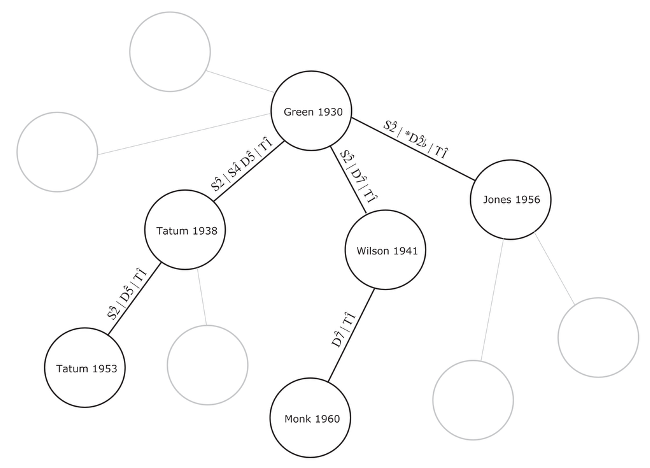
If I understand Kane’s model correctly, performance-nodes represent acts of both replication (i.e., “the selection of some, but not all, properties [of a previous performance] in order to produce an object that is substitutable for [it]” [62]) and nomination (i.e., the designation or identification of a particular performance as being of a named standard). So, in 1953, Art Tatum recorded some novel but familiar-sounding strains at the piano (replication) and then (or beforehand) called what he played “Body and Soul” (nomination). Let this musico-linguistic action be represented by a terminal node on a directed graph. In executing that action, Tatum would be (1) inviting us to make various comparisons: comparisons with, for example, his own 1938 performances of the standard—let this be represented by a parent node—or with the original 1930 version by Johnny Green that influenced the 1938 performance—let Green’s rendition be represented by the graph’s root node. He would also be (2) marking for our attention certain contextually accentuated musical features (the ones in virtue of which his latest performance counts as a replication and, contrastingly, the ones in virtue of which it appreciably deviates from what it replicates). And he would also be (3) contributing to the gradual shaping of our overall concept of “Body and Soul,” our ever-evolving sense of the standard’s constellation of individuating characteristics.
Now take all of the nodes—Tatum’s and everyone else’s—that can be traced back, via all the directed edges, to Johnny Green’s ur-performance of “Body and Soul.” The resulting graph is—or, I think it would be better to say, captures the content of our concept of—“Body and Soul” itself, in abstracto, i.e., over and above all the different versions of it. Example 1 is an incomplete sketch of such a graph:22
In case my rundown of the nuts and bolts of the model has obscured the model’s connection with historical materialism: the network model is a model of normative historical praxis. Replication and nomination are public performances and public enunciations, respectively, situated inside social practices governed by communal norms, practices the practicing of which takes on particular cultural meanings and particular aesthetic significances in particular (synchronic), evolving (diachronic) historical contexts. And those communal norms, qua communal, have as their source of authority nothing other than the consensus of the community of musical producers and consumers: “if a community accepts an object as a substitute, then it is one” (62). A performance is a performance of standard X if it is offered and accepted as a performance of standard X.23 An upshot of Kane’s dependency thesis—his view that standard-status is relative to social ratification—is that, as intimated earlier, since our social practices can change over time, (our concept of what it is to be an instance of) a particular, name-bearing jazz standard can also change over time. Jazz standards are mutable, and the path of their mutation, as encoded in a Kaneian network, is a path set by how we see fit to conduct our music-creative and music-appreciative social practices; it is a path whose twists and turns are dictated by what role we ask and allow certain musical deeds and certain concomitant acoustical events to play in the auditory lifeworld we co-inhabit. We—where “we” means “we the productive and appreciative members of the jazz community”—thus do and must make “judgments about the identity and individuation” of jazz standards in the absence of any presumption of “fixed structure” (59), i.e., in the absence of any presumption that there are permanently applicable necessary and sufficient structural (chordal, linear-melodic, etc.) conditions a sound sequence has to satisfy in order to be an exemplification of one or another jazz standard.
As you can see, the network model is a fairly simple way of mapping out a genealogy of influence—by no means a new preoccupation in music theory. For the most part, this simplicity is a strength. One measure of the model’s utility is how effective it is at throwing into relief—indeed, at literally drawing a picture of—the significant differences that distinguish the jazz community’s norms from those that are indigenous to other zones of music-making and music-taking. I cannot imagine that, having once encountered Kane’s explanation of how it is that differing replication and nomination conventions alter the way the “work concept” operates in the disparate ideological economies of jazz culture, rock culture, and classical culture, any reader will hanker for an altogether different kind of account. Without question, I would say, Kane is barking up the right tree. Still, simplicity comes at the cost of some sacrifice in exactness, and the model has drawbacks that stem from Kane’s willingness to make this sacrifice. Case in point: the structure of all of Kane’s graphs suggests that any given act of replication is a replication of one and only one immediate antecedent and thus belongs to one and only one lineage of replications. In graph-theoretic lingo: every node in Kane’s graphs other than the root has an in-degree of exactly one.24 But this flies in the face of the musical facts on the ground. For, manifestly, later performances can simultaneously draw on more than one earlier precedent. This shortcoming wouldn’t be hard to fix. Again in graph-theoretese: simply allow the nodes’ in-degree to be greater than one, such that the depicted networks are, formally, directed acyclic graphs instead of aborescences (rooted trees). (Speaking more loosely, what we want is a river that has both tributaries and branches, and one whose branches and tributaries themselves have branches and tributaries.) After that, even more sophistication could be brought into the mix by the use of weighted edges reflecting differing proportions of influence.
That such tweaks are called for does not impugn the architecture of the model that calls for them; if anything, it shows the resilience and flexibility of the model. But I can think of objections that are not so easily blocked by piecemeal tweaking of formalisms. For instance, I doubt that it is really the case that replications can always be justly regarded as “chained” to one another. Suppose an encyclopedically knowledgeable jazz musician is familiar with the whole network of a standard, in whatever state of flux the standard is in at some snapshotted moment in its continuous development. And now suppose that this musician gives a performance of the standard that proceeds from this holistic familiarity, a performance that is steered by an impressionistic gut feeling for the “gist” of the totality of the network, and that is not (as a matter of psychological and volitional fact) directly influenced or guided by any one past performance. In such a case, what, if anything, is being replicated? And how should the graph of this performative scenario be drawn? Would it need to have all the old nodes (or all the old terminal nodes?) linked to a single new node? But that picture of things seems unavoidably to suggest deliberate selection of, or definitive influence by, a finite catalogue of individuated features of discrete past performances—not the sort of holistic guidance by an all-embracing gestalt that my thought experiment attributes to my imaginary jazz virtuoso. And here’s the kicker: surely the presence of some significant element of “gut-feeling holism,” or whatever you want to call it, is really the rule rather than the exception in the playing of jazz standards (even non-encyclopedically-knowledgeable playings) and in other cognate performative practices. To see what I mean, take, for comparison, a “replicative” performative practice such as telling an old joke. Sure, we might be able to forensically pick apart how a particular telling of it constitutes (perhaps unbeknownst to the teller) a selection or rejection of particular features of the particular erstwhile tellings with which our comic happens to be familiar. And, sure, the teller might even consciously carry out that winnowing, so that the concepts of selection and rejection are unproblematically felicitous to invoke in offering a “network” interpretation of the telling-action. But, in many or most cases, many or most aspects of a joke-telling (even a highly premeditated, highly rehearsed telling) are going to be better conceived of as products of a creative act that springs from a loose mental prototype—one shaped in fantastically complicated ways by the teller’s exposure to past tellings—not as products of a purposeful sifting (whether conscious or unconscious) and reassembling of features of a fairly small number of sharply-defined utterance-molecules stored up in the mind. How, then, do we graph joke telling? Well, it isn’t obvious to me that we would always or ever want to graph it, because it isn’t obvious to me that the mental construct of a genealogy of individuated features is always or ever entirely apropos. And likewise with jazz.
I spotted a few other pickable nits as I combed through HD. But none of my analytic-philosophical nit-picking came close to changing my mind about how Kane’s model does a respectable job of rendering more conceptually tractable some vital aspects of some complicated and interesting musical-social practices. However, I did, in my capacity as an analytic philosopher, find myself visited by a more foundational, less shakable reservation about HD’s extended confrontation with analytic philosophy itself, which occupies much of Part 1 of the book. And this brings me to the topic with which I will hurry up and conclude: the ways in which MCMH and HD can, as I mentioned at the outset, be read as serendipitously mutually critiquing documents.
Conclusion: The Mutual Critique
If you will indulge me, I am going to momentarily turn this double review into a triple review, and an anachronistic one at that, by observing that HD closely hews to the template established by its notable forebear, Lydia Goehr’s Imaginary Museum of Musical Works.25 In each book, there is an initial forest-clearing effort whereby the author attempts to refute views about musical ontology defended by prominent analytic aestheticians. After the slash-and-burn opening gambit, the author then sows the seeds of what is supposed to be a new, appropriately historicized species of ontology that shall supplant and surpass the old, inappropriately ahistorical, “essentialist” species. The trouble with this is that, in both books, what actually happens is that there is an extended polemic against various two-tologies (categorial ontologies) that is then followed by the advancement of an orthogonal three-tology (a descriptive sociolinguistic ontology).26 Goehr spends about 100 pages taking swipes at “nominalism” (the view that “works are no more than linguistic items—general names or descriptions—serving as convenient ways to refer to certain classes of particulars and platonism” [17]) and “Platonism” (the view that “musical works are . . . contrary to common sense, . . . universals—perhaps even natural kinds—constituted by structures of sounds [that] lack spatio-temporal properties and exist everlastingly” [14]), and then pivots to charting out the history of “how the work-concept has actually functioned in practice” (6). Thirty-odd years later, Kane spends about 100 pages taking swipes at “realism” (the view that “musical works are real things, whether norm-kinds, initiated-types, or sound-structures” [130]) and then pivots to explaining how our evolving concept of a jazz standard tracks an unfolding history of more and more acts of replication and nomination, a history that can be modeled with a network. But in neither case does the pivot to historically situated conceptual practices refute or replace the pivoted-away-from two-tology. Instead, the pivot moves the bump in the rug, or kicks the can down the road, by introducing a new entity-type (the work-concept, the standard-network) that the zealous two-tologist will then feel the need to contrive a two-tological theory about. Goehr’s history-of-the-work-concept approach does not constitute any kind of two-tological alternative to, never mind a disproof of, nominalism or Platonism, for the simple reason that the work concept is (because concepts in general are) something you can be a Platonist or a nominalist (etc.) about; and Kane’s “network ontology” does not constitute any kind of two-tological alternative to, never mind a disproof of, realism, for the simple reason that a replication/nomination network is (because mathematical objects in general are) something you can either be a realist about or not.27 Successful arguments on behalf of the network model do not settle the question about realism—they require that it be asked all over again. Although HD makes a show of placing its bets against realism, it turns out that it doesn’t actually have its own horse in the two-tological race. That is because, as I’ve been insisting, the network model is straightforwardly and undeviatingly three-tological: it is a sociohistorical account of how, in an auditory culture, members of that culture do in fact, in practice, take and treat—conceptually handle—sounds and sound-structures in a certain norm-guided way. Call this “ontology” if you like, but to my ear “anthropology” is the “ology”-suffixed word that rings more of the right bells. And if “anthropology” seems to be too broad a term for what Kane is up to, and if you don’t like my annoying neologism “three-tology,” then by all means use the term I introduced at the outset: applied historical materialism. For three-tology, as I understand it—or, perhaps, three-tology of a sufficiently historical and economic bent, as in Kane’s book—just is applied historical materialism, as I understand it.
I therefore submit that MCMH functions as an inadvertent critique of HD in that MCMH reveals how HD labors under a partial misapprehension concerning its own genre. HD is not a work of ontology in the same sense that the works of ontology it butts heads with are works of ontology. Rather, as I began this essay by asserting, and as Hammel’s normative historical materialism helps us to clearly see and perspicuously describe, HD is a work of applied historical materialism—a superb one. Like any contribution to social science worth its salt, HD adduces an explanatory model; and, like only some such contributions, HD adduces a model that is historical-materialist in the precise Hammel-approved sense, inasmuch as Kane’s model addresses musical normativity by examining norm-governed musical practices within their enveloping cultural, technological, and economic matrix. But HD doesn’t—and as far as I am concerned needn’t and shouldn’t—also propound a two-tology that stakes a claim as to what category of basic constituent of reality networks belong to. Are networks Platonic objects? Initiated norm-types? Sets of performances? Who cares? Certainly not the music theorists who will make up the bulk of Kane’s readership. As a matter of psychological fact, nobody in Kane’s audience needed to be unconvinced of music-ontological realism before being convinced of the utility of the network model, and, as a matter of logical fact, realism (qua two-tology) and the network model (qua three-tology) are independent and compatible—they have no bearing on each other—so any such effort at unconvincing anyone is effort wasted. Given that HD is a work of applied historical materialism, and given that, accordingly and appropriately, it does not defend a two-tology,28 I don’t see why Kane should have dedicated any time or energy at all to locking horns with the analytic two-tologists. Hence I think readers of HD can, as it were, divide through by the whole issue of ontology, by fast-forwarding through all the parts of the book that extraneously spar with work-ontological realism,29 and maybe also by mentally substituting a phrase like “network-based elucidation of the content of our concepts of standards” every time Kane writes a phrase like “network-based ontology of standards” (10).
HD reciprocally critiques MCMH from a couple of different angles. For one, HD’s postulation and utilization of the network model shows that an explanatory project can abide by the methodological prescriptions MCMH issues without also being avowedly or identifiably Marxist in its political valence. This would seem to indicate that the mode of social science Hammel endorses is—contrary to his expressed wishes—strictly separable from the politics he wishes the science to serve (see note 18 above). The issue of separability has long been a self-wrought conundrum for Marxists, who have long wanted there to be something intrinsically politically revolutionary about the explanations (or about understanding or accepting the explanations) of capitalist development that Marx gives in Das Kapital and elsewhere. But this longed-for fusion of political and scientific horizons has never managed to hold up under much scrutiny. No causal explanation of a phenomenon—and Marx’s explanations of technological development, the falling rate of profit, and so on, are, without question, causal explanations—ever implies (that we ought to hold) a normative commitment about what to do, or about whether to do anything, about the phenomenon in question, for the familiar Humean reason that an is can’t imply an ought. There is no logical impediment to accepting everything Das Kapital says about how capitalism works and then saying “yeah, and that’s a good way for an economy to work.” Likewise, a Hammelian explanation of why the musical norms are as they are cannot, all on its own, tell us anything genuinely normative about how they ought to be (see note 12 above).30 The other way HD makes critical contact with MCMH is by itself serving as evidence that the call MCMH issues for a radical methodological upheaval in music studies is a call that has, at least in some corners, already been answered. To Hammel’s sound advice that we should get back to systematically investigating the sociality of musical norms, I think Kane and some others will want to reply: “Right on, and well taken, but what exactly do you think we’ve been doing—at least some select few of us—this whole time?” Whether or not Kane’s applied historical materialism can be convincingly shown to have Adler and Hanslick somewhere in its pedigree (I doubt it), it does seem to be the case that the flame of “classical musicology” was never snuffed out, and needs, if anything, stoking, not rekindling. Even the more Marx-flavored version of the stylistics project, where style norms are supposed to get thoroughgoingly technologically and economically worked over and contextualized, will hardly seem unusual or unpalatable to those music scholars working within the scholarly groove carved out by the “two Leonards,” namely Leonard Meyer and Leonard Ratner. And, going back just a little further in the history of music theory, I can think of a music theorist who, like Hammel, thought that Rameau got it all backwards, who saw pedantic textbook Stufentheorie as either irrelevant or inimical to musical praxis, who was keen to discover the ultimate geistig source of authority of musical norms, who held the rightness of musical action to be the proper object of formal-syntactic music analysis, who fervently believed that a commitment to organic coherence and teleological explanation could overcome “modern forms of skepticism” about musical style, and who desperately wanted music theory to be both a Wissenschaft and a form of politics/ethics. The guy I am thinking of was not a Marxist, and that’s putting it mildly.31 I am, of course, speaking of an eccentric Austrian piano teacher named Heinrich Schenker. A closing thought: If Hammel’s Marxian historical-materialist music-theoretical normativism is, viewed from a sufficiently high conceptual altitude, a form of neo- or post- or meta-Schenkerism,32 and if Kane’s discerning, socially and culturally astute music-analytical engagement with jazz resonates with Hammel’s Schenkerian Marxism—Schenker made hierarchical graphs of networks of tones, Kane makes hierarchical graphs of networks of tonal-social actions—then there is a lesson about ethics, a moral moral, to be learned from my extended juxtaposition of MCMH and HD. The lesson is most decidedly not that sympathetic vibrations with Schenker are somehow incriminating for Hammel and Kane or somehow rehabilitating for Schenker. Things are not—things rarely are—simple and clean-cut like that. Rather, the lesson is that the “politics of music analysis” (Agawu 2009) or the “ethics of music analysis” (Agawu 2004, 284n26), especially where they intersect and intertwine with the prior history and future development of Schenkerian thought (and of structuralism or organicist formalism more generally), with the music-analytical treatment of jazz (and of non-Western-classical music more generally), and with the forwarding of self-consciously revolutionary-emancipatory political initiatives (and of moral progressivism more generally) is tricky, treacherous territory. Navigating its terrain will require defter maneuvers than that of darkly and dourly intimating that some specific form of music analysis,33 or music analysis in the large,34 is indelibly ethically-politically compromised or permanently, congenitally morally problematic; nor, contrariwise, will we make any headway by glibly extolling some musical practices or repertoires or forms of musical structuration as essentially and innately liberatory or egalitarian35 (e.g., jazz) while branding others as essentially and innately reactionary or irremediably tainted by atavistic regressiveness (e.g., “Western” “common-practice” “tonality”36 ). Musical styles, styles of conceptualizing music, and normative conceptions of how to fashion ourselves as cognitive, musical, moral, and political agents are bound together, both logically and historically, in knots far too tangled to be unpicked by the off-the-shelf Manichaeism that has, of late, occasionally passed for “critique in music studies.”37 For
The web of our life is of a mingled yarn,
good and ill together: our virtues would be proud
if our faults whipped them not; and our crimes
would despair, if they were not cherished by our
virtues. (Shakespeare, All’s Well that Ends Well, Act 4, Scene 3)
I do not think that historical materialism is a magic bullet; even if it is a decent heuristic for devising explanations of the past, knowing how to interpret the world is still not the same as knowing how to change it.38 But I do think that paying close attention to normative praxis (as it is actually carried out in the shared lives of human agents) in and across history (wie es eigentlich gewesen)—the kind of attention-paying that, as I hope to have shown, Hammel and Kane demand and demonstrate—is a prerequisite for doing any justice whatsoever to the mingling of the yarn.
References
Adorno, Theodor. 2009. Current of Music. Cambridge: Polity Press.
Agawu, Kofi. 2004. “How We Got out of Analysis, and How to Get Back in Again.” Music Analysis 23 (2/3): 267–286.
———. 2009. “The Dynamics of Orality and the Politics of Music Analysis.” In L’analyse musicale: une pratique et son histoire, edited by Rémy Campos and Nicholas Donin, 123–130. Genève: Droz & Conservatoire.
Archard, David and Kaspar Lippert-Rasmussen. 2013. “Applied Ethics.” In The International Encyclopedia of Ethics, edited by Hugh LaFollette, 320–335. Malden: Blackwell Publishing.
Attas, Robin. 2022. “The Many Paths of Decolonization: Exploring Colonizing and Decolonizing Analyses of a Tribe Called Red’s ‘How I Feel.’” Music Theory Online 28 (2). https://www.mtosmt.org/issues/mto.22.28.2/mto.22.28.2.attas.html.
Brandom, Robert. 2019. A Spirit of Trust: A Reading of Hegel’s Phenomenology. Cambridge: Harvard University Press.
Chandrasekhar, Varun. 2024. Review of Hearing Double: Jazz, Ontology, Auditory Culture, by Brian Kane. Journal of Jazz Studies 15 (2): 194–197.
Engels, Friedrich. (1877) 1996. “Anti-Dühring: Herr Eugen Dühring’s Revolution in Science.” Marx/Engels Internet Archive. https://www.marxists.org/archive/marx/works/1877/anti-duhring/.
Ewell, Philip. 2023. On Music Theory, and Making Music More Welcoming for Everyone. Ann Arbor: University of Michigan Press.
Gjerdingen, Robert O. 2007. Music in the Galant Style. New York: Oxford University Press.
Goehr, Lydia. 1992. The Imaginary Museum of Musical Works: An Essay in the Philosophy of Music. New York: Oxford University Press.
Horton, Julian. 2001. “Postmodernism and the Critique of Musical Analysis.” The Musical Quarterly 85 (2) : 342–366.
———. 2020. “On the Musicological Necessity of Musical Analysis.” The Musical Quarterly 103 (1-2): 62–104.
Kagan, Shelly. 1992. “The Structure of Normative Ethics.” Philosophical Perspectives 6: 223–242.
Marx, Karl. (1847) 1999a. The Poverty of Philosophy. Marx/Engels Internet Archive. https://www.marxists.org/archive/marx/works/1847/poverty-philosophy/
———. (1859) 1999b. “A Contribution to the Critique of Political Economy.” Marx/Engels Internet Archive. https://www.marxists.org/archive/marx/works/1859/critique-pol-economy/index.htm.
———. (1875) 1999c. “Critique of the Gotha Program.” Marx/Engels Internet Archive. https://www.marxists.org/archive/marx/works/1875/gotha/.
McClary, Susan. 2024. “‘Tonality’ and Its Discontents.” Journal of Music Theory 68 (1): 149–155.
Mendelssohn, Edmund. 2025. Review of Hearing Double: Jazz, Ontology, Auditory Culture, by Brian Kane. Twentieth-Century Music 22 (1): 135–139.
Parkhurst, Bryan. 2017. “Making a Virtue of Necessity: Schenker and Kantian Teleology.” Journal of Music Theory 61 (1) : 59–109.
———. 2020. Review of Composing Capital: Classical Music in the Neoliberal Era, by Marianna Ritchey. Music Theory Spectrum 42 (2): 326–333.
———. 2022a. “Making Music Absolute Part 1: Theory.” Theoria: Historical Aspects of Music Theory 27: 65–98.
———. 2022b. “Making Music Absolute Part 2: History.” Theoria: Historical Aspects of Music Theory 27: 99–148.
———. 2023. “Completing the Triad: Schenker and Kantian Practical Philosophy.” In Perspectives on Contemporary Music Theory: Essays in Honor of Kevin Korsyn, edited by Bryan Parkhurst and Jeffrey Swinkin, 260–329. New York: Routledge.
———. 2024a. “Music as Capitalist Icon.” The Journal of Aesthetics and Art Criticism 82 (3): 315–329.
———. 2024b. “Sins of the Father: Schenker, Schenkerism and Ewell’s On Music Theory.” Music Analysis 43: 136–174.
Parkhurst, Bryan, and Stephan Hammel. 2019. “Pitch, Tone, and Note.” In The Oxford Handbook of Critical Concepts in Music Theory, edited by Alexander Rehding and Steven Rings, 3–39. New York: Oxford University Press.
Ridley, Aaron. 2003. “Against Musical Ontology.” The Journal of Philosophy 100 (4): 203–220.
Schenker, Heinrich. 1933. “Handwritten letter from Schenker to Cube.” Schenker Documents Online, edited by Ian Bent and William Drabkin. https://schenkerdocumentsonline.org/documents/correspondence/OJ-5-7a_46.html.
Scherzinger, Martin. 2001. “Negotiating the music-theory/African-music nexus: a political critique of ethnomusicological anti-formalism and a strategic analysis of the harmonic patterning of the Shona Mbira song Nyamaropa.” Perspectives of New Music 39 (1): 5–117.
———. 2022. “In Defense of African Harmony.” Ghana Studies 24: 91–98.
Shakespeare, William. n.d. “All’s Well that Ends Well.” From The Folger Shakespeare. Edited by Barbara Mowat, Paul Werstine, Michael Poston, and Rebecca Niles, https://www.folger.edu/explore/shakespeares-works/alls-well-that-ends-well/read/
Taruskin, Richard. 1989. “Reply to Brown and Dempster.” Journal of Music Theory 33 (1): 155–164.
Temperley, David. 2006. Review of Music in the Galant Style, by Robert O. Gjerdingen. Journal of Music Theory 50 (2): 277–290.
Tymoczko, Dmitri. 2013. Review of Music21: a Toolkit for Computer-aided Musicology, by Michael Cuthbert. Music Theory Online 19 (3). https://mtosmt.org/issues/mto.13.19.3/mto.13.19.3.tymoczko.html.
Walker, Jonathan. 2001. Review of Rap Music and the Poetics of Identity, by Adam Krims. Music Theory Online 7 (4). https://www.mtosmt.org/classic/mto.01.7.4/mto.01.7.4.walker.html.
Young, James O. 2011. “The Ontology of Musical Works: A Philosophical Pseudo-Problem.” Frontiers of Philosophy in China 6 (2): 284–297.
Notes
- One way of getting at the big disanalogy is to say that normative and applied ethics share a single domain (moral questions, whether general or specific) whereas normative and applied historical materialism pertain to two different areas (historiography and history, respectively).
- Marx’s most famous programmatic statements about the nature of historical materialism (a term coined and popularized by Engels, not Marx) can be found in The German Ideology (1845–46), the Poverty of Philosophy (1847), and, most especially and most quotably, the preface to the Contribution to the Critique of Political Economy (1859). “Social relations,” Marx writes in that preface, “are closely bound up with productive forces. In acquiring new productive forces men change their mode of production; and in changing their mode of production, in changing the way of earning their living, they change all their social relations. The hand-mill gives you society with the feudal lord; the steam-mill society with the industrial capitalist” (Marx [1847] 1999a).
- In the interest of full disclosure, I should mention that Hammel and I have coauthored several papers about Marx and historical materialism, and that I am thanked in the introduction to MCMH. But we were not actively collaborating during the period when he wrote the book, and none of its ideas were hatched in direct consultation with me. I should also mention that Hammel participated in AAMTRGC (see footnote 1) and thus was party to the genesis of some of my ideas about Kane’s ideas.
- For the sake of flow, and because they frequently bring up Marxian minutiae that are a bit too inside baseball for an essay in a music journal, my “little-picture” critical reactions to Hammel’s case for historical materialism will mostly be consigned to footnotes. However, the “big-picture” Kaneian critique of Hammel, which will speak more directly to the interests and concerns of music theorists and musicologists, dwells in the main body of the text and serves as part of the essay’s conclusion.
- I mean “red-pill” in its original, pre-social-media sense, which stems from The Matrix (1999), in which, by taking the red pill, Neo elects to face bravely a bitter truth (about oppression by exploitative overlords) rather than basking in a comforting illusion (read: ideology, false consciousness, etc.). It is curious, and a shame, that the term has become associated with the online alt-right, since the “red” of “red-pill” sounds like it should have Left-wing connotations—and seems to have been so intended in The Matrix.
- I am not sure how best to fill out the rather pat claim that the concepts are a function of the relations. But I am inclined to doubt that the class of musically relevant concepts—a vast category, given that there would seem to be few to no restrictions on what could conceivably count as relevant—is destined to be narrowly “productivist” in either origin or application. (And if “relevant” just means “relevant to production,” then the question is begged.) A nearby worry that nagged me as I read chapter 1 had to do with the epistemic credentials of our inquiries into music’s “specific mode of production.” Hammel maintains that “a break with the critique of scientific rationality”—a critique he rightly regards as having been taken over from Adorno and Horkheimer’s Dialectic of Enlightenment, uncritically and only half comprehendingly, by postmodern musicologists—“is a necessary prerequisite for making the adoption of historical materialism as a musicological method intelligible” (64). But, incongruously, he also says of the historical materialist method that “its analyses are not validated by correspondence to reality, or by their capacity to predict future events” (29). Rather, “materialism is realistic insofar as it participates in the transformation of social relations so as to bring them in line with the level of development of society’s ever more impressive capacities” (29). The either/or this sets up strikes me as being overdrawn, and, more than that, overdrawn along unwittingly Adornian-Horkheimerian “anti-positivist” lines. Common sense suggests that an analysis of reality will need to be accurate and predictive (etc.) for it to be of much aid to us as we seek to bring about “transformations of social relations.” Other things being equal, that is to say, true beliefs and solid empirical explanations (and the like) are a great boon to, and probably a sine qua non for, the efficient and efficacious realization of practical ends of whatever sort, including political ends. I do not see this anti-realist façon de parler as a deep problem for Hammel’s overall proposal, but I do think a slight tempering of anti-realist rhetoric could go a long way if Hammel wants us to take the “science” part of “science of style” (see below) at face value.
- Adorno’s influence over musicologists has waned over the last couple of decades. Nevertheless, the New Musicology can be understood as, in the main, Adornoism minus Marxism. And, as I contend in Parkhurst 2024a and 2024b, music theory is currently going through its postponed New-Musicological phase. Thanks to Tom Ingram for pressing me on this point.
- Hammel does not define “rightness,” but his use of the term calls to mind Robert Gjerdingen’s discussion of (Leopold Mozart’s discussion of) “good technical composition and the arrangement of material: il filo (der gute Satz, und die Ordnung, il filo)” (2007, 369). According to Gjerdingen, “Satz refers to the craft of musical composition, with all its rules and preferred procedures, while Ordnung refers to the choices made in the serial disposition of musical material. Placing things in a suitable order creates the cognitive thread (il filo) that, like Ariadne’s thread which led Theseus through the labyrinth, guides the listener through a musical work” (ibid.). When I mentally substituted “suitable ordering” for “rightness” when reading MCMH, I found that its claims made the same amount and kind of sense.
- See Brandom’s magisterial A Spirit of Trust: A Reading of Hegel’s Phenomenology (2019).
- Interpretatively, i.e., as an encapsulation of Hanslick’s view, I think Hammel’s inferentialism has a lot to recommend it. Indeed, I have on more than one occasion advanced a similar interpretation of what I take to be the core thesis of Hanslick’s Vom Musikalisch-Schönen (Parkhurst 2017, 2022a). However, philosophically, i.e., as a substantive position, I find musical inferentialism, at least in its Hanslickian and neo-Hanslickian Hammelian guises, to be unconvincing. Some of the immediate difficulties the view faces are these: (1) Much (good) music lacks robust, or even intermittently evident, syntactic organization. (2) Apart from strict canons and the conclusions of Fuxian fourth-species exercises, anything resembling genuine musical entailment—exceptionless necessitation—is vanishingly rare. (3) Violations of syntactic norms in music that is detectably syntactically organized might well be aesthetically praiseworthy (thus good, but not right?). (4) Particular grammatical norms are, virtually by definition, arbitrary, and thus syntactic licensing relations are not rational relations in any very profound sense of “rational.” One who says the sentence “That cats is ate those mouse” violates the rules of English grammar (which might well have been different) but commits no infraction against (e.g.) rational coherence. (5) Language users have good reasons to wish to be understood, and thus good reasons to adopt suitable means to that end, such as abiding by grammatical norms; but they don’t generally have good reasons to prefer one set of grammatical norms above any other. They just speak the language they happen to speak, and thus abide by the norms they happen to abide by. The musical/aesthetic/stylistic case looks to be much the same: one can certainly give style-internal reasons for deeming a compositional move to be stylistically correct, but it is hard to see how one could give good reasons for deeming a style itself to be the (or a) correct one to adopt or endorse. I give a more sustained, less ad hoc argument against what I call “tonal rationalism” in Parkhurst 2023. The problems that these objections pose for Hammel are by and large cosmetic, not devastating. The quick and dirty solution to them, one indicated by Hammel’s own music-historical case studies (see below), which are vivid and excellent, is to adjust the scope of his account so that its current zoomed-in focus on the propriety of intraopus compositional choices gets zoomed out so as to accommodate within its field of vision the investigation of the grounds of norm-governed music-centered actions quite generally. This amplification of purview would represent a transition from style understood as musical grammar to style understood as overall mode of musicking.
- Given that style just is conventional—differently put, style is institutional, not natural—and given that individual subjective style preferences are possible, actual, and (in the musical Tower of Babel that is aesthetic modernity) unavoidable, I fail to see how an observationally, descriptively, and explanatorily adequate “science of style” would or could do anything to ward off such “skepticism.” Either we will say, descriptively and neutrally, that a musical move in fact conforms with a style, which is to say no more than that it is conventional, relative to some convention; or we will say, evaluatively and approvingly, that we endorse a musical move, perhaps (but not necessarily) because we antecedently endorse the convention relative to which it is conventional. But no science of style can tell us what to endorse. If you are a skeptic about the legitimacy of the aesthetic values that underwrite such endorsements, a science of style is not the cure-all that will alleviate your unhappy condition.
- In Capital Volume 1, Marx presents a theory of technological innovation according to which it is a byproduct of capitalistic interfirm economic warfare. Capitalists innovate with a view to increasing productivity, which is for the sake of increasing the intrafirm rate of profit, which is for the sake of increasing market share, which is for the sake of eliminating competition, which is for the sake of avoiding elimination. This means that the Marxian-economistic concept of productivity can get no real grip on productive-creative circumstances in which what counts as a unit of output and a unit of input is not well defined. An increase in productivity, in Marx’s technical sense, is just a proportional decrease in units of input, measured not in physical quantities but in monetary value, relative to units of output, likewise measured in money. And this ratio is only pertinent as a metric for comparing different capitalist firms at a time or a single capitalist firm at two different times. But it will not do to ask, if it is asked in the language of Marxese: “did J. S. Bach’s use of figured bass allow him to be more productive than Palestrina?” John Cage came up with a slick trick for composing a piece of music (ORGAN2/ASLSP: As Slow as Possible) that will last for 639 years. This probably represents a world record for ratio of duration of musical work (in the sense of compositional process) to duration of musical work (in the sense of compositional product). But it does not thereby count as a productive innovation in Marx’s technical sense. There are a few historical vignettes in MCMH to which the authorized Marxian concept of productivity seemed to me to be similarly inapplicable, or at least not obviously and unproblematically applicable. For instance, in speaking of the “rules of counterpoint” (110) as tools for upping “productive capacity” (111), Hammel claims that “in a meaningful (even if not straightforwardly quantifiable) sense, more music is made by musicians ‘singing upon the book’ than by the same number performing a monophonic chant” (111). But, for the Marxian economist interested in productivity and efficiency, for “more music” to be meaningful, it needs to be exactly like “more potatoes” (or, actually: “more dollars’ worth of potatoes”)—i.e., straightforwardly quantifiable. This objection concerns how germane one of Hammel’s illustrative examples is; it is not an objection to the Marxian model of productive dynamics that Hammel appropriates, or to his decision to appropriate it. Most of Hammel’s musical examples are pre-1800, and thus antedate the full fruition of industrial capitalism and the systematic, wholesale, literal commodification of music that came in its wake. (The exception is a section titled “Organized Musical Labor,” which is exemplary, and which concerns musical unionism in the 19th and 20th centuries.) I look forward to future work in which Hammel fixes his analytical attention on musical style(s) in the epoch of industrial-capitalist ascendancy.
- The suggestion that root-based analysis of chords is irrelevant to practice leaves out of consideration the many practices in which practical, practicing musicians do indeed think and talk in terms of chord roots. The Nashville Number System, for example, is very much a pragmatic component of a living, breathing musical culture.
- This seems to me to elide scientific “discovery” (of hitherto unknown facts) with the postulation of entity-types via the adoption of ontological frameworks—Kane’s problematic, as we are about to see. The question, that is, is not whether it is a “scientific discovery” that triads are invertible; the question is whether a certain chord-typology gives us a potentially scientifically (or otherwise) useful vocabulary with which to enunciate the content of empirical observations about music, such as the observation that V$$^{4}_{2}$$ chords like to go to I6 chords in such-and-such contexts.
- Setting to one side the question of how scrupulous or charitable Hammel’s reading of Rameau is, we can note that Hammel closely hews to the type of reasoning that spurs Gjerdingen’s repudiation of Roman numeral analysis, theories of sonata form, and Schenkerian analysis, which Gjerdingen variously deprecates as “fetish-object[s]” (Gjerdingen 2007, 415), “totalizing theoretical ideolog[ies]” (435), and “metaphysical solution[s] to a self-inflicted problem” (425). Hammel strikes a critical note that has a Gjerdingenian timbre when he tells us that “the Romanesca represents a practical solution to a voice leading problem, namely, the bass accompaniment of voices moving in parallel thirds or sixths. Interpreted as a chord progression, the Romanesca does not conform to a theory of chordal syntax derived from harmonic theory. Indeed, the progression itself is not best understood as expressing or representing harmonic motion at all” (143). Don’t get me wrong, I like a good linear-intervallic pattern, and hate extraneous Roman numerals, just as much as the next Schenkerian. But I fear that this Rameauvicide is too hasty by half. I don’t know whose “theory of chordal syntax” Hammel has in mind, but presumably the prevalence of the Romanesca in a given repertory should be treated as an important datum that a syntactic theory of that repertory must accommodate; and a demonstrable lack of “conformance” indicates, in the first place, the need to revise our provisional syntactic claims, not yet a need to summarily abandon the root-talk in terms of which we couch those syntactic claims. Also, plainly, the Romanesca is not the least bit recalcitrant to description in terms of root motion: it goes I–V–vi–iii (or I6). David Temperley has raised an objection to Gjerdingen that is similar in spirit: “[G]alant music—like common-practice music generally—is largely built around certain patterns of root motion in relation to the tonic. Indeed, many of Gjerdingen’s schemata could well be characterized partly in terms of functional root progressions. In some cases, using scale degrees and figured bass, as Gjerdingen does, works just as well. But consider a pattern like the Fonte. This virtually always occurs in a harmonic context that can be very efficiently described in Roman-numeral terms: V$$^{6}_{5}$$/ii–ii–V$$^{6}_{5}$$–I. Gjerdingen’s definition of the schema . . . seems less precise (or, at best, a more cumbersome way of saying the same thing)” (Temperley 2006, 284). The wider point here is that, although Gjerdingen likes to advertise his allergy to Roman numerals, his system nevertheless interprets verticalities in terms of keys, bass scale degrees, and figured bass, such that his designations are (quite literally) logically equivalent to Roman-numeric/inversional designations. Gjerdingen makes an ideological mountain out of what is actually a lexical molehill—a distinction in nomenclature that captures no deep conceptual difference—and his abjuration of Roman numerals is, to that extent, a case of terminological parti pris bereft of substantive import. I owe this insight to a number of conversations I have had with Tom Ingram about the potential conceptual equivalence of notationally distinct music-analytical designations.
- A strong case could be made that Gjerdingen 2007 does exactly this. Thanks to Tom Ingram for bringing this to my attention.
- This passing allusion to “planners of the music making system in a post-capitalist order”—Ministers of Proletarian Culture?—smuggles in some assumptions about the desirability of central planning that seem to me to be detachable from historical materialism as a mode of inquiry and explanation. And they happen to be assumptions I do not share. I think, and I think that Marx thought, that the point of inaugurating a “post-capitalist order” is to make people freer, indeed radically free, not to make their art-making activities more beholden to bureaucratic administration and more managed by “planners.” Marx and Engels looked forward to the withering away of the state—“The state is not abolished, it dies out” (der Staat wird nicht „abgeschafft“, er stirbt ab) as Engels put it in his Anti-Dühring (Engels [1877] 1996). In the Critique of the Gotha Program, Marx asked: “What changes will the state organization undergo in a communist society? In other words, what social functions still remain there which are analogous to the present functions of the state?” (Marx [1875] 1999c). The answer he seems to favor is: no functions that cannot be adequately fulfilled by decentralized, voluntary, maximally free association of uncoerced autonomous individuals. Similarly, in embracing Hammel’s normative historical materialism, one need not also embrace the presupposition that a “common musical language” is an unquestionable desideratum, nor the presupposition that we (i.e., we Marxists) ought to aspire to “musical communism” in which “general musical skills [are expected] to reach a high enough level that most are able to participate in music making, both on a small scale for domestic use, and as part of large-scale ensembles when greater forces are called for” (128). Consider that, for all we (i.e., we Marxists) know, “large-scale ensembles”—I see Männerchöre and Berlioz orchestras in my mind’s eye—may well be historically parochial and destined to go the way of drive-in movies and the glass armonica. My point is that central planners, universal musical grammar, and large ensembles all need to be defended independently. They aren’t bundled together with historical materialism as parts of a package deal.
- This is partly an index of how many inapt and inept things Adorno said, partly an index of how there are no pre-Hammel counterparts in musicology to (e.g.) towering Marxist art historians Arnold Hauser and Meyer Schapiro. (I am not tempted to describe Georg Knepler or János Maróthy as “towering.”)
- I consider the corpus studies revolution in music theory to be a resuscitation of style study, one that used quantitative methods as a defibrillator.
- My thoughts about these different senses of “ontology” took shape during a series of discussions with Tom Ingram, whose independent study on music ontology I advised during the fall semester of 2025.
- Even the arguments in Parkhurst and Hammel 2019, all of which I stand by, seem to me to lack the irresistible persuasive force of some of Kane’s arguments, owing to Kane’s superior marshalling of details.
- The graph’s edge labels indicate chord choices (of the composer whose name is in the label of the parent node) with a function label—tonic, subdominant, or dominant—and a bass scale degree.
- We should recollect, at this juncture, Hammel’s proposal that the materialist conception of music history promotes the attainment of “a theoretical understanding of musical norms that makes them amenable to scientific investigation” (79), where that investigation amounts to “the process of making explicit to consciousness what these norms are and how they come to have the normative force and content that they do” (87).
- Granted, I didn’t catch Kane anywhere insisting that networks must be like this. But I also did not catch him allowing that they needn’t be like this, and allowing for that possibility seems like it ought to be a high theoretical priority.
- Kane says that Imaginary Museum’s influence on HD “is operative at a level deeper than the endnotes” (9).
- I mean that the books polemicize against what are in fact two-tologies and advance what are in fact three-tologies, according to my taxonomy. I do not mean that Kane and Goehr advance three-tologies under that description, or that they criticize two-tologies for being two-tologies. Not at all: the whole issue, as I see it, is that Kane and Goehr do not observe the needed tripartite distinction, and thus see everything as undifferentiated “ontology.” This leads them to mistakenly think that they are talking to, when in fact they are talking past, the analytic ontologists. Thanks to Evan Martschenko for prompting me to underscore this point.
- The network model is not an alternative two-tology that replaces (say) Platonism as a two-tology. However, I am deeply sympathetic to the Wittgensteinian idea that advancing a successful three-tology is a method of dissolving rather than defeating (pointless, meaningless, confused, etc.) two-tological questions, a way of showing that the questions are idly posed, rather than incorrectly answered, by Platonists et al. So, in that Wittgensteinian, philosophically quietistic sense—which is not a sense that Kane brings out or leans on—the network model most certainly is an “alternative” to what Kane calls “realism.”
- Kane does make negative two-tological assertions, e.g.: “A standard is not any particular node in this network, but a permissive set of protocols, rules, strategies, and customs that emerges from the network in its holism” (7). But, yet again, the question just re-arises as to what ontological status a “set of protocols” has. Are we to be realists, nominalists, Platonists, or what, about sets of protocols?
- The best reason to ignore these parts of Kane’s book is that the analytic two-tology of music has given rise to some of the most tedious and pointless hairsplitting ever to be perpetrated across the entire history of Western philosophy, on which pathology see Ridley 2003 and Young 2011. Somewhat strangely, in light of that accusation, the second-best reason to ignore these parts of Kane’s book is that his arguments against the analytic two-tologists do not approach the caliber of rigor one encounters in the two-tologists’ own arguments for their own (utterly tedious and pointless) two-tological theories. While there is far, far more musical wisdom to be gleaned from Kane’s analytical application of the network model than there is to be gleaned from (e.g.) anything Peter Kivy has written in defense of musico-metaphysical Platonism, this does not change the fact that Kivy’s defense of his view is far more careful and rigorous than is Kane’s breezy dismissal of it (and other views like it). I can well imagine the two-tological “realists” whom Kane lumps together and perfunctorily criticizes (see 129ff.) having a field day, in the pages of the Journal of Aesthetics and Art Criticism or the British Journal of Aesthetics, with both the lumping and the criticism.
- There is normativity operating at many different levels here, which might inflict some puzzlement. Hammel’s historical materialism is normative (it tells us how to do music history), and the thing it tells us how to historicize is a normative creature (a style, constituted by various musical prescriptions and prohibitions). My point hereabouts is that doing music history in the recommended way, by giving descriptions and explanations of the structure of norm-governed musical practices, cannot settle the question of whether to normatively endorse those practices (or the musical moves that go on inside of them). There is also the separate and very different normative question of whether to endorse the historical materialist approach to music history in the first place. The reason to do that, I would hastily say, is that the approach yields robust and satisfying explanations of salient musical phenomena—normative styles. But, obviously, one needn’t endorse the style itself to endorse the (norm-describing and norm-explaining) approach to historicizing the style.
- “Posterity (including the French, the English, and all who profited from crimes against Germany) will celebrate Hitler’s historical service—that of having eradicated Marxism—with no less gratitude than they will celebrate the great deeds of the greatest Germans! If only unto music the man were born who would similarly root out the musical Marxists: this would require, above all else, that the masses draw nearer to this inherently esoteric art form—something, however, that is, and must remain, a contradictio in adjecto. ‘Art’ and the masses have never belonged together, nor will they ever belong together. But then where would one get the number of musical ‘Brownshirts’ one would need to succeed in driving out the musical Marxists?” (Schenker 1933, translation mine).
- On the topic of meta-Schenkerism as a conceptual precursor to Marxian historical materialism, see Parkhurst 2022b, 137–138.
- For overviews and thoughtful critiques of ethically- and politically-driven anti-formalism and anti-structuralism, see Scherzinger 2001 and 2022 as well as Horton 2001 and 2020.
- See Attas 2022 for discussion of how “the notion that music has elements to begin with, and even the notion that it is possible to isolate those elements from other sounds or a broader context” is a “Eurocentric—and by extension, colonial—aspect[ ] of music analysis.” This suggestion raises an uncomfortable question about whether “the notion that music has elements to begin with” is, as Attas puts it, a mere aspect of music analysis, maybe one that could somehow be excised or ameliorated or turned against itself (in advancement of an anti-Eurocentric or anti-colonialist agenda), or whether instead music analysis by its very nature treats of parts and wholes—as indeed is suggested by the etymology of “analysis” (from “ana” = “up, back, throughout” + “lysis” = “a loosening,” thus a resolution of what is complex into its constituent elements). If music analysis is essentially mereological, and if part-whole thinking is essentially Eurocentric and colonialist, it is hard to see how anything recognizable as music analysis could be ethico-politically redeemable. Needless to say, I would rather perform modus tollens than modus ponens on the conditional.
- See Walker 2001 and Parkhurst 2020 on this trend.
- See McClary 2024 on tonality’s “authoritarian premises and its policing impulses” and on tonality as an “abstract ideal that transcends human culture, that demands the elimination of impurities for the sake of some notion of closure, presents in music a particularly visceral experience of this logic. Racist, anti-Semitic, misogynist. ‘Tonality’ has a lot to answer for” (151). Although McClary puts “tonality” in quotes, she seems to be using, not mentioning, the word—i.e., she seems to be talking about the misdeeds of the thing itself, not about the badness of having a music-theoretical concept of tonality. McClary also gives an interpretation of Ewell 2023 that holds that “Ewell has argued that tonality’s hierarchical orientation and demands for eradicating dissonant elements resonate with a racist agenda” (ibid.)—where, again, the culprit is the thing, not the concept thereof.
- Hammel addresses this issue in chapter 3, p. 63ff.
- The eleventh of Marx’s Eleven Theses on Feuerbach, which is also the epitaph on Marx’s gravestone, reads: “The philosophers have only interpreted the world, in various ways. The point, however, is to change it.”