Sergei Taneev’s Place in the Russian Functional Harmony Tradition
Jeffrey Scott Yunek
Abstract
The progression of Hugo Riemann’s functional harmonic theories in Russia is consistently described as going from the proto-functional theories in Nikolai Rimsky-Korsakov’s textbook in 1885 to a full embrace of Riemann’s functional ideas by Georgy Catoire in his 1924 textbook. My research attempts to fill in this forty-year gap by establishing that Sergei Taneev—the lead music theorist at the Moscow Conservatory before Catoire—was teaching functional elements seen in both Rimsky and Riemann. To do so, I explore functional elements in Taneev’s theory of unifying tonality, as well as statements from his own diaries and from his students that document his engagement with Riemann’s texts. I conclude that Taneev was the first major figure to teach elements of functional analysis at the Moscow Conservatory and that Taneev serves as a significant intermediary figure between the proto-functional ideas of Rimsky and the full embrace of Riemann by Catoire.
Keywords and Phrases: Sergei Taneev, functional theory, modulation, Russian music theory, Hugo Riemann
Introduction
Every scholar who has researched the arrival of Riemannian functional analysis in Russia has noted that it is one of the most impactful and resonant theories in the history of Russian music theory (Boyarkina 2017; Carpenter 1983; Ewell 2020a; Starostin 2010, 2013). The progression of Hugo Riemann’s theories in Russia is consistently described as going from the proto-functional theories in Nikolai Rimsky-Korsakov’s 1885 textbook to a full embrace of Riemann’s functional ideas by Georgy Catoire in his 1924 textbook (Carpenter 1988, 577; Ewell 2020a, 62; Starostin 2010, 49). This conception has a nearly forty-year gap, which is surprising given that Riemann’s Vereinfachte Harmonielehre (1893) was translated into Russian in 1901 (along with many of Riemann’s other writings; see Boyarkina 2017). This lacuna raises the question: Were any prominent Russian music theorists studying and teaching functional analysis in this over twenty-year gap between Riemann’s translations into Russian and the publication of Catoire’s textbook?
An obvious person to look at is Sergei Taneev. According to a recent article by Ivan Starostin (2013, 22–23), Taneev was the main theoretical force at the Moscow Conservatory before Catoire. Taneev spent nearly thirty years teaching music theory at the conservatory before Catoire, became director of the conservatory at twenty-five, and was the beloved teacher of many famous Russian composers and theorists including Alexander Scriabin, Sergei Rachmaninoff, Reinhold Glière, and Boleslav Yavorsky (Brown 2001). Accordingly, there are multiple Russian books and articles dedicated to Taneev’s teaching at the Moscow Conservatory (Starostin 2013, 2018; Korabel’nikova 1974; Protopopov 1947; Yavorsky 1987, 241–348). This admiration of Taneev is echoed by Western scholars such as Philip Ewell, who writes, “Taneev, through his pedagogical activities, had a greater impact in late nineteenth- and early twentieth-century Russia than anyone else” (2019, [3.11]). Similarly, Gordon McQuere writes, “Taneev was at that time the dominant music theorist in Moscow and perhaps in all of Russia” (1983, 160n5). Furthermore, Taneev was connected to all the earliest figures in the Russian functional harmony tradition, including Rimsky, Catoire, and Yoel Engel, the main translator of Riemann’s writings in Russia (Boyarkina 2017).
Despite these connections, most Russian and Western scholars do not associate Taneev with functional analysis. To be explored in depth later, many of the Russian scholars who specifically study Taneev’s teaching of harmony never mention Taneev’s teaching of function or Riemann in general (Korabel’nikova 1974; Fedorovna 2017; Starostin 2010, 2013, 2018). Instead, most scholars focus on Taneev’s teaching of counterpoint (Segall 2014; Desbruslais 2015; Lukina 2020). However, Taneev himself explicitly refers to functional harmony in multiple places, including in his strict counterpoint book, in which he writes,
In the free style the use of intervals is entirely different from that in the strict, and varies according to the harmonic context. At times their use is in agreement with the strict style, at other there is more or less departure, finally all connection with the strict style is broken, as harmonic function takes control. (1962, 299)
Taneev’s engagement with functional theory is further supported by references to harmonic function by Taneev’s close friend, Georgy Conus, who recounts the following about Taneev’s instruction of Scriabin: “Young Scriabin composed the D-major Prelude Op. 11 in order to prove to his current (or former) harmony teacher that the forbidden progression of D–S is legitimate” (Mazel’ 1978, 323).
Correspondingly, there are some Russian and Western scholars who connect Riemann’s harmonic ideas to Taneev’s unpublished theory of unifying tonality. This theory was developed by Taneev from 1898 to 1912, which lies between the harmony textbooks of Rimsky ([1885] 2014) and Catoire (1924). In this theory, Taneev explicitly uses parallel and relative relationships to extend harmonic function and stresses the importance of subdominant- and dominant-function harmony in establishing tonic. As I will show later, however, these references to Riemannian elements in the secondary literature either simply note correlations (Carpenter 1988, 442) or lack supporting evidence showing Taneev’s engagement with Riemann’s ideas (Arzamanov 1984; Zenkin 2022, 72).
In this paper, I strengthen the minority opinion that Taneev was the first major figure to teach elements of functional analysis at the Moscow Conservatory by expanding on current observations of Riemannian elements in Taneev’s theory of unifying tonality, exploring Taneev’s professional and theoretical connections to Rimsky and his proto-functional ideas, and exploring Taneev’s engagement with Riemann’s writings on functional harmony. Building on Ellon Carpenter’s (1988, 442) and Fedor Arzamanov’s (1984, 50) observations, I will show the Riemann-like elements in Taneev’s analyses of unifying tonalities and connect them to Taneev’s comments on the importance of tonic, subdominant, and dominant function in his writings (Taneev 1952, 246). Next, I will establish Rimsky’s status as a proto-functional figure in the literature (Capenter 1988, 577; Ewell 2020a, 61–62; Starostin 2010, 29), Taneev’s professional relationship with Rimsky (Taneev 1952, 28–50), and how Taneev’s teaching reflected Rimsky’s proto-functional ideas. Finally, I will show that Taneev possessed, studied, and taught Riemann’s harmonic theories, and I will show how the key relationships in Taneev’s theory of unifying tonality closely correlate with the modulation tables in Riemann’s Systematische Modulationslehre als Grundlage der musikalischen Formenlehre (henceforth Systematic Theory of Modulation, translated by Engel in 1898) in both content and theoretical reasoning. These new claims draw on two sources that are not often discussed in the literature: (1) Taneev’s diaries, which relay that he possessed many of Riemann’s writings and attended presentations on Riemann’s harmonic system by Engel (Taneev 1981, 1982, 1985), and (2) Yavorsky’s “Reminiscences of Sergei Ivanovich Taneev,” which establishes that Taneev was distinct in his acceptance of Riemann at the conservatory, both in his use of Riemann’s textbooks and endorsement of Riemann’s inversional conception of minor (Yavorsky 1987, 241–348).1 As a result of these findings, I conclude that Taneev was the first major figure to teach elements of functional analysis at the Moscow Conservatory and that he serves as an intermediary figure between the proto-functional ideas of Rimsky and the full embrace of Riemann by Catoire.
1. Current Literature on Taneev’s Relation to Riemann
Although they acknowledge the significance of Taneev’s teaching before Catoire, the primary Western scholars on Russian functional analysis have only explored how Rimsky’s proto-functional theories proceeded to Catoire’s adoption of Riemann’s ideas. As recently as 2020, Ewell writes,
Rimsky-Korsakov’s Harmony Textbook was the first to group together families of chords based on common-tone relationship, which he did eight years before Riemann. Catoire’s Theoretical Course of Harmony was the first to use the Riemannian designations T, D, and S in conjunction with harmonic analysis. (2020a, 61–62)
This echoes earlier statements made by Carpenter:
Incipient functionalism in harmony had already entered Russian music theory through Rimsky-Korsakov’s textbook, and thus Russian theorists were congenial to its acceptance. Catoire, though, was the first Russian theorist to adapt Riemann’s approach to a practical, pedagogical use, and to publish textbooks based on it. (1988, 577)
Both of these scholars were well aware of Taneev’s pedagogy and the progression of functional harmony in Russia. Carpenter is the main Western resource on Taneev’s theory of unifying tonality (1983, 265–273), whereas Ewell recently discussed Taneev’s teaching of Yavorsky (Ewell 2019, [3.11]–[4.8]) and Yavorsky’s exposure to Riemann (Ewell 2019, [9.4]; 2020b). Despite Carpenter’s (1988) claims that functionalism flowed from Rimsky to Catoire, she does note that Taneev’s juxtaposition of subdominant and dominant in his (soon to be explored) theory of unifying tonality “may be related to” (442) the dualistic approaches of Moritz Hauptmann and Riemann.2 As I suggest later, this similarity is more than coincidental and likely ties to Taneev’s study of Riemann’s functional writings.
This Rimsky–Catoire link in Western scholarship reflects most Russian accounts, including scholars who also studied Taneev’s teaching at the conservatory. For instance, Starostin’s recent article on the history of harmonic instruction at the Moscow Conservatory states,
However, the general idea of the Theoretical Course—that is, the functional system of classical harmony—has a dual origin. Initially, it was adopted by Catoire (as a methodological principle) from his St. Petersburg teachers—Rimsky-Korsakov and Lyadov [. . .] and was subsequently developed by taking into account Riemann’s theory.3 (2010, 49)
Not only does Starostin reaffirm that the functional ideas of Rimsky flowed to Catoire, but he goes on to state that this is in opposition to what occurred during Taneev’s tenure: “However, we must not forget that representatives of the Taneev tradition (as well as Lyadov’s) chose very different paths in creativity, scholarship, and pedagogy” (50). Accordingly, Taneev is not mentioned as a teacher of functional analysis in most of the Russian writings on Taneev’s teaching, including Lyudmila Korabel’nikova’s S.I. Taneev at the Moscow Conservatory (1974), Leonid Sabaneev’s Remembrances of Taneev (2003), Protopopov’s Memories of Sergei Ivanovich Taneev (1947), and Starostin’s other writings (2013, 2018).
Although there are some Russian scholars that claim a Riemannian influence on Taneev, they never substantiate their claims by showing Taneev’s access to (or interest in) Riemann nor any detailed correlations between Taneev’s analyses and Riemannian theory. The boldest claim is by Konstantin Zenkin, who states Taneev “considered himself a Riemannian” (2022, 72). However, the entire paragraph housing this claim lacks any citation. The closest citation comes in the following paragraph, which cites Starostin’s 2018 article on Taneev’s teaching of harmony.4 However, this source only mentions Taneev’s focus on the “functional T, D, and S triads” and never mentions Riemann (Starostin 2018, 6). Given Starostin’s recently mentioned claim that the Taneev school taught differently than Rimsky and Catoire, it is hard to claim that Starostin’s singular reference to T, D, and S meant to convey that Taneev employed Riemannian functional analysis—especially since this article never mentions Riemann. The other Russian scholar claiming a Riemannian influence is the main Russian source on Taneev’s theory of unifying tonality, Arzamanov, who writes, “Taneev used the valuable tenets of Riemannian functional teaching in many aspects of this theory [of unified modulatory plans]” (1984, 50). However, the remainder of his discussion of modulatory plans never mentions Riemann again. Furthermore, none of Arzamanov’s examples feature any distinctive Riemannian notation (e.g., Sp or
T<).
More broadly, distinctive Riemannian notation is not found in any of the other primary or secondary sources featuring Taneev’s analyses of unified modulatory plans (Belyaev 1927; Carpenter 1983, 1988; Taneev 1952).
In the following sections, I plan to overturn the broad consensus that Taneev did not incorporate Riemannian analysis into his teaching at the Moscow Conservatory. First, I build on previous discussions of Taneev’s theory of unifying tonality to show how it reflects two major elements of Riemannian functional analysis: (1) the importance of both subdominant and dominant in harmonic progressions and (2) assigning chords function based on similar pitch-class content (Lill 2024, 8–16). I then explore Taneev’s connection to two of the earliest figures in the Russian functional harmony tradition: Rimsky and Riemann (via Russian translations of the latter’s works).5
2. Riemannian Elements in Taneev’s Unifying Tonality
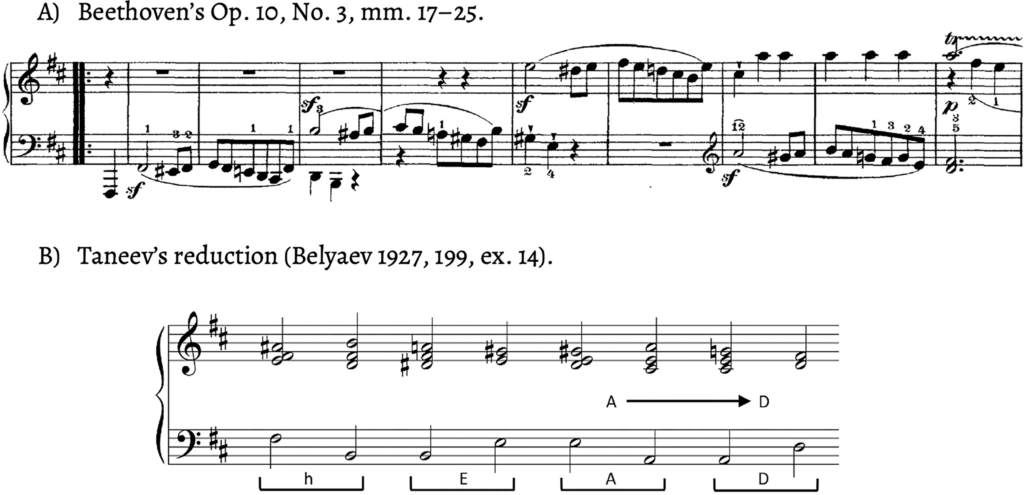
The main sources that overview Taneev’s theory of unifying tonality are Arzamanov (1984) and Carpenter (1983; 1988, 428–443). In turn, their explorations of Taneev’s theory are primarily based on his letters to Nikolai Amani and Alexi Stanchinsky (Taneev 1952, 219–249) and Viktor Belyaev’s secondhand account of Taneev’s twelve-page notebook containing his analyses of Ludwig van Beethoven’s piano sonatas (Belyaev 1927). As the name suggests, the main element of the theory is that all keys are related to a unifying tonality. In this theory, related keys are defined as being either a diatonic triad or a commonly used chromatic chord within that unifying key.6 These relationships are primarily shown through harmonic reductions. One of the clearest examples is his analysis of Beethoven’s op. 10, no. 3, III, mm. 17–25 (Example 1), which reduces the score to a four-voice chorale.7 Underneath the score, Taneev lists the tonicized keys with capital and lowercase letters to distinguish major and minor, respectively, with note names in the Germanic system (e.g., h = B minor). Each key is typically associated with two chords that are bracketed together: the first is the applied dominant and the second is the tonicized triad.8 Belyaev describes how Taneev’s analysis shows the unity amongst these keys: “[Example 1] demonstrates the dominant key playing the role of a unifying tonality. Here we have the keys of B minor, E major, and A major as representatives of II, V, and I in the key of A major, which is the dominant of the main key” (1927, 198–199). Accordingly, B minor, E major, and A major are part of a ii–V–I progression of the unifying tonality of A major (the dominant of the home key of D major).9
Example 1. Correlation of Beethoven’s op. 10, no. 3, III, mm. 17–25 to Taneev’s reduction.
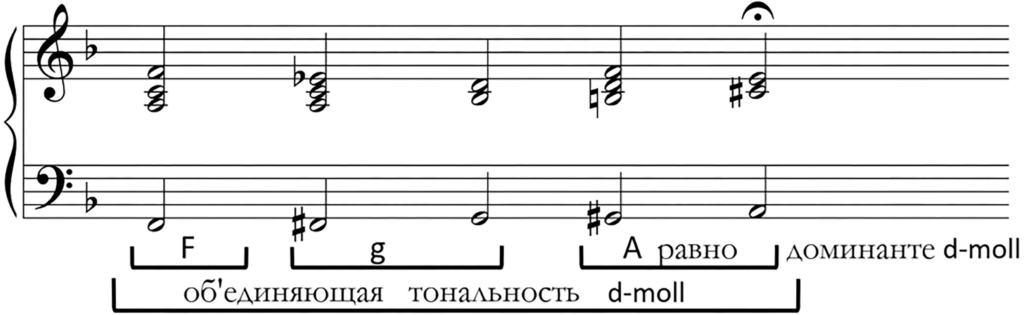
However, it is important to note that most of the keys referenced by Taneev are not what modern scholars would call modulations because they are often just resolutions of applied dominants. Looking at the previous example, B minor and E major occur within a falling fifths sequence featuring their applied dominants and fall well short of being considered strong subsidiary keys reinforced by perfect authentic cadences. Similarly, Taneev’s analysis of Beethoven’s op. 10, no. 3, II, mm. 34–43 features another example of applied chords, diminished-seventh chords in this case, resolving to major or minor triads (Example 2).10
Example 2. Taneev’s reduction of Beethoven’s op. 10, no. 3, II, mm. 34–43 (Belyaev 1927, 198, ex. 13).
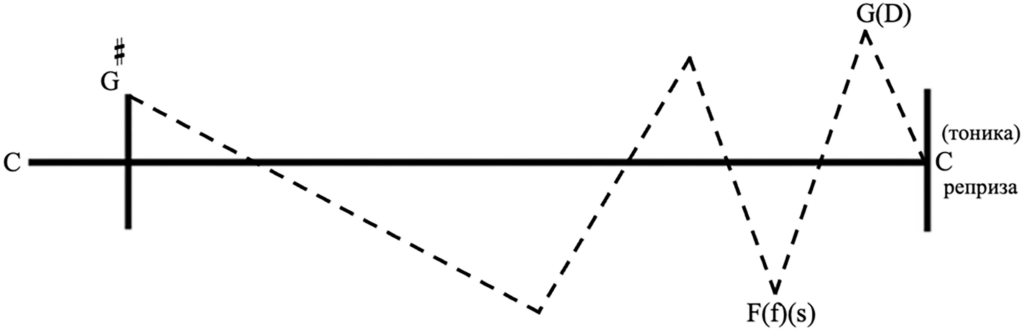
The second type of example Taneev employs is a line graph, which underscores that a modulatory plan should tonicize both subdominant- and dominant-side keys before returning to tonic. From Taneev’s archives, Arzamanov shows a graph that Taneev provided to his form students as a general outline for a modulatory plan for a development section in a C-major sonata (Example 3).11
Example 3. Taneev’s generic modulatory plan for a sonata development (Arzamanov 1984, 64).
As Arzamanov notes, Taneev displays the unifying tonality with a solid horizontal line in the middle and the progression of tonicizations with a dashed line. The vertical placement of the given tonicizations roughly aligns with their associated key signatures—with relatively sharp-/dominant-side tonalities placed higher and flat-/subdominant-side tonalities placed lower.12 Although the middle keys are unannotated, Taneev specifies the three major functions at the end with (s), (D), and (tonika) and maps those designations on to their associated keys of F major and F minor, G major, and C major.
Accordingly, this graph appears to employ Riemann-like T, D, and S symbols to refer to chords with their corresponding functions and illustrates the importance of tonicizing subdominant- and dominant-function keys before proceeding to tonic. This resonance with functional analysis is supported by Carpenter, who notes,
Taneev clearly depicts the interaction between the dominant and subdominant “spheres” in the development section, which culminates in their juxtaposition and the aspiration towards tonic. Taneev’s “dualistic” approach may be related to similar approaches by Hauptmann and Riemann. (1988, 442)
More importantly, Taneev himself highlights the importance of tonic, dominant, and subdominant function in modulatory plans in his letter to Stanchinsky, writing,
The prepared tonality acquires the greatest stability when it is surrounded by keys on both sides: the side of the subdominant and the side of the dominant, just as in a sequence of chords where the central (tonic) chord is a triad that is preceded by its subdominant and dominant. In this case, the prepared tonality serves the goal of the preceding movement of the harmony. [. . .] All these harmonic functions (funktsii garmonii) introduce life, unity, organic coherence, and meaning into a composition and are inseparably connected with the tonal system and cease to operate in its absence. (Taneev 1952, 246)
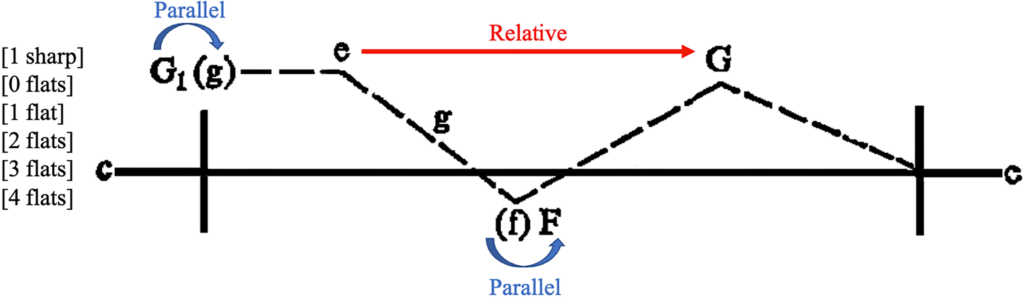
Furthermore, I suggest that Taneev’s line graphs consistently highlight Riemann-like functional equivalencies through parallel and relative relationships. Taneev consistently refers to parallel relationships as odnoimennogo (i.e., of the same name) and relative relationships as the German cognate parallelnogo throughout both his letters to Amani and Stanchinsky (Taneev 1952, 219–249) and the footnotes of his Beethoven analyses relayed by Belyaev (1927). Looking at the previous line graph (Example 3), Taneev equates the parallel subdominant keys of F major and F minor even though their different key signatures would suggest different placements on the line graph. Accordingly, parallel keys are also placed on the same plane in his other line graphs, such as in his analysis of the development section in Beethoven, op. 13, I (Example 4).
Example 4. Taneev’s line graph of Beethoven’s op. 13, I, with added Riemannian relationships in color (Arzamanov 1984, 65).
Taneev also places the relative keys of E minor and G major on the same plane in the dominant sphere, which suggests that they both serve dominant function. In fact, in his letter to Stanchinsky, Taneev explicitly states that E minor is able to serve as a dominant in the key of C major because of its relative relationship to G major (Taneev 1952, 247). In this letter, Taneev comments on the tonicizations in Stanchinsky’s Fugue no. 1:
In this instance, the first harmony [i.e., E minor] is on the dominant side (relative to G major), whereas the other three belong to the subdominant group. (1952, 247)
My research also finds that Taneev’s requirement for tonicizations of both subdominant and dominant seen in the line graphs carry over to Taneev’s harmonic reductions. Looking back, there are tonicizations of both subdominant and dominant keys in both of the previous reductions (Examples 1 and 2) and in Taneev’s analysis of Stanchisky’s fugue. In total, roughly 68% of Taneev’s reductions seen in Belyaev (1927) and Arzamanov (1984, 61) feature tonicizations of both subdominant and dominant keys (Table 1). In the table below, I show all the keys tonicized in Taneev’s examples from Belyaev and Arzamanov as roman numerals and indicate whether the example features both subdominant and dominant keys. I treat VI in minor as a subdominant and iii in major as a dominant because of their respectively flat and sharp key signatures. This practice follows Carpenter (1988, 442) who states that the line graphs depict flat and sharp keys as existing in subdominant and dominant zones, respectively.
Major Excerpts
Minor Excerpts
Ex.
Key
RNs
S&D?
Ex.
Key
RNs
S&D?
2)
A
V IV I
Yes
1)
Fm
III i VI iv V
Yes
4)
A
I $$\flat$$VI I
No
3)
Am
III i v V
No
5)
A
IV $$\flat$$II V I
Yes
6)
Cm
VI V
Yes
10)
E$$\flat$$
v IV iv
Yes
7)
Am
III iv V
Yes
14)
A
ii V I IV
Yes
8)
Cm
iv VI i V iv i V
Yes
16)
D
I IV vi $$\flat$$VI V
Yes
9)
Cm
iv V
Yes
19)
E
I IV $$\flat$$II I
No
11)
Cm
III iv i
No
20)
C
ii iii
Yes
12)
Am
iv III i
No
21)
E$$\flat$$
I ii
No
13)
Dm
III iv V
Yes
15)
Dm
VI iv $$\flat$$II III V
Yes
17)
Dm
iv VI $$\flat$$II I
No
18)
A$$\flat$$m
i VI V
Yes
*
Gm
VI iv i V
Yes
Table 1. Key relationships in Taneev’s twelve-page notebook on modulatory plans (Belyaev 1927) with an additional example (*) from Arzamanov (1984, 61).13
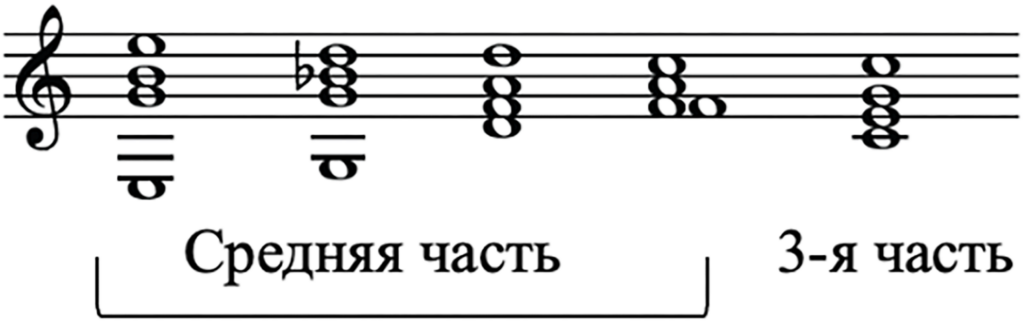
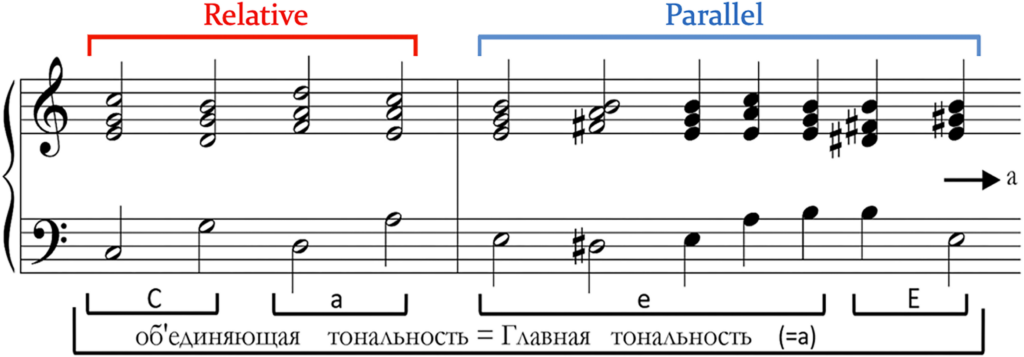
If tonicizing both subdominant- and dominant-function harmonies is a significant element in most reductions, what is the significance of the other 32% of the reductions? I suggest these remaining reductions may be meant to illustrate the importance of function-preseving relationships because they all feature relative, parallel, and leittonweschel key relationships, save for example 21 (from Table 1).14 For instance, Taneev’s analysis of Beethoven’s op. 2, no. 2, IV, mm. 66–74 does not feature a clear subdominant-function chord but features consecutive relative and parallel relationships (Example 5).15
Example 5. Taneev’s reduction of Beethoven’s op. 2, no. 2, IV, mm. 66–74 (Belyaev 1927, 195, ex. 3) with annotations by the author in color.
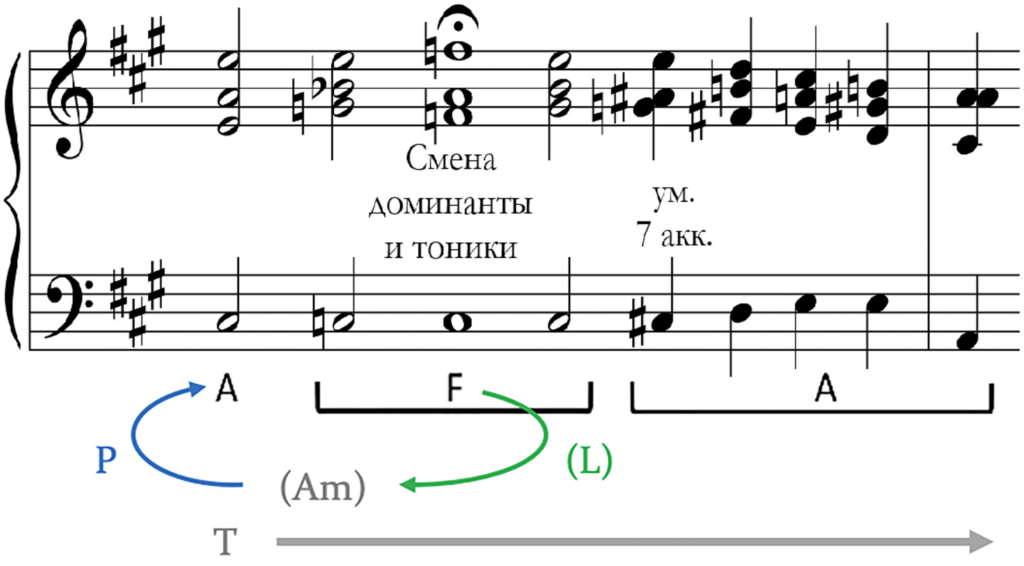
In another example, Taneev refers to the substitution of F major for A minor in his analysis of op. 2, no. 2, IV, mm. 139–148 (Example 6)—which suggests a leittonwechsel relationship.16 Belyaev relays a footnote by Taneev which states, “Taneev explained this as a relationship of the latter harmony (F major) with A minor, the parallel of the main tonality” (Belyaev 1927, 195). Accordingly, F major is related to A minor via a leittonwechsel. Because this excerpt does not actually feature the A-minor tonicization mentioned by Taneev, it appears that he is suggesting an elided leittonwechsel-parallel relationship, in which the leittonwechsel relates F major to the elided A minor and the parallel relationship relates the elided A minor back to the main tonic of A major.
Example 6. Taneev’s reduction of Beethoven’s op. 2, no. 2, IV, mm. 139–148 with added Riemannian annotations in color (Belyaev 1927, 195, ex. 4).
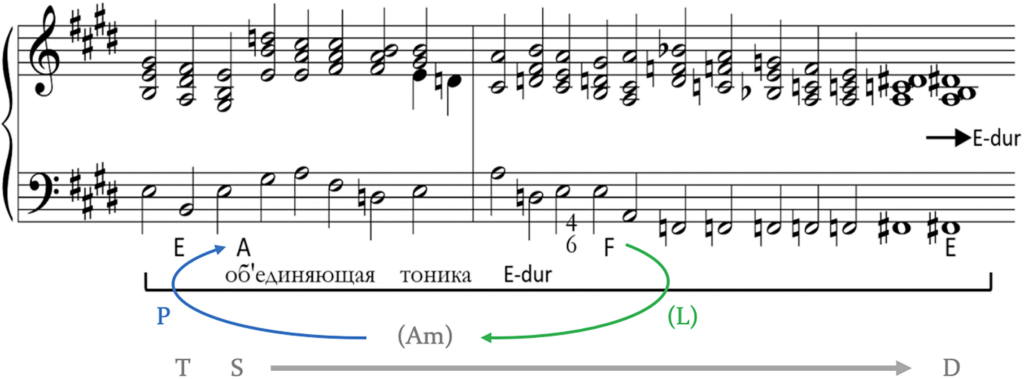
This A major–(A minor)–F major relationship is replicated in a later example (Belyaev 1927, 200–201) except in this case the progression relates subdominant-function chords (i.e., IV–(iv)–$$\flat$$II). Belyaev writes, “In Example [7], the minor subdominant (A minor) is replaced by VI, the key of F major.”17 As in Example 7, there is no A-minor chord despite Taneev mentioning a minor subdominant in this E-major excerpt. Accordingly, this suggests another elided leittonwechsel-parallel relationship.
Example 7. Taneev’s reduction of Beethoven’s op. 14, no. 1, III, mm. 88–107 with added Riemannian annotations in color (Belyaev 1927, 200 ex. 19).
In closing, Arzamanov and Carpenter are correct in noting that some aspects of Taneev’s theory of unifying tonality correlate with Riemannian relationships. My research builds on Carpenter’s claim that Taneev’s line graphs depict Riemann-/Hauptmann-like juxtapositions of dominant and subdominant spheres by showing quotes by Taneev that refer to the importance of surrounding tonic with subdominant and dominant keys.18 Furthermore, I demonstrated how Taneev related chords via relative, parallel, and leittonwechsel relationships by highlighting these relationships in Taneev’s line graphs and reductions.
3. Taneev’s Relationship to Rimsky and Riemann
Naturally, showing that some of Taneev’s key relationships are Riemann-like is far from establishing that Taneev knew of Riemann’s theories and was implementing them in his analyses. However, it does invite an exploration into any connection between Taneev and the early figures within the Russian Riemannian tradition. In Taneev’s case, he has strong connections to both Rimsky and Riemann. In this section, I will first establish Taneev’s connection to Rimsky by showing that Taneev’s teaching departed from Tchaikovsky to emulate Rimsky’s dualistic focus on I, IV, and V and that Rimsky and Taneev discussed the latter’s theory of modulatory plans. Next, I will show that Taneev read, studied, and taught Riemannian functional analysis and that Taneev’s theory more closely corresponds to Riemann’s writings than to the theories of Rimsky or other theorists used by Taneev at the conservatory (Tchaikovsky 1900; Bussler 1884; Prout 1896). The goal of this exploration is not to pinpoint exactly when Taneev shifted away from Tchaikovsky, when he may have emulated Rimsky’s pedagogy, or when he incorporated Riemannian analysis. Instead, I intend to alter the current perspective that Rimsky’s proto-functional theory prepared Russians for Catoire’s much later adaptation of Riemann’s theory of harmonic function by making a more direct claim that the Rimsky prepared Taneev (and his students) for the acceptance of harmonic function through his writings and pedagogical conversations with Taneev. Then, I show that Taneev started reading Riemann’s functional theories and incorporating elements from Riemann’s theories into his upper-division form class. Finally, I suggest that Taneev’s initial teaching of harmonic function and long friendship with Catoire paved the way for Catoire’s full embrace of Riemann’s harmonic theories in his textbook. Accordingly, I suggest that Taneev serves as a likely intermediary between Rimsky’s proto-functional aspects and Catoire’s adoption of Riemann that is overlooked by the vast majority of Western and Russian scholarship.
3.1 Rimsky
Taneev was well aware of Rimsky’s teaching, given that they discussed pedagogy and curriculum over letters, they shared pedagogical materials, and Taneev visited the St. Petersburg Conservatory to oversee exams. Rimsky’s and Taneev’s tenures at their respective conservatories largely overlapped, with Rimsky starting at the St. Petersburg Conservatory in 1871 and Taneev starting in Moscow in 1878; both ended their tenures in 1905 with each writing a letter of support regarding the other’s departure (Taneev 1952, 47, 524).19 In addition to multiple personal letters and mutual piece dedications, Taneev and Rimsky often discussed pedagogy (Taneev 1952, 28–50). In fact, Taneev’s archives show that he possessed and annotated Rimsky’s “Program for the Theory of Composition” for the St. Petersburg Conservatory (Korabel’nikova 1974, 104), and Taneev’s diaries show that he purchased Rimsky’s Textbook of Harmony for his students (Taneev 1982, 168, 8 May 1900).20 Furthermore, Taneev would have witnessed the teaching at the St. Petersburg Conservatory firsthand when he helped oversee exams there in 1898 (Taneev 1952, 37–38). During this trip, Taneev documents that he discussed his modulatory theory with Rimsky at length on 27 April 1898, writing,
I went to Nikolai Andreevich [Rimsky-Korsakov]’s house. [. . .] We talked all evening about forms, modulations, and developments. I showed him my modulatory plans of Beethoven’s sonatas. (1981, 212)
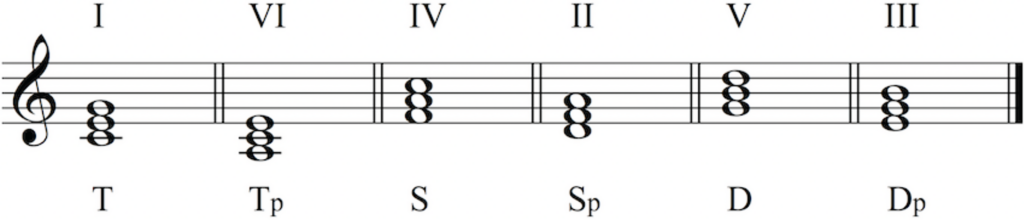
So, what were the proto-Riemannian elements that Taneev would have seen in Rimsky that deviated from prior Russian pedagogy? Rimsky’s textbook contains two claims that are related to functional harmony: (1) I, IV, and V generate the major scale and (2) vi, ii, and iii are tonic, subdominant, and dominant chords, respectively, based on relative relationships. Rimsky’s first claim that I, IV, and V create the major scale (Rimsky [1885] 2014, 15) can be seen as a clear departure from previous Russian music theory because it drew the ire of Tchaikovsky. When editing Rimsky’s textbook, Tchaikovsky wrote, “This does not explain anything, since the entire scale is also contained in the II, V, and VI chords” (Tchaikovsky 1957, 232–233). As Ewell (2020a, 64) notes, Rimsky’s idea that I, IV, and V generate the major scale is a bedrock principle of function theory (cf. Harrison 2004, 11). Although Tchaikovsky’s textbook similarly notes that I, IV, and V contain all the notes of the major scale, he gives I, IV, and V special stature based on different criteria: (1) they are the only major triads in the major scale and (2) their keys are close to each other on the circle of fifths (1990, 11). Regarding functional groups, Ewell shows how Rimsky set chords into functional tonic, subdominant, and dominant groups according to their common tones and relative-key relationships (Example 8).
Example 8. Ewell’s depiction of Rimsky’s functional relationships between I and VI, IV and II, and V and III (Ewell 2020a, 66).
Despite Taneev’s continued use of Tchaikovsky’s textbook (Starostin 2013, 17), Taneev emulated these two functional elements from Rimsky by (1) initially restricting students to I, IV, and V in his teaching and (2) considering vi, ii, and iii to have tonic, subdominant, and dominant function, respectively. Starostin conveys that Taneev’s focus on I, IV, and V clearly departed from Tchaikovsky’s teaching, writing,
As a student of Tchaikovsky, Taneev was guided by the principles of his harmony textbook, but in his practical teaching he adhered to his own principles. Thus, the initial stage of harmony training under Taneev was associated with mastering the functional triads T–D–S—in contrast to Tchaikovsky, who accustomed his students to the full range of diatonic triads.21 (Starostin 2018, 188)
This focus on the main functional triads is supported by Taneev’s student Yavorsky, who claims that Taneev prioritized I, IV, and V and considered vi as a tonic and iii as a dominant, writing,
According to Taneev’s concepts, tonality was defined by a clear juxtaposition of the first, fourth, and fifth degrees in all their triad and seventh-chord forms. [. . .] The sixth degree was freely tolerated as an interruption after the dominant or as an extension of the progression from the tonic to the subdominant; the third degree was tolerated in its dominant position before the tonic.22 (Yavorsky 1987, 269)
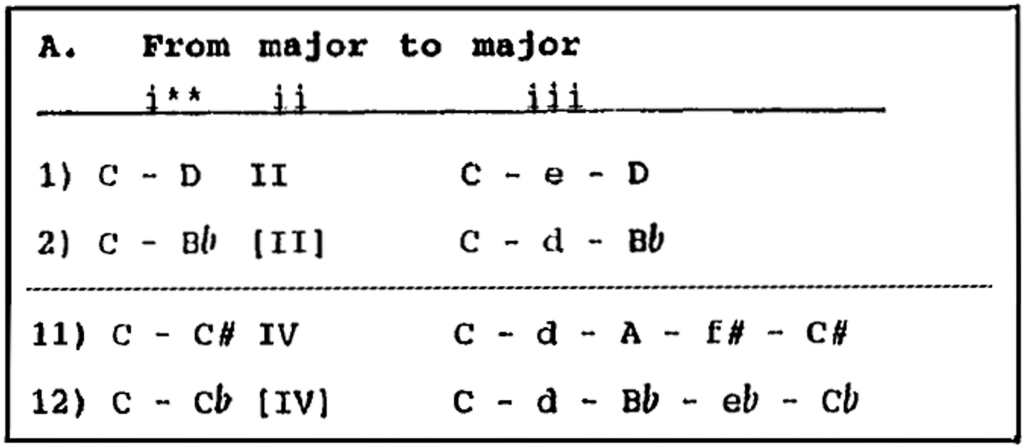
Naturally, there are also instances where Taneev’s theory departs from Rimsky. Most notably, even though Taneev and Rimsky specifically met to discuss Taneev’s modulatory plans of Beethoven (Taneev 1981, 212), they have distinctly different theories of key relationships. The main point of intersection between Rimsky’s and Taneev’s theories of modulatory plans is that they sought to avoid abrupt modulations. However, Rimsky is more focused on smooth paths between keys, whereas Taneev is more focused on each key’s relationship to the unifying key. As shown by Larisa Jackson (1996, 48–97), Rimsky states that modulations should only occur between closely related keys—specifically his notion of first-degree key relationships. For Rimsky, a first-degree key relationship is a major or minor triadic subset of the presiding scale—which includes the chromatic minor subdominant and the major dominant from Rimsky’s harmonic major and minor scales, respectively. Therefore, to get to more distantly related keys, one must develop a modulatory plan that traverses a series of closely related keys. Shown below, Rimsky’s first example of a more distant modulation features increasingly sharp keys, followed by a second one featuring increasingly flat keys (Example 9). The last two examples feature significantly more extended series of modulations incorporating the major dominant in minor (#11: D minor to A major) and the minor subdominant in major (#12: B$$\flat$$ major to E$$\flat$$ minor).
Example 9. Selected modulatory plans between major keys from Rimsky’s Prakticheskii Uchebnik according to Jackson (1996, 69).
In this respect, Rimsky’s modulatory plans are like nautical maps, in which one ventures to more distant realms through a series of intermediary destinations. In contrast, Taneev’s theory promotes modulations that are all related to a unifying key by being diatonic chords or commonly used chromatic chords within that unifying key.23 Taneev’s insistence that keys be related to the unifying tonality not only set his theory apart from Rimsky but most of the theorists Taneev referenced at the Moscow Conservatory (e.g., Tchaikovsky 1900; Bussler 1884; Prout 1896; see Yavorsky 1987, 258–259), who all allowed for modulations a tritone away.24
In summary, there are two functional aspects in Rimsky’s theory that correlate with documented aspects of Taneev’s teaching: (1) focusing on I, IV, and V in a way that contrasts with Tchaikovsky and (2) assigning different chords into tonic, subdominant, and dominant groups. However, there is also clear evidence that Taneev’s theory employed functional elements that go beyond Rimsky’s proto-functional theory. Kaja Lill isolates two aspects of Riemann’s theory of harmonic function that can be used to compare Rimsky’s and Taneev’s theories: (1) assigning chords function based on pitch-class content and (2) assigning chords a particular location in a harmonic progression (Lill 2024, 9).25 In regard to the first element, Rimsky only assigns harmonies into function groups based on relative relationships. In contrast, Taneev’s theory of modulatory plans also relates harmonies by parallel and leittonwechsel relationships (Examples 5, 6, and 7). Regarding the second element, Rimsky does not claim that passages must feature subdominant and dominant harmony for cadences. Instead, Rimsky’s discussion of cadences primarily focuses on the final two chords in a phrase ([1885] 2014, 33–56). In contrast, Taneev constantly emphasizes the importance of featuring both subdominant and dominant keys in his modulatory plans—particularly in his line graph examples. Looking beyond function, Taneev also deviates from Rimsky in terms of modulation (despite both discussing their similarly named modulatory plans) by requiring all keys to be closely related to a unifying tonality.
3.2 Riemann
I suggest that Taneev’s use of extended common-tone relationships, his insistence on subdominant- and dominant-function tonicizations, and his view of key relationships reflect his broad study of Riemann’s theoretical works—particularly Systematic Theory of Modulation (Riemann 1898, trans. Engel). To support this claim, I will establish that Taneev had access to many of Riemann’s writings and that he studied and taught Riemann’s harmonic theories. I will then show that Taneev’s key relationships closely resemble the modulation tables in Riemann’s Systematic Theory of Modulation (1898), that Taneev had access to this work at the onset of his theory of unifying tonality, and that both Riemann and Taneev rationalize their key relationships by referencing functional harmonic progressions (i.e., cadences). Finally, I will explore the other theorists Taneev references at the Moscow Conservatory to see how their key relationships compare with Taneev’s related keys.
As shown in his diaries, Taneev possessed many of Riemann’s writings and he even attended meetings dedicated to discussing Riemann’s harmonic theories. According to the editor of Taneev’s diaries (Korabel’nikova in Taneev 1981, 1982, 1985), Taneev possessed over twenty of Riemann’s books (Taneev 1982, 286n175, 24 November 1901).26 Although these books are never listed in their entirety, the diaries do mention Taneev studying Riemann’s Lehrbuch des einfachen, doppelten und imitierenden Kontrapunkts (1888), Katechismus der Fugenkomposition (1890a), Katechismus der Harmonielehre (1890b), and Musik-Lexicon (1882).27 Furthermore, Taneev’s diaries reveal that he attended multiple meetings on Riemann’s harmonic system in 1903 led by his former student Engel (1985, 89, 101) who translated Riemann’s Vereinfachte Harmonielehre in late 1901 and Riemann’s Systematic Theory of Modulation in 1898. The latter text seems important within Taneev’s sphere of influence because it was not only translated by Engel, but also by another of Taneev’s students, Yavorsky, in 1899 (Ewell 2019, [9.4]).28
In his “Reminiscences of Sergei Ivanovich Taneev,” Yavorsky confirms that Taneev taught from Riemann’s textbooks in his form class and that Taneev accepted Riemann’s inversional conception of minor (1987, 241–348).29 First, Yavorsky establishes that Taneev used textbooks by Riemann (amongst others) in some of his classes, writing,
These same considerations guided [Taneev] in his selection of textbooks. He settled on the works of Bussler and Bellermann, as well as those of Riemann and Prout, which had already appeared during his teaching career and sought to blaze new trails in the area of constructive foundations of musical thought. He did not use the textbooks of A. B. Marx, Lobe, Jadassohn, Richter, and other theorists, widely known in Western Europe, although he knew them well.30 (Yavorsky 1987, 258–259)
Yavorsky then goes on to clarify that these authors were used in Taneev’s counterpoint and form classes and relays Taneev’s appraisals of each author. At first, Yavorsky establishes that Taneev preferred some theoretical aspects from Ludwig Bussler and Ebenezer Prout over Riemann because Riemann attempted to subject counterpoint and nineteenth-century harmony to an underlying diatonic framework:31
When selecting textbooks on strict and free styles and forms, [Taneev] settled upon the works of Bussler, as they afforded the greatest freedom of thought; in the strict style, they rejected the formulaic rigidity of “white-key” major tonality, whereas in the free style, they gravitated toward Bach-style voice leading. Subsequently, for these very same reasons, he preferred the textbooks of Prout to the works of Riemann—who sought to subject the strict style, the fugue, and the music of the nineteenth century alike to a rationalistic “diatonic” formula and claimed the primacy of meter over rhythm.32 (Yavorsky 1987, 251)
However, this criticism of Riemann is immediately followed by Taneev’s praise for other (unnamed) aspects of Riemann’s theories:
Despite this rejection of these fundamental principles of Riemann’s musical thinking, there coexisted in Taneev an exceptional acknowledgment of the scholarly value of Riemann’s works. In this regard, in Taneev’s estimation, Prout could not compete with Riemann. (Yavorsky 1987, 251)
Because the earlier quote primarily focused on counterpoint, fugue, rhythm, and meter,33 I suggest the latter part of this quote refers to Riemann’s other theoretical contributions—namely his theories of modulation, form, function, and dualistic harmony. In fact, Taneev’s approval of some of Riemann’s dualistic ideas is relayed in a later quote by Yavorksy, who writes, “[Taneev] accepted Riemann’s interpretation of the minor scale as an inversion of the major scale and in other difficult situations relied on it” (1987, 269–270).
Although Vereinfachte Harmonielehre is arguably Riemann’s most influential harmonic text for music theory in general, I suggest Riemann’s Systematic Theory of Modulation was the most influential text for Taneev’s theory of unifying tonality for two reasons: (1) its earlier translation aligns with the onset of his theory of unifying tonality, and (2) its subject matter aligns with Taneev’s upper-division form class in which Taneev’s theory of unifying tonality was taught. As discussed earlier, Engel’s translation of Vereinfachte Harmonielehre was not published until late 1901, and Taneev only mentions studying Riemann’s harmonic theories at meetings hosted by Engel in 1903. Given Taneev’s departure from the conservatory in 1905, it leaves very little time for Riemann’s mature harmonic concepts to be incorporated into his form class (Zenkin 2022, 72). In contrast, Riemann’s Systematic Theory of Modulation was translated by Engel in 1898, which chronologically aligns with Taneev’s first mention of his analyses of modulatory plans in Beethoven sonatas with Rimsky and the beginning of Yavorsky’s time at the conservatory. This earlier text also correlates with Taneev’s distinct teaching of key relationships in his form class.34 Arzamanov specifically highlights Taneev’s focus on modulatory plans in his form class, writing,
The theory of the tonal plan—which unifies keys—was fully developed in Russia for the first time by the remarkable scholar and pedagogue S.I. Taneev. By incorporating this theory into the curriculum for musical forms, Taneev once again approached the subject in a creative and innovative manner. (Arzamanov 1984, 15)
Furthermore, Yavorsky mentions Taneev’s teaching of Riemann’s inversional conception of minor (seen in Riemann’s use of “o” notation for minor, e.g., og = C minor) and the importance of T–S–D–T progressions, which are present in this earlier text (Riemann 1898, 25). Conversely, Riemann’s Systematic Theory of Modulation does not contain some of Riemann’s most distinct functional designations seen in later Vereinfachte Harmonielehre (e.g., Tp), which correlates with the lack of this notation in Taneev’s writings. Finally, Taneev specifically advised students to study form with Riemann as they traveled abroad, writing, “I am advising [Alexander Kartsev] to study free counterpoint with Glière or [Pavel] Juon in Berlin, and then musical forms with Riemann” (1985, 317–318, 2 May 1907).35
In Systematic Theory of Modulation, Riemann creates modulation tables that are related to functional harmonic progressions (i.e., Riemann’s cadences). Riemann clearly lays out that these modulation tables are the most important aspect of this text in the conclusion of this book, writing,
I shall limit myself merely to reiterating the significance of the tables of key relationships (p. 195 et seq.) and to most emphatically draw the reader’s attention to the fact that these tables comprehensively cover everything that is musically conceivable in this regard. If a student has not yet acquired sufficient fluency in navigating all the various keys, a single glance at these tables—or at a quickly sketched chart of keys related to a chosen one—can, at times, prove of inestimable value. (1898, 227–228)
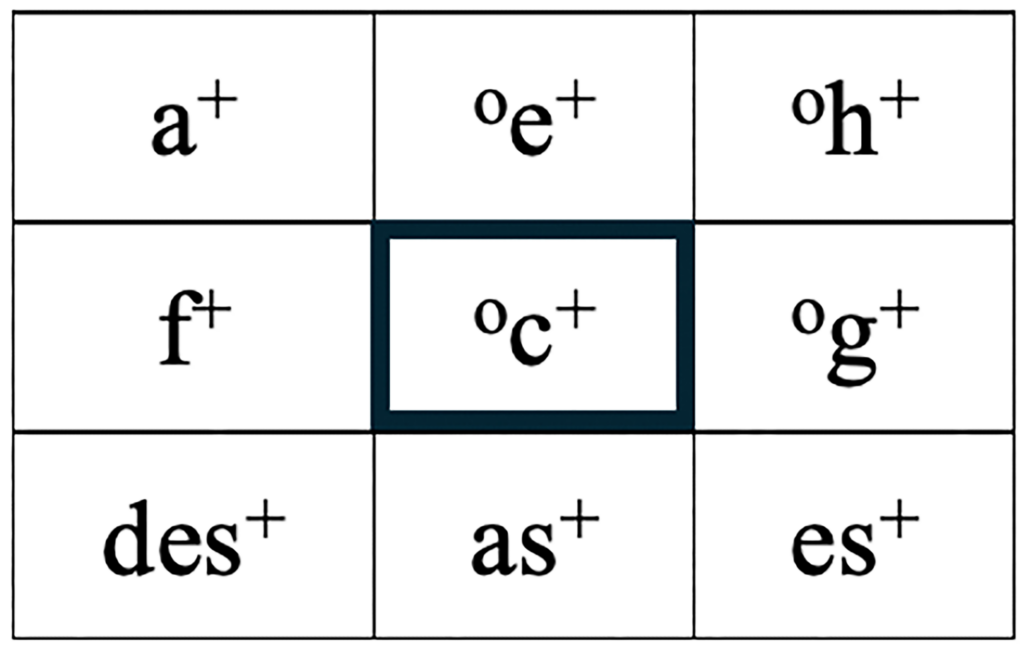
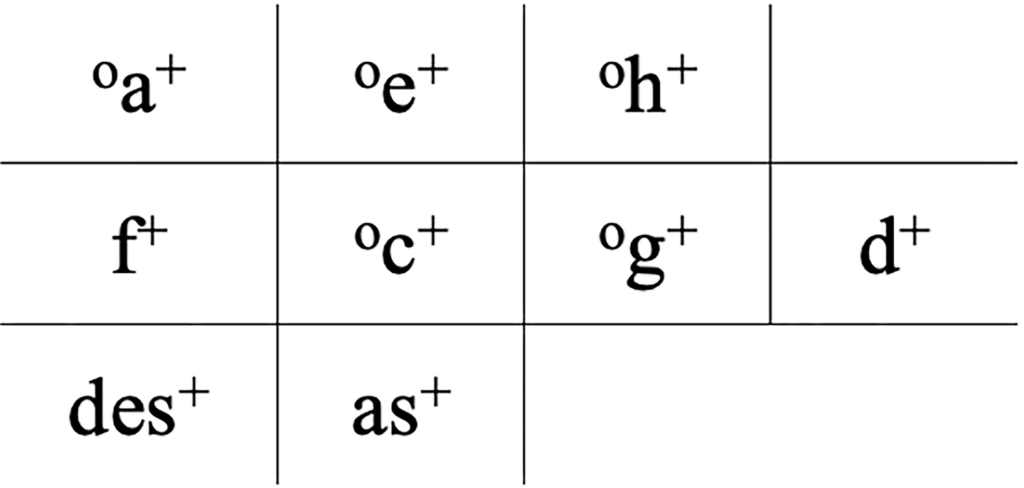
After showing Arthur von Oettingen’s Tonnetz, Riemann displays a modulation table for C major that is based on nearby tones in the Tonnetz (Table 2).
Table 2. Riemann’s modulation table for C major from Systematic Theory of Modulation (1898, 196).
In this table, C major (i.e., c+) is placed in the center with the subdominant and dominant chords of F major and G major placed on the left and right, respectively. Above and below, Riemann places major keys a major third away from the central major chords. Finally, many chords feature minor-chord-producing inversions around their (Riemannian-conceived) roots by also having the “o” symbol to the left (e.g., oc for F minor).36 After presenting this table, Riemann almost immediately shows a similar modulation table based on the extended cadence in C major, which Riemann refers to as a “somewhat different form” of the earlier modulation table (Table 3). The only differences are that this second one includes D minor and D major while excluding E$$\flat$$ major.
Table 3. Riemann’s extended cadence table from Systematic Theory of Modulation (1898, 197).
Following Lill (2024, 8–61), I suggest that the pitch-class relations of the first table correspond with the cadence-based relationships in the second table. Below, I give a table reflecting Riemann’s first modulation table with roman numerals (Table 4). The only addition is the minor supertonic (i.e., ii), which appears in Riemann’s extended cadence, in addition to being prominently featured in his later writings on modulation (e.g., Katechismus derHarmonie- und Modulationslehre [1906, 184]).
Table 4. Riemann’s keys from his modulation tables.
These keys in Riemann’s modulation tables are far closer to Taneev’s related keys than they are to the systems of key relationships seen in the other theorists Taneev referenced at the conservatory. Although Taneev never lists the entirety of his closely related keys, he did feature many key relationships in his analyses that are subsequently confirmed by Yavorsky. Table 5 shows all the tonicizations within a major key in Taneev’s analyses with their number of instances below.
Table 5. Tabulation of key relationship in Taneev’s twelve-page notebook on modulatory plans (Belyaev 1927).
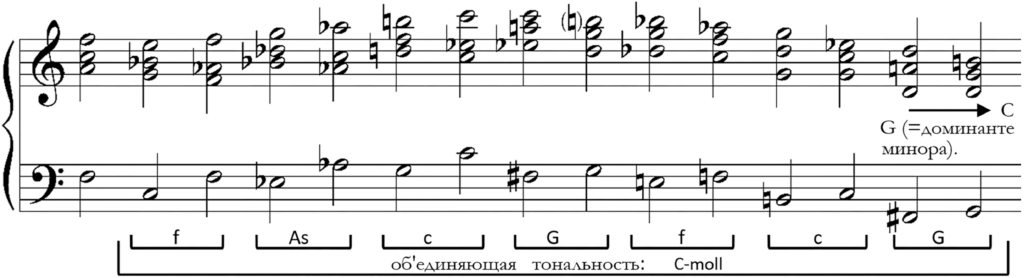
Although the parallel minor tonic is never featured as a tonicization, Taneev claims that the parallel minor tonic commonly substitutes for the main major tonality (Example 10).37 For example, Taneev’s analysis of Beethoven’s op. 2, no. 3, IV in C major shows C minor serving as the unifying tonality for mm. 143–167 (shown at the bottom of the score with “C-moll”), which is explicitly stated by Taneev according to adjoining footnote relayed by Belyaev (1927, 197). Accordingly, every tonicization in this section is diatonically related to C minor (the parallel of the main key of the movement, C major) except for the common appearance of the major dominant at the end.38
Example 10. Taneev’s reduction of Beethoven’s op. 2, no. 3, IV, mm. 143–167 (Belyaev 1927, 197, ex. 8).
From these analyses, we can produce Table 6a, a list of related keys seen in Taneev’s analyses, which closely correspond to Yavorsky’s recollection of Taneev’s related keys (Table 6b). To show how these keys relate to Riemann’s closely related keys, I have preserved the progression of chords seen in Table 4 (with missing chords denoted by “x”).
Table 6a. Modulations featured in Taneev’s analyses of Beethoven for major (Belyaev 1927).
Table 6b. Taneev’s related keys for major according to Yavorsky (1987, 269).
The only difference is that Yavorsky also adds in III and $$\flat$$III (also seen in Riemann, Table 4 above) as well as $$\sharp$$v (enharmonic parallel of $$\flat$$VI). Furthermore, Yavorsky emphasizes that “Taneev was especially fond of major on the lowered second degree (in C major: D$$\flat$$)” (Yavorsky 1987, 269). This inclusion of $$\flat$$II sets Taneev apart from every other contemporary writer he references on key relations—except Riemann. As seen below, the other writers on key relationships Taneev referenced at the Moscow Conservatory both avoid $$\flat$$II and feature far less overlap with Taneev than Taneev does with Riemann (Table 7).39
Table 7a. Tchaikovsky’s and Prout’s related and nearly related keys for major (Tchaikovsky 1900, 11; Prout 1896, 38).
Table 7b. Rimsky’s first-degree relations for major ([1885] 2014, 69).
Having discussed Rimsky’s key relationships earlier, I will only discuss the nature of Tchaikovsky’s and Prout’s key relationships here. Although Tchaikovsky spends most of his time discussing closely related triads, he does mention that the “normal course” for modulations was based on the circle of fifths (1900, 68), which I realize as the keys a perfect fifth above and below tonic and their relative keys.40 Prout alternatively bases his key relationships on intervallic relationships in which IV and V are closest because “their tonics form perfect consonances with [I],” whereas vi, ii, and iii are nearly related because they are relative keys of I, IV, and V (1896, 38).41
Not only do Taneev’s key relations closely match those in Riemann’s modulation tables, but both figures also similarly assign these keys subdominant, tonic, and dominant function. Because of their key signatures, Taneev’s theory would designate the diatonic keys of IV and ii as subdominant, I and vi as tonic, and V and iii as dominant. Similarly, Riemann assigns F major and D minor as subdominant, C major and A minor as tonic, and G major and E minor as dominant in his modulation table and extended cadence for C major (Tables 2 and 3).42 This correlation continues to their functional designations of chromatic keys. As seen in Examples 6 and 7, Taneev shows examples where major triads can be substituted with major triads a major third below—specifically F major in A major.43 Tonic is substituted with $$\flat$$VI in Example 6, whereas subdominant is substituted with $$\flat$$II in Example 7. Similarly, Table 2 shows that Riemann places $$\flat$$VI and $$\flat$$II respectively in the tonic and subdominant columns of his modulation table for C major (i.e., as+ and des+). The only functional deviation between Riemann’s modulation table and Taneev’s analyses is that Riemann’s table shows F minor and C minor (i.e., oc and og) as being in the tonic and dominant columns, whereas Taneev’s examples would assign these chords subdominant and tonic function because of their parallel relationship (cf. Examples 3 and 4).44
Looking at broader theoretical relationships, both figures similarly correlate key relationships with functional chord progressions (i.e., cadences). In his letter to Amani, Taneev states that the key relationships for C major are based on “cadences” (i.e., functional cadential progressions), writing,
In other words, what brings connection to the keys to which we modulate? Just as a key brings connection and unity to a series of chords belonging to it, so can a series of keys can be united by a key of a higher order. Let us call such a key a unifying tonality.
For example, in a cadence in C major, if we make modulations in a key corresponding to its individual chords, then these keys will preserve the same connection among themselves as the chords of the cadence had, and their unifying tonality will be C major. (Taneev 1952, 226)
This resembles Riemann’s connection of the keys related within his modulation table (Table 2) to the chords within the extended cadence in C major (Table 3). In addition, Taneev similarly uses the term “cadence” to refer to an extended harmonic progression, rather than a two-chord closing harmonic formula. This contrasts with Tchaikovsky, who typically refers to “cadence” as a two-chord closing formula, although Tchaikovsky also refers to a prototypically four-chord “extended cadence” (rasprostranennoy kadentsiyey) that also goes tonic–subdominant–dominant–tonic (1900, 57).
Furthermore, this interrelation of functional cadential progressions and modulation can be seen in both Taneev’s and Riemann’s views on form. As mentioned earlier, Taneev taught his theory of unifying tonality in his upper-division form class (Zenkin 2022, 72). Accordingly, each of Taneev’s line graphs depicts a development section in a Beethoven sonata ending with a S–D–T progression of keys (Examples 3 and 4; see more line graphs in Arzamanov 1984, 65). Similarly, Riemann connected modulations and functional cadential progressions with form. The connection of modulation and form is given in the full title of his work: Systematic Theory of Modulation as the Basis of a Theory of Musical Forms (1898). Early in the text, Riemann identifies the two factors that combine to create form: “These two factors—the harmonic construction of cadences and rhythmic symmetry—together constitute what is known in music as ‘form’” (Riemann 1898, 8). Despite mentioning rhythmic symmetry, however, Riemann primarily focuses on the formation of cadences (i.e., T–S–D–T; chap. 1–3) and modulation techniques (chap. 4–7) with only one subsection devoted to rhythm (sec. 19). Accordingly, Riemann almost exclusively discusses the harmonic construction of phrases (i.e., microform) and key relationships—thus avoiding any meaningful discussion of small or large forms. Similarly, all of Taneev’s harmonic reductions focus on the harmonic relationship between keys in phrases.
Conclusion
Despite the widespread consensus that Russian functional theory flowed from Rimsky’s proto-functional theories to a full embrace of Riemannian functional analysis by Catoire, I showed that Taneev was teaching elements of functional harmony at the Moscow Conservatory decades before Catoire and that he was well aquainted with the writings of both Rimsky and Riemann. To show this, I first built on the observations of Arzamanov (1984) and Carpenter (1983, 1988) that highlight Riemann-like juxtapostions of subdominant and dominant harmonies and function-preserving key relationships in Taneev’s theory of unifying tonality. Next, I showed how Taneev’s theory connects to the proto-functional aspects of Rimsky’s writings by showing that Taneev frequently discussed pedagogy and curriculum with Rimsky and emulated his focus on I, IV, and V in a distinct departure from Tchaikovsky. Finally, I showed that Taneev read Riemann’s functional writings and taught Riemann’s functional ideas in his classes, and I isolated correspondences between Taneev’s theory of unifying tonality and Riemann’s Systematic Theory of Modulation involving both content and theoretical reasoning. These new findings partially came from referencing two sources that are not often discussed in the literature: (1) Taneev’s diaries, which show that Taneev possessed and studied Riemann’s harmonic theories, and (2) Yavorsky’s “Reminiscences of Sergei Ivanovich Taneev,” which states that Taneev taught Riemann’s theories and that Taneev accepted some of Riemann’s harmonic ideas.
Accordingly, I show how Taneev can be seen as an important figure between the proto-functional elements of Rimsky and Catoire’s later adoption of Riemann. Following Carpenter (1988, 577), I find that Rimsky opened Russians up to the idea of functional relationships which were subsequently implemented by Catoire through his adoption of Riemann. My research simply adds that Taneev served as an important intermediary between these two figures by being the first to introduce Riemann’s functional ideas into the Moscow Conservatory. Noting Taneev’s role in introducing Riemann to the Moscow Conservatory does little to diminish Catoire’s significance because Taneev’s use of Riemann appears to be more limited and less focused than Catoire’s. That is, Taneev referenced a wide variety of well-known scholars throughout Europe and Russia, including Tchaikovsky, Rimsky, François-Joseph Fétis, Prout, Bussler, Heinrich Bellermann, A.B. Marx, Johann Lobe, Salomon Jadassohn, Ernst Richter, and others—including Riemann. In contrast, Catoire served an important role in elevating Riemannian functional analysis by primarily focusing on adapting Riemann’s functional ideas. In short, Taneev was more focused on combining Riemann’s ideas with other contemporary theories (including his own) than prioritizing Riemannian functional analysis.
I hope this research spurs further study into Taneev’s theory and its impact on his students. As mentioned by Arzamanov, the Tchaikovsky State Memorial Music Museum in Klin contains many additional line graphs made by Taneev that may shed new light on his theory (Arzamanov 1984, 65). In addition, many famous composers who studied with Taneev have not been examined through his theory of unifying tonality, including Scriabin, Rachmaninoff, Nikolai Medtner, and Glière. In particular, Scriabin would be an ideal case study because it is already documented that he applied Taneev’s theory to his personal study of Beethoven’s sonatas (Belyaev 1927, 203).
In closing, the arrival of Riemannian functional theory in Russia is consistently viewed as one of the most significant moments in Russian music theory (Boyarkina 2017; Carpenter 1983; Ewell 2020a; Starostin 2010, 2013). Despite previous scholars stating that Riemann’s ideas were not prevalent until Catoire’s Riemann-based textbook in 1924, I have suggested that aspects of Riemann’s theory were present over twenty years earlier through the teaching of Taneev. This raises multiple questions regarding what happened during this over twenty-year gap between Taneev’s teaching of Riemann and Catoire’s textbook. Did Riemann’s ideas impact the theories of Taneev’s theory students such as Yavorsky? Did Taneev’s use of Riemann in the teaching of form continue after he left the conservatory in 1905? Did Taneev and Catoire’s constant meetings—which lasted from the onset of Taneev’s theory of unifying tonality until Taneev’s death—impact Taneev’s teaching or Catoire’s later adoption of Riemann?45 These questions must wait for another study. What is clear is that Taneev’s impact on Russian music pedagogy goes beyond his much-discussed teaching of counterpoint. Starostin states that Taneev’s teaching elicited high praise for not only counterpoint, but for harmony and form as well (Starostin 2013, 17). This study shows that Taneev’s practice of reading a wide variety of scholars to develop novel approaches to music instruction is not limited to counterpoint. Taneev was studying and teaching the most recent theories on harmony and form from throughout Russia and Europe—introducing the momentous theories of Riemann in the process.
References
Arzamanov, Fedor Georgievich. 1984. С. И. Taneev—prepodavatel’ kursa muzykal’nykh form [Sergei Taneev: Teacher of a course on musical form]. Moscow: Muzyka.
Bakulina, Ellen. 2020. “The ‘Brigade Textbook:’ Disseminating the Riemannian Legacy in the Russian-Soviet Theoretical Tradition.” Theoria 26: 85–110.
Belyaev, Viktor. 1927. “Analiz moduliatsii v sonatakkh Betkhovena’ S. I. Taneeva” [The analysis of modulations in Beethoven’s sonatas by S. I. Taneev]. In Russkaia kniga o Betkhovne [A Russian book about Beethoven], edited by Konstantin Alekseevich Kuznetsov, 191–204. Moscow: Gosudarstvennaia akademiia khudozhestvennikh nauk.
Boyarkina, Albina. 2017. “Perevody trudov Gugo Rimana na russkiy yazyk” [Russian translations of works by Hugo Riemann]. Zhurnal Obshchestva Teorii Muzyki [Journal of the Society for Music Theory] 2 (18): 41–48.
Bussler, Ludwig. 1884. Musikalische Formenlehre. Translated by Nikolai Kashkin and Sergei Taneev. Moscow: Jurgenson.
———. 1885. Der Strenge Satz. Translated by Sergei Taneev. Moscow: Jurgenson.
Carpenter, Ellon. 1983. “The Contributions of Taneev, Catoire, Conus, Garbuzov, Mazel, and Tiulin.” In Russian Theoretical Thought in Music, edited by Gordon McQuere, 253–378. Ann Arbor, MI: UMI Research Press.
———. 1988. “The Theory of Music in Russia and the Soviet Union, ca. 1650–1952.” PhD diss., University of Pennsylvania.
Desbruslais, Simon. 2015. “The Western Reception of Sergei Taneyev.” Zhurnal Obshchestva Teorii Muzyki [Journal of the Society for Music Theory] 9 (1): 7–18.
Ewell, Philip. 2019. “On the Russian Concept of Lād, 1830-1945.” Music Theory Online 25 (4). https://www.mtosmt.org/issues/mto.19.25.4/mto.19.25.4.ewell.html.
———. 2020a. “Harmonic Functionalism in Russian Music Theory: A Primer.” Theoria 26: 61–84. https://digital.library.unt.edu/ark:/67531/metadc2237392/.
———. 2020b. “Reexamining the 1930 Conference on Boleslav Yavorsky’s Ladovy Rhythm and the Early Politics of Soviet Music Theory.” Iskusstvo muzyki: teoriya I istoriya [The art of music: Theory and history] 22/23: 214–233.
Fedorovna, Malysheva. 2017. “B. L. Yavorskiy o muzykal’nykh predpochteniyakh S. I. Taneeva” [B. L. Yavorsky on the musical preferences of S. I. Taneev]. Historical, Philosophical, Political, and Legal Sciences: Cultural Studies and Art History: Issues of Theory and Practice 8 (82): 118–120.
Fétis, François-Joseph. 2008. Traité complet de la théorie et de la pratique de l’harmonie. Translated by Peter M. Landey. Hillsdale, NY: Pendragon Press.
Harrison, Daniel. 2004. Review of Hugo Riemann and the Birth of Modern Musical Thought, by Alexander Rehding. Music Theory Online 11 (2). https://mtosmt.org/issues/mto.05.11.2/ mto.05.11.2.harrison.html.
Jackson, Larisa. 1996. “Modulation and Tonal Space in the Practical Manual of Harmony: Rimsky-Korsakov’s Harmonic Theory and Its Historical Antecedents.” PhD diss., Columbia University.
Korabel’nikova, Lyudmila. 1974. S.I. Taneev v Mosckovskoy Konservatorii [S.I. Taneev at the Moscow Conservatory]. Moscow: Muzyka.
Lill, Kaja. 2024. “Harmonic Function: Hugo Riemann and his Czech Reception.” PhD diss., University of Michigan.
Lukina, Galima. 2020. “An Overview of Russian and English-American Studies on Sergey Taneyev’s Creative Activity.” Advances in Social Science, Education and Humanities Research 416: 277–281.
McQuere, Gordon D. 1983. “The Theories of Boleslav Yavorsky.” In Russian Theoretical Thought in Music, edited by Gordon McQuere, 109–159. Ann Arbor, MI: UMI Research Press.
Protopopov, Sergei. 1947. Pamyati Sergeya Ivanovicha Taneeva [In memory of Sergei Ivanovich Taneev]. Moscow: Myzgiz.
———. 1898. Systematische Modulationslehre als Grundlage der musikalischen Formenlehre. Translated by Yoel Engel. Moscow: Jurgenson.
———. 1906. Katechismus der Harmonie- und Modulationslehre. Leipzig: Max Hesse.
Rimsky-Korsakov, Nikolai. (1885) 2014. Uchebnik garmonii [Harmony textbook]. St. Petersburg: Planeta Muzyki.
Sabaneev, Leonid. 2003. Vospominaniya O Taneeve [Reminiscences of Taneev]. Moscow: Klassika-XXI.
Segall, Christopher. 2014. “Sergei Taneev’s Vertical-Shifting Counterpoint: An Introduction.” Music Theory Online 20 (3). https://mtosmt.org/issues/mto.14.20.3/mto.14.20.3. segall.php.
Starostin, Ivan. 2010. “K istorii prepodavaniya muzykal’no-teoreticheskikh distsiplin v Moskovskoy konservatorii” [On the history of teaching music-theoretical disciplines at the Moscow Conservatory]. Scientific Bulletin of the Moscow Conservatory 1: 44–56.
———. 2013. “Moskovskaya shkola prepodavaniya garmonii” [The Moscow school of harmony teaching]. PhD diss., Moscow Conservatory.
———. 2018. “Nachal’nyi etap izycheniia garmonii pod rukovdstvom S. I. Taneeva” [The initial stage of harmony instruction under the guidance of S.I. Taneev]. In S.I. Taneev i A N. Skryabin. Uchitel’ i uchenik [S.I. Taneev and A.N. Scriabin: Teacher and pupil], edited by I.A. Skrortsova, N.D. Sviridovskaya, and E.E. Potyarkina, 184–194. Moscow: Chaykovskiy Moscow State Conservatoire.
Taneev, Sergei. 1952. S. I. Taneev: Materials and Documents. Moscow: Academic Sciences of the USSR.
———. 1962. Convertible Counterpoint in the Strict Style. Translated by G. Ackley Brower. Boston: Bruce Humphries.
———. 1981. Diaries. Vol. 1, 1894–1898. Edited by Lyudmila Korabel’nikova. Moscow: Muzika.
———. 1982. Diaries. Vol. 2, 1899–1902. Edited by Lyudmila Korabel’nikova. Moscow: Muzika.
———. 1985. Diaries. Vol. 3, 1903–1909. Edited by Lyudmila Korabel’nikova. Moscow: Muzika.
Tchaikovsky, Pyotr Ilyich. 1900. Guide to the Practical Study of Harmony. Translated by Eil Krall and James Liebling. Moscow: Jurgenson.
Yavorsky, Boleslav. 1987. “Vospominaniya o Sergeye Ivanoviche Taneeve” [Reminiscences of Sergei Ivanovich Taneev]. In Izbrannïye trudï [Selected works], vol. 2, part 1, compiled by Isaak S. Rabinovich, 241–348. Moscow: Sovetskiy kompozitor.
Zenkin, Kostantin. 2022. “Russian Pedagogy in Composition and Music Theory during Scriabin’s Creative Period.” In Demystifying Scriabin, edited by Kenneth Smith and Vasilis Kallis, 64–80. Suffolk, UK: Boydell Press.
Notes
Since all the dates in the letters and diaries are originally written according to the Julian calendar, I have preserved the Julian calendar throughout to ensure that dates referenced in the diaries and letters correspond to the dates they were created.
Carpenter’s comment is limited to a single sentence, and she does not discuss Riemann again for another two chapters (1988, 520).
All translations throughout the paper are my own unless they come from preexisting translations of entire works (e.g., G. Ackley Brower’s translation of Taneev’s Convertible Counterpoint in the Strict Style [Taneev 1962]).
Zenkin inadvertently cites a different Starostin article (2010), but the inclusive pages and content match Starostin’s 2018 article.
As shown by Ellen Bakulina (2020), the writers of the “Brigade” textbook are significant figures in the later standardization of Russian Riemannian analysis. Although Starostin notes a connection between the teaching of Taneev’s theory of modulatory plans and the “Brigade” textbook (2013, 14), a full examination of these links is outside the scope of this article.
I will later show how this definition reflects Riemann’s correlation of key relationships and extended cadences in his Systematic Theory of Modulation, trans. Engel (1898).
Taneev’s reduction of Beethoven’s op. 10, no. 3, III (Example 1) normalizes the bass register and largely ignores the right hand.
The only common exception is the opening chord, which is often the main key of the movement (as seen in Example 2).
The subsequent arrow to “D” refers to the last clause in Taneev’s quote that A major is the dominant of D major (Belyaev 1927, 202). Taneev’s diagrams consistently use arrows to show dominant to tonic relationships (see Belyaev 1927, exx. 5, 8, 11, 15, 16, 18, and 19.)
Translation of Russian in Example 2: “Unifying tonality is D minor,” and “A [major] equals the dominant of D minor.” Note that the use of an apostrophe instead of a hard sign (ъ) is original to Belyaev.
Translation of Russian in Example 3: “Tonic” is in parentheses above “reprise,” signaling the recapitulation following this development section.
I use the term “roughly” since these line graph are not very precise. For instance, his prototypical line graph for developments (Example 3, see Arzamanov 1984, 64) features two explicit instances of G major, but the height of the last instance is almost twice as far from the center line as the first.
For clarity, I only show the keys related to the overall unifying tonality. Three examples (Belyaev’s examples 2 and 6 and the Arzamanov example) feature Taneev’s concept of a unifying tonality of a higher order. For more on this concept, read Carpenter (1983, 269–271), Belyaev (1927, 195–196), and Arzamanov (1984, 56–62).
Belyaev explains that example 21 is Taneev’s example of a direct juxtaposition of keys without a modulation (1927, 201).
Translation of Russian in Example 5: “The unifying tonality = the main tonality (= A minor).”
Translation of Russian in Example 6: “Exchange of dominants and tonics” and “dim[inished] seventh chord.”
In fact, Taneev’s direct quote (preserved in Belyaev 1927, 202), does not even mention F major, writing, “Example [7] is an example of the juxtaposition of the major and minor subdominants.”
Taneev’s reference to the similar use of dominant and subdominant chords will be explored later on through Riemann’s similar overlap of key relationships and functional cadential progressions.
Rimsky was pushed out for his support of his students during the First Russian Revolution, whereas Taneev resigned primarily due to the firing of his colleague Georgy Conus.
For context, Taneev was working on counterpoint and harmony with a student named Kolya. After the lesson, Taneev gave the student money to buy Rimsky’s textbook and keep the change. The adjoining footnote by the editor confirms that it was Rimsky’s harmony textbook (1982, 396n94).
Although Tchaikovsky introduces I, IV, and V before vi, ii, and iii in his textbook (1900, 11), Tchaikovsky’s opposition to Rimsky’s focus on I, IV, and V reinforces Starostin’s claim that Tchaikovsky likely presented all diatonic triads together in his teaching.
Yavorsky also notes that Taneev approved of Rimsky’s complex consonance sequences (Yavorsky 1987, 269).
A notable difference between Taneev and Rimsky is how closely they consider parallel keys. Because the minor tonic is a common chromatic chord in major, Taneev considers it a closely related key (Carpenter 1983, 268). In contrast, Rimsky considers both I→i and i→I to be second-degree relationships (Jackson 1996, 69–70).
To be clear, Taneev was aware of how other theorists modulated a tritone away and an example of him showing a tritone modulation can be found in Starostin 2018, 187. However, Taneev’s theory of modulatory plans certainly did not showcase tritone modulations.
Lill also highlights voice leading, which is not a relevant element in Taneev’s theory of modulatory plans (Lill 2024, 9–10).
I am currently unable to directly confirm these contents due to travel restrictions to Russia. There appear to be no digital archives and my attempts to directly contact the managers of the archive have not received a reply.
The diary also mentions Riemann’s “Harmony” book (1982, 102, 6 November 1899), but it is not clear whether it is Skizze einer neuen Methode der Harmonielehre (1880), Handbuch der Harmonielehre (1887), or another reference to the Katechismus der Harmonielehre (1890b). Since it is dated 6 November 1899, it does not reference Engel’s translation of Vereinfachte Harmonielehre, which occurred in 1901.
Ewell notes that Yavorsky completed his translation at twenty-two years old (2019, n. 49), suggesting a date of 1899. I assume that Yavorsky never published this translation because Engel published a translation of the exact same text a year earlier.
As mentioned by Starostin (2013, 17), Taneev’s harmony classes continued to use Tchaikovsky’s harmony textbook.
An important “other theorist” would be François-Joseph Fétis, who is repeatedly mentioned by Taneev regarding his theory of unifying tonality (1952, 230–231; 1962, 19). Although Fétis’s derision of omnitonality correlates with Taneev’s theory that all keys should be related (Fétis 2008), I do not reference Fétis further because he never establishes a theory of closely related keys. For more on Fétis and Taneev, read Carpenter (1983, 266–267).
Rather than ascribing to a universal approach to music, Taneev is associated with delineating musical styles into historical time periods (Korabel’nikova 1974, 39; Starostin 2010, 48, 54; 2013, 17; Yavorsky 1987, 301).
Yavorsky’s framing suggests that Bussler’s textbook was used for the strict and free styles, whereas Prout’s and Riemann’s textbooks were used for form.
Riemann’s theories on rhythm and meter were rejected by Taneev’s close colleagues, Conus and Catoire—the latter of which was otherwise one of the most notable advocates for Riemann’s theories in Russia (Carpenter 1983, 308). Conus and Catoire are two of the most mentioned figures in Taneev’s diaries (1981, 1982, 1985). Conus has over 300 pages worth of entries, and Catoire has 135 pages worth of entries.
Beyond key relationships, Taneev’s program for his form class included the study of sentences and periods, phrase expansions and extensions, song forms, minuet and trio form, rondo form, sonata form, and cyclic forms (Arzamanov 1984, 18).
In an earlier diary entry, Taneev encourages another student (Azanchevsky) to “study theory” with Riemann while living abroad (Taneev 1985, 106, 11 January 1904).
The use of both symbols to signify two distinct chords (e.g., oc+ signifies both F minor and C major) is supported later in the text (1898, 229), in which Riemann also writes out both the minor and major chords in prose.
Translation of Russian in Example 10: “Unifying tonality: C minor,” and “G (=the dominant [of C] minor).” As Carpenter (1983, 268) notes, the parallel tonic is the most common unifying tonality outside of the main tonic.
C major returns at the beginning of the refrain in m. 181, which is shown in Taneev’s example with an arrow pointing to C major (i.e., capital “C”).
As described earlier, these figures often allowed for distant modulations up to a tritone away. Accordingly, this example shows each figure’s related keys, not which keys are allowed for modulation.
My reading reflects Tchaikovsky’s opening exploration of the essential major triads (I, IV, V) and their relative chords (vi, ii, iii), which Tchaikovsky also relates to the circle of fifths (1900, 11).
Adding in Prout’s second-degree relationships brings it much closer to Taneev and Riemann by adding in III, $$\flat$$III, iv, VI, and $$\flat$$VI (Prout 1896, 38–39). Accordingly, there would not have been much conflict in Taneev’s utilization of both Prout and Riemann. Prout also similarly advised against distant modulations like Taneev despite showing tritone modulations (1896, 51).
In Riemann’s later writing on key relationships in Katechismus der Harmonie- und Modulationslehre (1906, 184), he features a different set of diatonic relationships in which they can have multiple functions (e.g., vi could be either Tp or
S<).
Taneev’s preserved commentary on this example (from Belyaev 1927, 202) draws specific attention to F major being a major third below tonic, writing, “In example [6], there is a modulation to the major key that lays a major third lower, which can be explained as the harmonic desire of the unifying tonality to be like the parallel minor [i.e., A minor].”
As shown in Table 6, there are no examples of Taneev discussing the functional associations of the other keys shown in Riemann’s modulation table for C major (i.e., III, $$\flat$$III, ($$\natural$$)VI, and ($$\natural$$)VII).
Although there is no explicit documentation that their conversations involved Riemannian functionalism, there is evidence that the two figures thought similarly. First, both figures heavily referenced German music theory. Catoire unambiguously employed Riemannian music theory, whereas Taneev (with Nikolai Kashkin) translated Bussler’s Musikalische Formenlehre (1884) and Der Strenge Satz (1885). Additionally, the two mutually bemoaned the rise of unmitigated chromaticism in modern music and employed mathematical concepts in their theoretical works (Carpenter 1983, 292).
Thank you for your submission!
Intégral‘s co-editors will be in touch within 5 business days regarding your submission.
Intégral is committed to ensuring equitable and diverse representation in its published scholarship. In order to support those ends, we collect voluntary, self-reported demographic information on those who submit to our journal. Please consider filling out the anonymous demographics survey by clicking below: