Ram Reuven
Abstract
This article examines one-time occurrences (OTOs)—single events or larger groupings occurring only once within a work—that function as structural and formal markers. It outlines a typology of OTOs grounded in three sources of marked singularity (motivic deviation, parametric extremity, and absence or omission) and shows how their salience emerges against established patterns of repetition and expectation. Through case studies from the common-practice tonal repertoire, the article demonstrates how OTOs articulate cadential arrivals, momentum toward closure, sectional boundaries, and narrative pivots. The analyses integrate formal, voice-leading, and hypermetric perspectives. Treating OTOs as analytical objects clarifies how the rarity and marked status of singular events shape formal articulation and guide listening.
Keywords and Phrases: One-time occurrence (OTO), repetition, motivic deviation, extremity, absence
Introduction
Contextually unusual musical occurrences, often climactic or strikingly distinct, frequently articulate structural or formal goals. This study focuses on a particular subset of such occurrences whose markedness arises not only from deviation or extremity but also from their singularity: one-time occurrences (OTOs). These OTOs may consist of single events, such as individual notes or beats, or of larger units like motives, phrases, or episodes that appear only once within a given piece.1 OTOs represent the highest degree of rarity and can heighten perceptual salience even when the material itself is understated.
This study examines how OTOs can articulate formal and syntactic milestones by marking cadential arrivals, directing momentum toward closure, or delineating sectional boundaries. While such functions may occur across diverse repertoires, this study focuses on common-practice Western tonal music, where the interaction between syntactic and formal articulation offers a particularly fertile ground for examining the expressive potential of singular events.
As Arnold Schoenberg observed, “intelligibility in music seems to be impossible without repetition” (Schoenberg 1967, 20, quoted in Margulis 2014, 5). Analytical discourse has long emphasized recurrence—whether simple or varied, overt or latent—as central to motivic development, formal construction, and perceptual coherence. Identifying patterns of repetition among thematic, motivic, rhythmic, and harmonic elements is foundational to much musical analysis. These repetitions create connections between musical events, contribute to internal logic, and suggest that the work’s elements are not random.
By contrast, OTOs, defined here by the absence of repetition in at least one parameter (possibly against a background of continued repetition in other parameters), have rarely been treated as an independent object of inquiry. While singularity is sometimes acknowledged in particular theoretical traditions—for instance, in discussions of melodic climax—it has not been systematically explored as a distinct analytical category.2 Unlike repetition, which is readily classified and often foundational to analytical methods, singularity is often regarded as incidental or anecdotal. This paper argues that OTOs merit analytical consideration in their own right and accordingly develops an analytical framework and typology of OTOs grounded in three sources of marked singularity: motivic deviation (alteration of familiar material), parametric extremity (climax or saturation in a single parameter), and absence or omission (suppression of repetition or other expected material).
The present study employs markedness in a restricted sense. Following Robert Hatten (1994, 291–292), markedness is “the asymmetrical valuation of an opposition (in musical structure, language, culture)”: a marked element is rarer in distribution and possesses greater specificity of meaning than its unmarked counterpart. In the present context, this opposition concerns a singular, marked occurrence and a more regular, repetitive, unmarked background. Cast in structural, formal, and perceptual terms, markedness here refers to occurrences whose rarity and deviation from an established context of repetition assign them prominent roles in musical design, articulating formal and structural organization. This restricted usage remains compatible with Hatten’s (1994, 2004) semiotic model of markedness without invoking the full semiotic or narrative apparatus of his theory. Markedness involves not only differences in relative frequency but also differences in evaluative weight: the rarer element in an opposition acquires a distinct cultural and stylistic weight, shaped by what a given musical culture or interpretive community—historically situated composers, performers, listeners, and analysts engaged with this repertoire—takes to be important (Almén 2008, 47–48). In this light, the type of OTO considered in this study is not simply any one-time occurrence, but a singularity accorded relatively high value within a given stylistic and analytical frame—for instance, by its participation in cadential positions, formal hinges, registral peaks, or other locations that independent structural and formal analyses already identify as prominent.3
Within this framework, the marked status of an OTO is not an intrinsic property of the sounding event but reflects an evaluative stance grounded in stylistic norms and listening practices. In this sense, OTOs emerge through analytical engagement with music rather than existing as ontologically self-sufficient entities in the score. From this perspective, the relevant question is not whether OTOs exist as pre-given entities in the score, but how particular occurrences are identified and interpreted as OTOs within specific stylistic, cultural, and analytical frames, and under what conditions such identifications are analytically persuasive. In the present study, such occurrences are confined to notated configurations of pitch (including contour, harmony, and register), rhythmic structure, and texture. These occurrences are examined at time scales ranging from local motives, phrases, and sections to complete movements and, in one case, the finale of an operatic act. Other potential singularities, such as microtiming nuances or multi-movement constellations, lie beyond the present scope.
The perceptual salience of an OTO often arises not in isolation, but through its contrast with a stable context of repetition and expectation. Repetition across motivic, rhythmic, and textural dimensions establishes a framework against which deviations become more salient. Thus, repetition and singularity operate as complementary forces: repetition creates the conditions that make an OTO’s uniqueness perceptible.
Two notions central to the analytical status of OTOs draw on complementary strands of scholarship. First, the notion of locally salient events that articulate boundaries and pivots is informed by work on perceptual segmentation and similarity in music. This scholarship addresses perceptually salient local features or cues that stand out from the musical surface and are implicated in processes that segment the acoustic continuum into discrete events, streams, and larger-scale groupings (Cambouropoulos 2009, 11–13). Second, the relation between a particular occurrence and a background of repetition is examined in scholarship on recontextualization and repetition perception, which examines how perceived musical sameness arises from the recurrence of an element across contextually distinct instances (Hanninen 2003, 59–60, 70–72; Margulis 2014, chap. 2). Taken together, these perspectives highlight how local cues and recurrent patterns shape listeners’ perceptual segmentation of the musical surface across multiple time scales. The present study asks what happens when a salient occurrence is not part of a chain of recurrence, focusing on OTOs that function as boundary- and pivot-marking cues. For these OTOs, a lack of recurrence against an established background of repetition supports their role in marking structural and formal significance rather than their relegation to incidental or anecdotal status.
This paper begins by examining clear cases of OTOs that stand out against highly uniform textures, showing how altered motives or extreme events create salient moments that mark formal boundaries and pivotal points. It then turns to an extreme OTO in a sonata-form movement and to an operatic example in which an OTO functions as a narrative hinge between dramatic realms. A subsequent section broadens the focus to OTOs grounded in absence or omission, including silence, suppressed pitch classes, and the nonappearance of highly recurrent motives. The article culminates with a J. S. Bach fugue that integrates multiple OTO types at cadential and sectional junctures.
1. OTOs in Uniform Motivic Textures
The first three examples are composed by Bach: Prelude in C Major, the Well-Tempered Clavier (WTC I), BWV 846; Invention in E$$\flat$$ Major, BWV 776; and the Gigue from the Partita No. 1 in B$$\flat$$ Major, BWV 825. These pieces feature OTOs that deviate from the consistent motivic frameworks that unify each composition. These frameworks are reinforced through multiple repetitions that solidify underlying motives in the listener’s memory and intensify the impact of each unexpected occurrence. The OTO’s impact is especially heightened when a single motive is repeated continuously throughout, as in Bach’s Prelude.
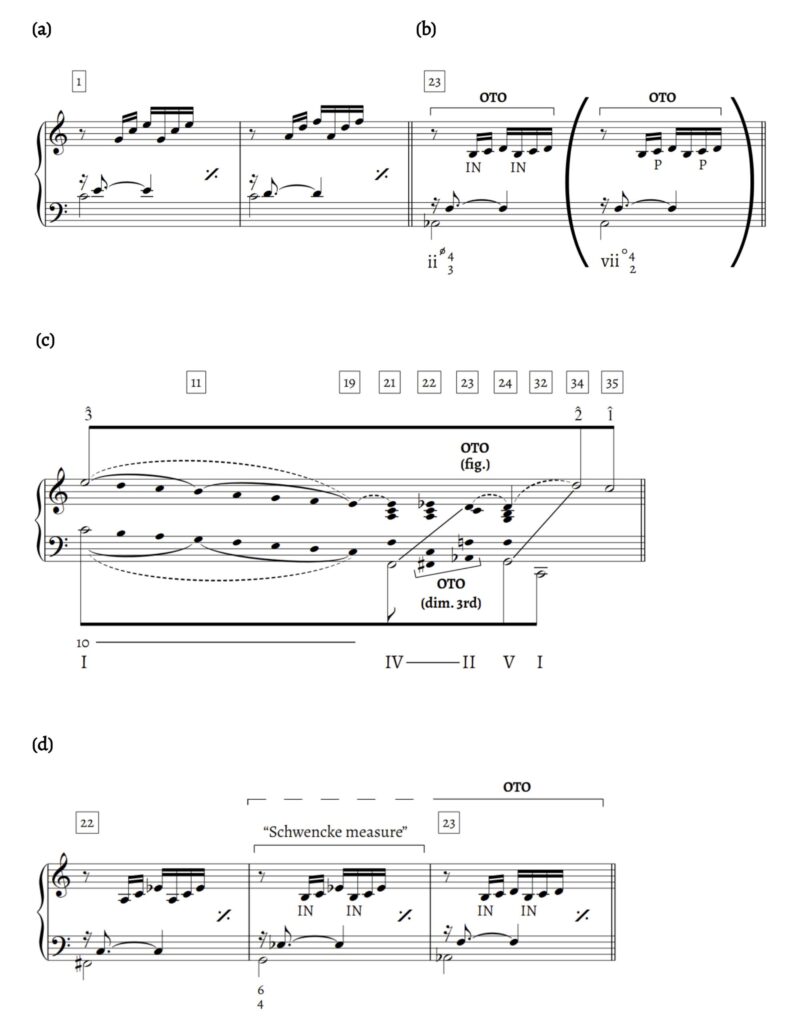
The governing motive in the Prelude is a half-measure five-voice figuration (Example 1a, m. 1) that occurs twice per measure throughout mm. 1–32 (only in mm. 33–35 does Bach suspend this framework). Within these initial thirty-two measures, the figuration always includes at least one leap in the right hand, and chord tones are unambiguous. The figuration consists of an arpeggiated triad (as in m. 1) or seventh chord (as in m. 2) and occasional suspended tones—but no passing or neighboring notes. Only in m. 23, as depicted in Example 1b, does Bach deviate from this consistent figuration by introducing an altered melodic shape in the right hand: a three-note stepwise span. This deviation generates local ambiguity: either B3 functions as an incomplete neighbor to C4 within iiø$$^{4}_{3}$$, or C4 functions as a passing tone within viio$$^{4}_{2}$$. Example 1c, a middleground summary after Schenker ([1932] 1969), demonstrates Schenker’s preference for the first option: the incomplete neighbor B3 is omitted from m. 23, and the harmony is presented using four voices rather than five. The graph also provides broader context, showing that the OTO occurs on the last chord in the pre-dominant area. Additionally, this is where the structural $$\hat{2}$$ of the Urlinie makes its first appearance, just before progressing to the dominant. Thus, this OTO serves as a structure-highlighting marker, and it joins another OTO with the same function: the salient diminished-third leap in the bass between mm. 22 and 23, which is the Prelude’s only diminished melodic interval.4 Some earlier editions of the WTC smoothed this rough leap by adding a mediating passing six‐four chord, known as the “Schwencke measure,” shown in Example 1d. The additional measure undermines both OTOs: first, it cancels the bass OTO, and second, it extends the right-hand OTO backward into the added measure (because both the added measure and m. 23 contain an incomplete right-hand neighbor, the occurrence in m. 23 loses its singular status and its salient effect is weakened). Interestingly, the non-chordal B3 in the added measure, functioning as an incomplete neighbor to C4, seems to support Schenker’s decision to omit B3 in m. 23 of his analysis (Example 1c).
The OTO in Bach’s Invention in E$$\flat$$ Major, BWV 776, arises under more complex circumstances. Unlike the figuration in the Prelude, which recurs continuously, the pattern that underlies the Invention’s OTO occurs in only about 60% of the piece. Additionally, the OTO does not result from a deviation within a single statement of the recurring pattern but from the contour of its melodic sequencing.
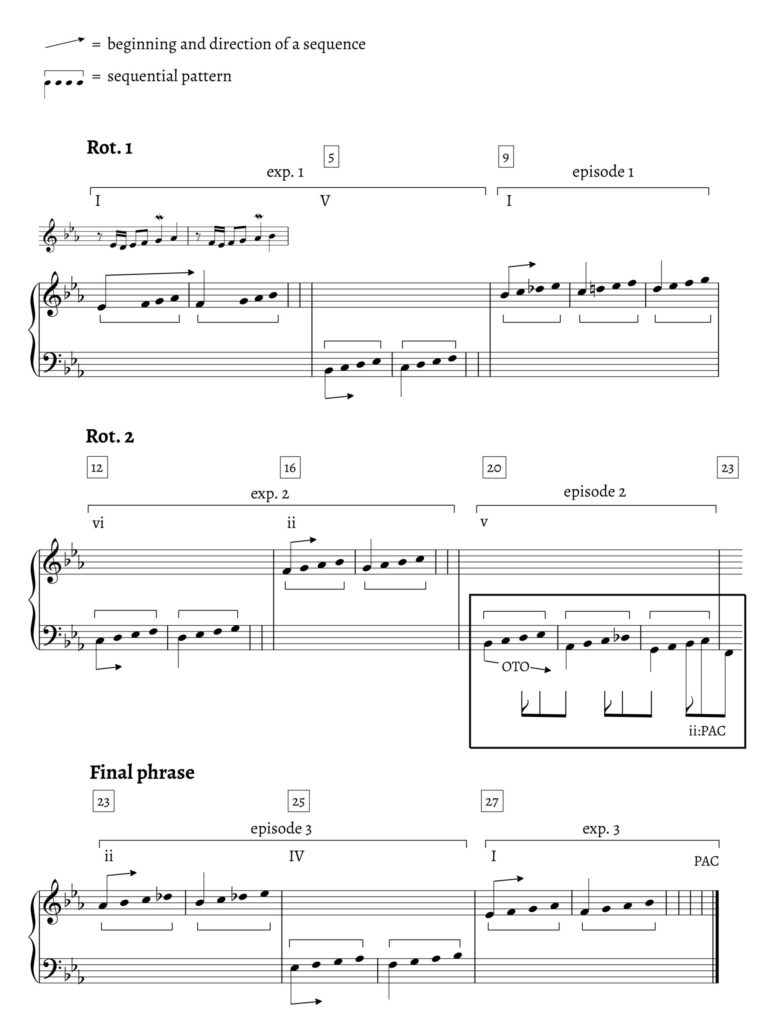
The Invention, analyzed in Example 2, is designed as a free mini-fugue with double counterpoint and a modulatory subject. The Invention includes two rotations, labeled Rot. 1 (mm. 1–11) and Rot. 2 (mm. 12–22), followed by a final phrase (mm. 23–32). The brackets above the system indicate that each rotation consists of an exposition (dux and comes) and an episode, while the final phrase consists of a retransitional double episode and a non-modulatory extended subject. The main motive, fully displayed in m. 1 on the ossia staff, features a stepwise ascent of a perfect fourth, the first note of which is decorated with a lower neighbor. In Example 2, all instances of this motive are labeled with a bracket; on the main staffs, the motive is reduced to a four-note stepwise ascent. Bach sequences this melodic pattern in both the expositions and the episodes. In Example 2, each sequence is marked with an arrow that indicates its beginning and direction, and each sequential pattern begins with a stem. All sequences ascend except the framed sequence in episode 2, which descends; hence, this change of direction in an expected melodic contour is an OTO. Since this exceptional melodic sequence is played by the left hand, it is also harmonically exceptional: it creates a sort of cadential connection between its patterns until the actual cadence is finally obtained (ii:PAC). The OTO not only leads to the cadence but also emphasizes its structural status: this is the Invention’s only cadence other than the final cadence. Moreover, the OTO also contributes to the form’s articulation, as it emphasizes the junction between the last rotation and the non-rotational final phrase.
The OTOs observed in the Prelude and the Invention stand out for their singular occurrence, while remaining subtle in character. In the next example, a more salient OTO similarly emerges within a consistent motivic and textural framework and, in this instance, within a more complex form.
In the Gigue from Bach’s Partita No. 1 for keyboard, BWV 825, the listener’s expectations are stabilized by both the unified motivic and textural design shown in Example 3a and the consistent quadruple hypermeter. As shown in Example 4, the Gigue can be understood as comprising three rotations within a binary form.5 These rotations are end-oriented due to the similarity of their concluding units: each rotation is a phrase consisting of two subphrases, the second of which is an eight-measure end rhyme (ER). Each ER consists of a dominant pedal point (DPP) followed by a PAC, and each ER occurs in a different key area.
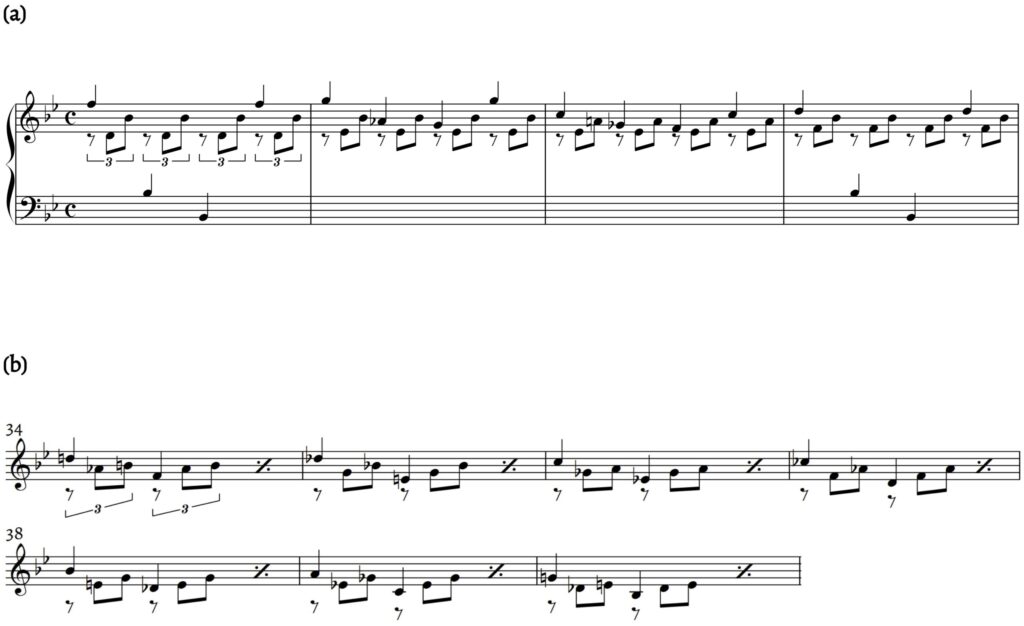
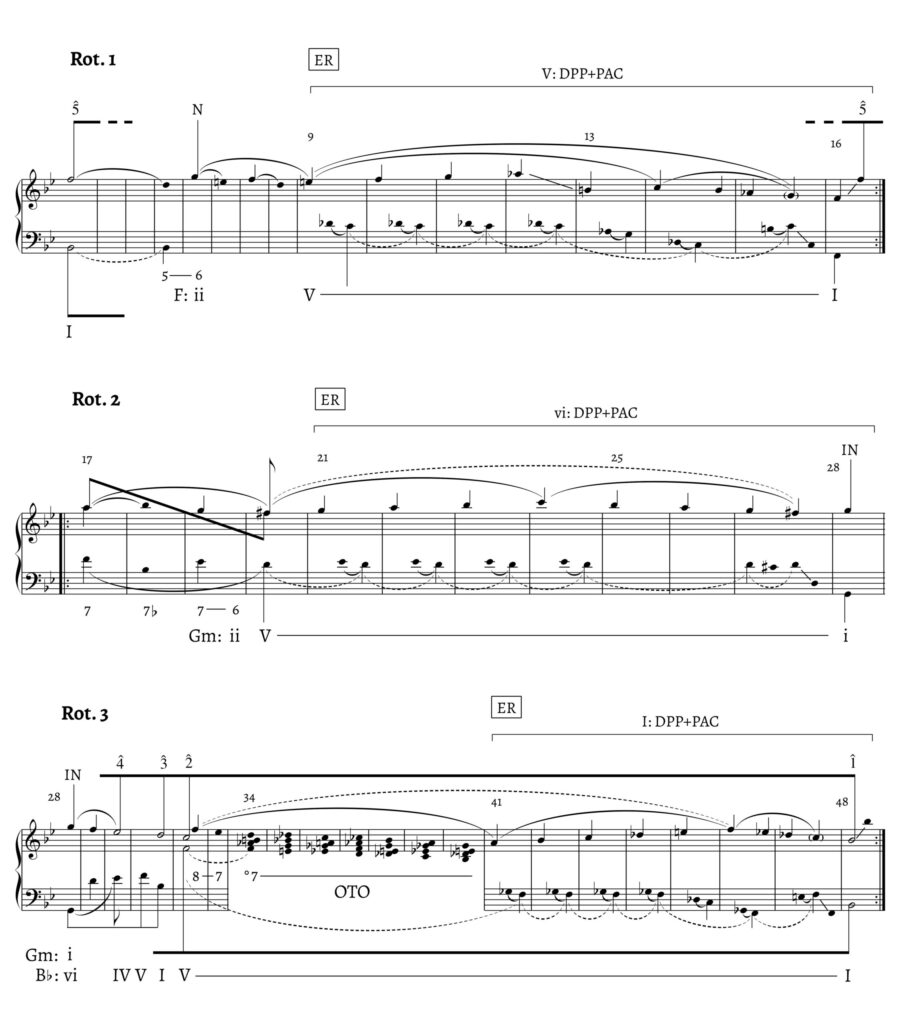
The discussion below compares the opening subphrases of the Gigue’s three rotations (see Example 4). Rot. 1 is symmetrical: both the first subphrase and the ER subphrase span eight measures, and the first subphrase is divided into an opening formula (mm. 1–4) and a modulatory unit (mm. 5–8). In Rot. 2, the first subphrase is reduced to four measures (mm. 17–20), functioning as both a medial repeat that echoes mm. 1–4 and a modulatory unit comparable to mm. 5–8. In this rotation, the DPP begins in m. 20, one measure before the onset of the ER. As a result of this nonconcurrence, the F$$\sharp$$5 in m. 20 resolves not to the G5 in m. 21, but instead to the G5 in m. 28. The first subphrase of Rot. 3 does not resemble those of Rot. 1 and Rot. 2, nor does it serve the same function; rather, it acts as a retransition, beginning with a modulatory unit that leads back to the home key (mm. 28–31).6 The DPP that begins in m. 32 precedes the ER, as in Rot. 2. However, after the V8–7 in mm. 32–33, Bach introduces a salient OTO that generates momentum into the ER and the final cadence: a seven-measure melodic sequence, comprising seven parallel diminished-seventh chords descending chromatically (mm. 34–40). Bach avoids strict consistency and does not spell these chords as literal parallels; rather, each appears in a different inversion. Another inconsistency occurs between mm. 39 and 40, where the progression departs from the preceding chromatic descent and instead descends by a whole step. Alongside the harmonic and voice-leading deviation introduced by the OTO, the texture changes subtly, featuring a half-measure figuration that occurs twice in each measure, similar to the Prelude in C Major (compare Examples 3b and 1a). Not only does the chromatic chain of diminished-seventh chords unsettle harmonic orientation, but its seven-measure span also disrupts the regular quadruple hypermeter, yielding hypermetric ambiguity.
This example from the Gigue differs from those derived from the Prelude and the Invention in that the OTO does not signal the arrival of a structural cadence, but rather marks a formal juncture leading into the ER. Tonally, the OTO, fully contained within the DPP, interrupts the DPP and suspends its expected continuity, generating tension and heightening anticipation of its eventual reactivation. In retrospect, however, the DPP’s return does not merely resume a process but initiates the ER as a new formal unit.
Despite its harmonic and contrapuntal irregularities, the OTO integrates coherently into the Gigue, aided both by preparation (the earlier ERs feature diminished-seventh chords that embellish structural dominants, and the half-measure figuration emerges as early as mm. 32–33) and by the smooth connection that follows. The progression from m. 40 to m. 41, though marked by a bass leap, lands on another diminished-seventh chord, creating a seamless connection into the final ER.
In the three examples discussed thus far—Bach’s Prelude, Invention, and Gigue—the listener can recognize the OTO through its deviation from an otherwise uniform figurative or motivic framework, whether the OTO is subtle, as in the Prelude and Invention, or striking, as in the Gigue. Bach avoids gestures that might disrupt a tightly woven motivic fabric; instead, he draws attention to a single, carefully placed OTO that signals the arrival of a structural cadence or a formal unit. In a composition not organized around tightly repetitive motivic cells, an OTO that signals the arrival of a structural cadence or a formal unit may be more salient and may require contextual preparation to maintain coherence. Such a salient OTO, closely resembling the one in the Gigue, is the focus of the following analysis of a sonata-form movement by W. A. Mozart.
2. An Extreme OTO in Sonata Form
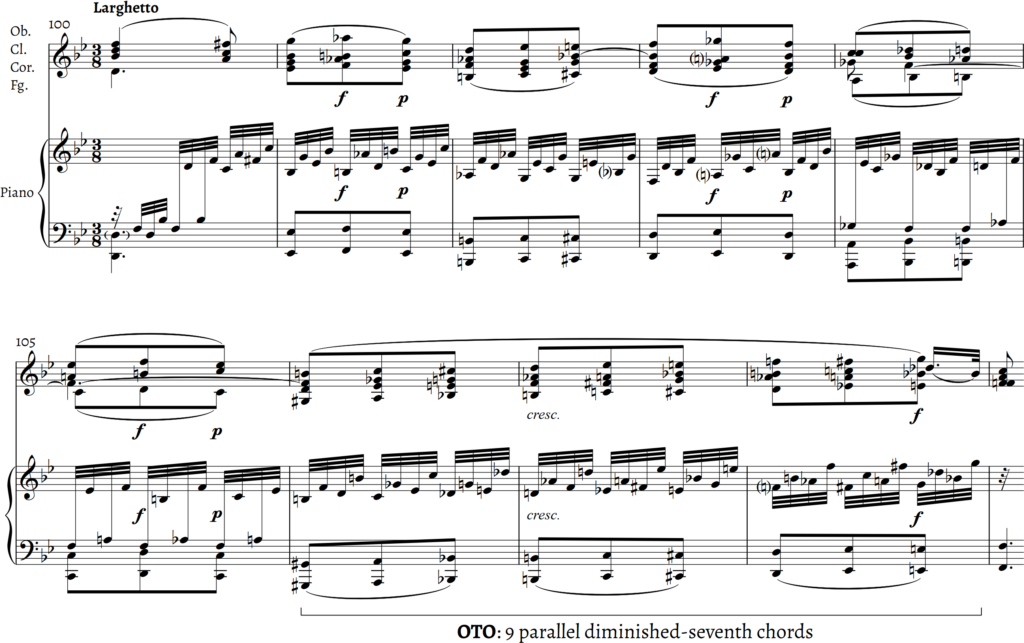
In the second movement of Mozart’s Quintet in E$$\flat$$ Major for Piano and Winds, K. 452, a particularly prominent OTO appears just before the ESC: nine parallel diminished-seventh chords (Example 5, mm. 106–108).7 This unusual OTO stands out as a highly salient event within the movement. The exceptional features of the sonata form in this movement lead to an ambiguous ESC, and the OTO draws significant attention to this moment, effectively marking the ESC as a pivotal structural event. Despite its uniqueness, the OTO is well integrated into the movement through both an intensification process and preparatory material introduced early in the movement.
The second movement in the E$$\flat$$-Major Quintet features a Type 3 sonata form with a continuous exposition of the Expansion-Section subtype, in which the transition evolves into a Fortspinnung (TR⇒FS).8 Each of the two rotations is tripartite, consisting of the following sections:9
- P: a compound period
- TR⇒FS: a compound sentence concluding with the EEC or ESC
- C: an expanded cadential progression repeated twice, followed by a codetta comprising brief cadential modules
Building on this formal framework, the OTO marks the climax of an intensification process within the TR⇒FS section of the recapitulation, as illustrated in Example 6. This intensification will now be examined in detail, starting with its harmonic and form-functional characteristics and then turning to its articulation through hypermeter.
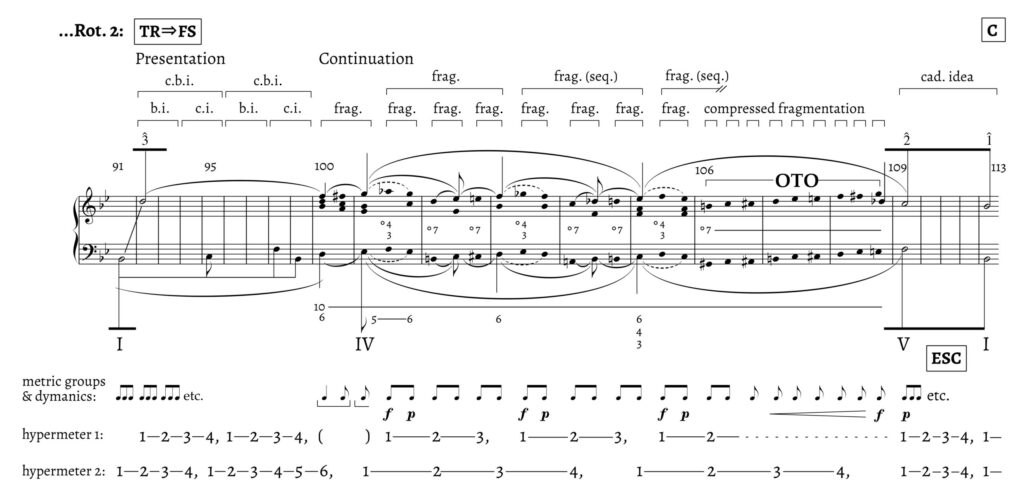
The process of intensification begins with a relatively stable compound presentation (mm. 92–99).10 This expands tonic harmony and, like the corresponding passage in the exposition (mm. 19–26), is characterized by symmetry between two- and four-measure units (see the form-functional analysis above the system). This symmetry corresponds to multiple repetitions and provides the foundation for emphasizing the deviations that follow. The tension then gradually intensifies during the compound continuation, whose expanded dimensions delay the arrival at the ESC. The extended fragmentation (mm. 100–108), which includes the OTO, prolongs the structural pre-dominant and is unified throughout by parallel tenths between the outer voices (see the 10 marking below m. 100 and the subsequent horizontal line).11 As in the exposition, a one-and-a-half-measure fragment (mm. 100–101) is followed by shorter fragments of a diminished-seventh chord and its resolution (mm. 101–105). Two-chord units, each comprising a diminished-seventh chord and its resolution, occur frequently throughout the movement, thus forming a motive likely well ingrained in the listener’s perception. However, here, the rapid eighth-note alternation creates a particularly fast harmonic rhythm that heightens tension. Unlike the fragmentation in the exposition, which comprises only four such short fragments (mm. 28–30), eight short fragments appear here, grouped into three sequential patterns (the third is truncated), forming three higher-level fragments. The tension that intensifies throughout the sequence culminates in the OTO (mm. 106–108). The third truncated sequential pattern (mm. 105–106), like its predecessors, opens with short fragments, each commencing with a diminished-seventh chord. However, in the second short fragment (at the beginning of m. 106), the initial diminished-seventh chord fails to resolve and instead ascends to a parallel diminished-seventh chord. This is the first ascent in the OTO, which unfolds as a chromatic ascending melodic sequence of nine parallel diminished-seventh chords (notated with varying enharmonic spellings), constituting compressed fragmentation. In the absence of a cadential trill or other rhetorical gesture, the OTO functions as a distinctive marker signaling the arrival of the ESC, the movement’s most structurally significant cadence.
Hypermetric complexities further contribute to the intensification process outlined above, shaping the listener’s perception of the OTO. These are reflected in the three analytical lines below the system: hypermeter 2 underlies the harmonic rhythm in the presentation and corresponds with the notated meter in the continuation, while various tension-enhancing disturbances are revealed through the metric groups & dynamics and hypermeter 1. The presentation, while relatively stable, already exhibits hypermetric nonconcurrence between the outer voices. Hypermeter 2—comprising two hypermeasures (1–2–3–4 and 1–2–3–4–5–6)—is supported by the bass, with harmonic rhythm articulated mostly in two-measure units, and by its parallelism with the two preceding hypermeasures (Example 7, mm. 82–91). In contrast, hypermeter 1 (Example 6)—consisting of two quadruple hypermeasures followed by an additional measure in parentheses—is supported by the soprano and by the formal functions indicated above the system.12 In the fragmentation section, the steady rhythmic surface intensifies hypermetric ambiguity. Hypermeter 2 in this passage outlines two quadruple hypermeasures, aligning with the notated $$^{3}_{8}$$ meter. The notated meter is supported by nearly consistent one-measure slurs in the wind instruments during the sequential fragmentation (Example 5, mm. 101–105) and in the piano’s left hand during the OTO (Example 5, mm. 106–108). In contrast, metric groups & dynamics support the intensified hypermeter (1–2–3, 1–2–3, 1–2 . . .), shown in hypermeter 1 (Example 6, mm. 101–106). The pairs of diminished-seventh chords and their resolutions function as compressed $$^{2}_{8}$$ measures, each pair forming a hyperbeat, with forte accents on the second eighth note of mm. 101, 103, and 105 operating as hypermetric downbeats. The OTO then marks the peak of this tension: its uninterrupted succession of parallel chords, accompanied by a crescendo that leads to nowhere, obscures the metric organization and intensifies the sense of hypermetric disorientation. This can be heard as a brief hypermetrical tunnel in John Paul Ito’s (2013, 63) sense: hypermetric orientation is effectively suspended, making it difficult to construct a larger-scale temporal orientation or to anticipate the resumption of more regular phrase structure, an experience Ito associates with William Rothstein’s (1989, 42–43) metaphor of holding one’s breath. Clarity is restored in m. 109 with the return of a stable $$^{3}_{8}$$ meter (shown in Example 6 under metric groups & dynamics) and the reestablishment of quadruple hypermeter, as shown in hypermeter 1.
The impact of the OTO in the E$$\flat$$-Major Quintet is reinforced by additional contextual factors within the movement and beyond. First, the OTO’s rarity exceeds the boundaries of the movement itself. It is the only instance of nine parallel diminished-seventh chords across the entire three-movement quintet, Mozart’s chamber music repertoire, and conceivably his entire oeuvre. Moreover, within the tonal repertoire of the common practice period, melodic sequences of parallel diminished-seventh chords occur more frequently in descending motion—as in the Bach Gigue (Examples 3b and 4)—than in the ascending motion heard here. The stylistic rarity of this OTO significantly contributes to its markedness, rendering it particularly striking for the informed listener. Second, although unique in its occurrence, this OTO is nevertheless anticipated by earlier material within the movement. The OTO, which constitutes the final appearance of a diminished-seventh chord, is prepared by the first occurrence of parallel diminished-seventh chords, as well as the material that prefigures these chords. The P section, shown in Example 7, is constructed as a compound period (this analysis is applicable to both the exposition and the recapitulation). Its components closely parallel those of the compound sentence in the recapitulation’s TR⇒FS, discussed above: (1) the compound period begins with a c.b.i., followed by sequential fragmentation; (2) in the consequent, the figuration intensifies and extends the continuation in relation to the c.b.i.; and (3) most notably, against the backdrop of a crescendo concluding the fragmentation, the final fragment signals the arrival at the cadence through two ascending parallel diminished-seventh chords. This precedent and the OTO are the only passages in the movement that feature parallel diminished-seventh chords.
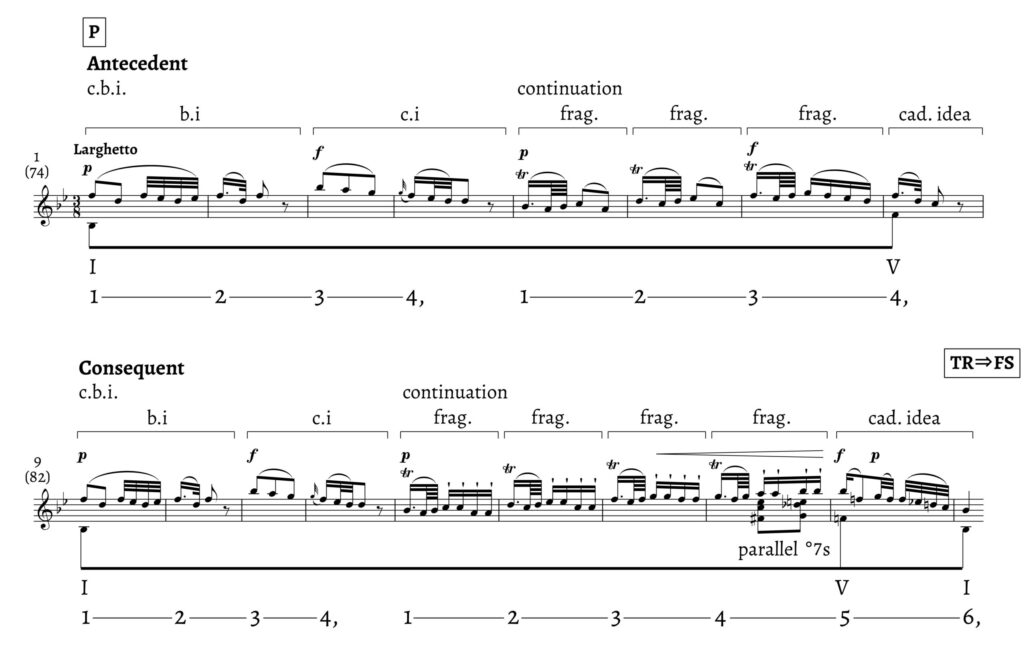
3. An OTO at a Narrative Hinge
The next example shows how an OTO may function as a formal and structural marker within a textual and dramatic context. A case in point appears in Richard Wagner’s debut opera, Die Feen. In the first act, the mortal heir to the throne, Arindal, resides in the fairy realm with the half-fairy Ada, who has renounced her immortality for the sake of their life together. Yet their union is bound by a taboo: Arindal must never inquire into Ada’s origins. The fairies, seeking to end the relationship, manipulate Arindal’s perception and emotional state, ultimately provoking him to break this prohibition. Consequently, he is cast out of the fairy realm into a barren, desolate wilderness. Wandering in grief and unaware of the magical forces behind his exile, he is eventually found by friends who inform him of his father’s death and persuade him to return to the troubled kingdom he had abandoned eight years earlier. Left alone, Arindal falls into an enchanted sleep at the outset of the act’s Finale—a moment that marks a transition back to the realm of the fairies, where Ada reappears, torn between her love for him and the cost of her sacrifice.
Arindal’s transition from earthly reality back to the realm of the fairies is depicted in Example 8, which presents the final six measures before he falls asleep, as he sings, “O cruel one, farewell, farewell forever, I go to fight for my homeland, and my only hope is death!” The text “zieh’ ich für mein Vaterland” (I go to my homeland) in mm. 24–25, which refers to an earthly destination, is set to a conventional minor-key deceptive cadence. Arindal sings the local leading tone, E$$\natural$$4, and resolves it to F4 ($$\natural$$$$\hat{7}$$–$$\hat{1}$$). Immediately afterward, the text “und meine Hoffnung ist allein der Tod!” (and my only hope is death!), signifying a transition beyond mortal reality, culminates in a different minor-key deceptive cadence, framed in mm. 26–28. This cadence introduces Arindal’s unexpected falling asleep, resolving V7 to a minor submediant on the word “Tod!” (death!). The resolution is strikingly unconventional for a minor key. In this progression, the leading tone, B$$\natural$$4, is “resolved” to its enharmonic doppelganger, C$$\flat$$5 ($$\natural$$$$\hat{7}$$–$$\flat$$$$\hat{1}$$). In other words, the minor VI does not include the tonic tone, $$\hat{1}$$, but, rather, the paradoxical $$\flat$$$$\hat{1}$$, which is the enharmonically reinterpreted leading tone after being “resolved into itself.”13 This deceptive cadence is a distinct OTO. The sense of surprise generated by the unconventional resolution is further heightened by its contrast with the four preceding conventional resolutions of the leading tone B$$\natural$$ to the tonic C ($$\natural$$$$\hat{7}$$–$$\hat{1}$$) in mm. 21–23: first in Arindal’s vocal line on the word “Leb’wohl” (farewell), then three more times in the orchestra.
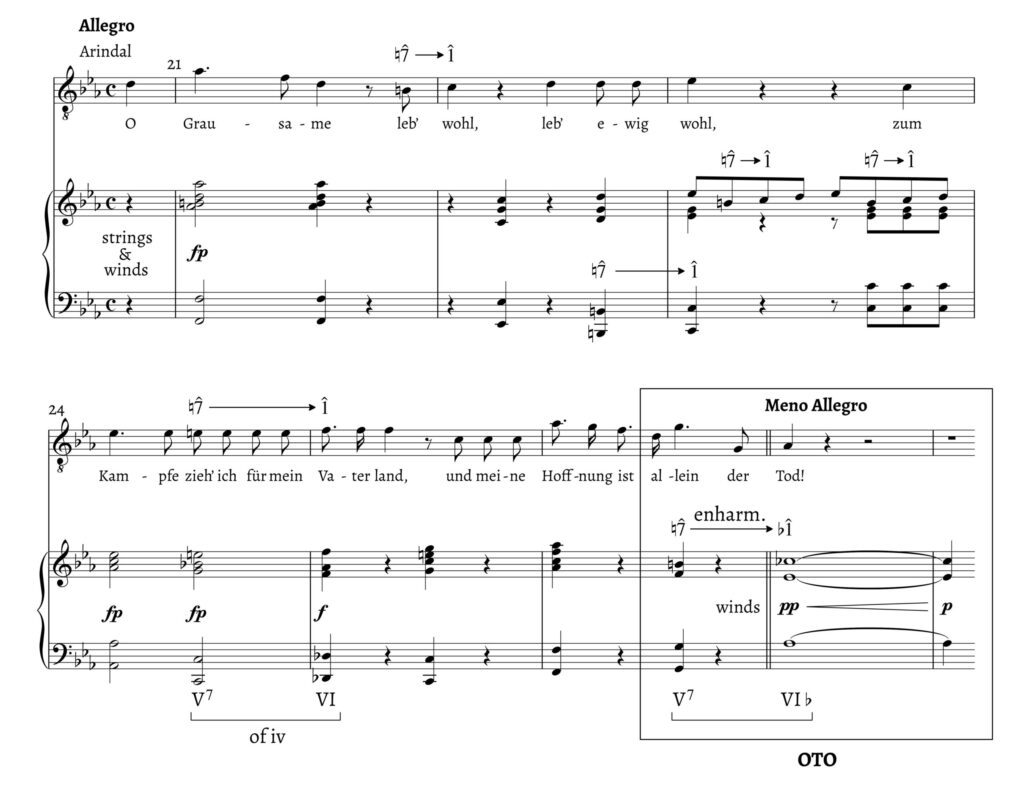
As with the OTO in the second movement of the Mozart E$$\flat$$-Major Quintet, the rarity of the OTO in Die Feen is not confined to its formal context. It is the sole instance of such a deceptive cadence, not only in the first act but across the entire opera. It is fair to say that such an OTO is extremely rare within the tonal repertoire of the common practice period. This scarcity amplifies the OTO’s distinctiveness, making it especially striking to listeners attuned to its uncommon harmonic character.
Inessa Wagner-Rubinstein (2016, 21–25) contextualizes this exceptional deceptive cadence within Wagner’s broader exploration of states of “betweenness” in his operas—transitional states of consciousness such as falling asleep, awakening, dreaming, and being under a spell. This OTO highlights a harmonically adventurous gesture and, simultaneously, functions as a structural hinge between narrative realms: from earthly reality to magical space and from waking life to enchanted suspension. In this dual role—as musical anomaly and dramatic signpost—it functions as a formal pivot within the opera’s narrative.
4. Absence and Omission
The preceding discussion has examined two sources of marked singularity: motivic deviation and parametric extremity. Examples of deviation include altered intervals within or between expected melodic figuration patterns, as in Bach’s Prelude, and a change in expected melodic contour, as in Bach’s Invention. Extremity-based cases emerge within a tightly constrained motivic context, such as the parallel diminished-seventh chords in Bach’s Gigue, or arise in more complex formal and textural settings, as in the parallel diminished-seventh chords in Mozart’s E$$\flat$$-Major Quintet or the exceptional deceptive cadence in Wagner’s opera.
In addition to deviation and extremity, a third source of marked singularity is absence or omission. This category is less intuitive, as analysis typically focuses on what is present rather than what is lacking. Nevertheless, the notion of absence is not foreign to music theory. Schenkerian theory, for example, incorporates implied tones and substitutions, as well as the auxiliary cadence, in which the tonic is absent at the beginning.14 Absence becomes perceptually salient against a background of established expectations. Much like a motivic deviation, it can stand out through contrast with multiple repetitions—for instance, with the omission of a pervasively recurring motive. Absence and omission thus function within the context of a cognitive principle that links seemingly unrelated phenomena, including the suppression of a highly recurring motive; a pause in the musical texture; or, in rotational designs, the omission of a recurring theme from a single rotation. Interestingly, similarities between extreme values—such as the very long or the very high—may be more readily perceived than the kinship between different types of absence.
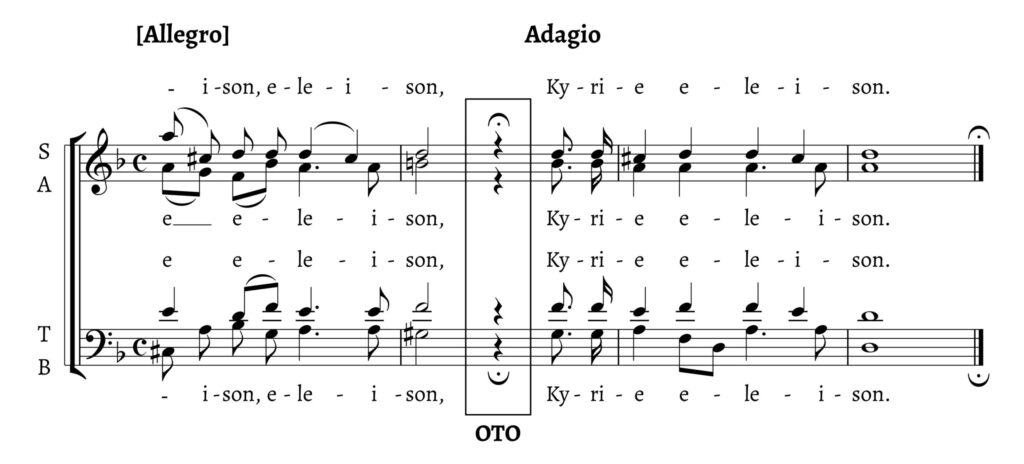
The most salient absence is silence against a continuous sonic surround. Such a general pause (GP) can function as a disruption aimed at creating enhanced tension. For example, in the Kyrie from Mozart’s Requiem in D Minor, K. 626 (Example 9), a deceptive V–viiº$$^{7}$$/V progression—itself an OTO analogous to the exceptional deceptive resolution in Example 8—precedes a GP, which then resembles the abrupt halt of a moving train. The GP, located in the antepenultimate measure, marks the sole absence of sound in the entire movement, occurring after restless, continuous fugal activity. Its dramatic effect draws the listener’s attention toward the concluding cadence that immediately follows. Such an acoustic silence, occurring after dense contrapuntal motion and a harmonically charged deceptive resolution, is a perceptually saturated span: the withdrawal of sound affords both the retrospective digestion of the preceding fugal process and a continuation in the listener’s inner hearing that projects the imminent cadential goal across the gap, rather than functioning as a neutral break in the texture (Margulis 2007, 245–246, 252–253, 260).15
A suppressed note (Wagner 2004) is the absence of a specific pitch class (PC) from a passage.16 Naphtali Wagner discusses pentatonicism in The Beatles’ songs and demonstrates that it was obtained by leaving two “holes” in a seven-note diatonic scale. He further conjectures that listeners may be unaware of a missing PC, yet its (re)appearance has a powerful effect and might attract special attention. Composers may heighten the effect using other parameters, for instance by placing the reintroduced PC on a strong beat, repeating it continuously, associating it with a significant word in sung music, or aligning it with a pitch climax.
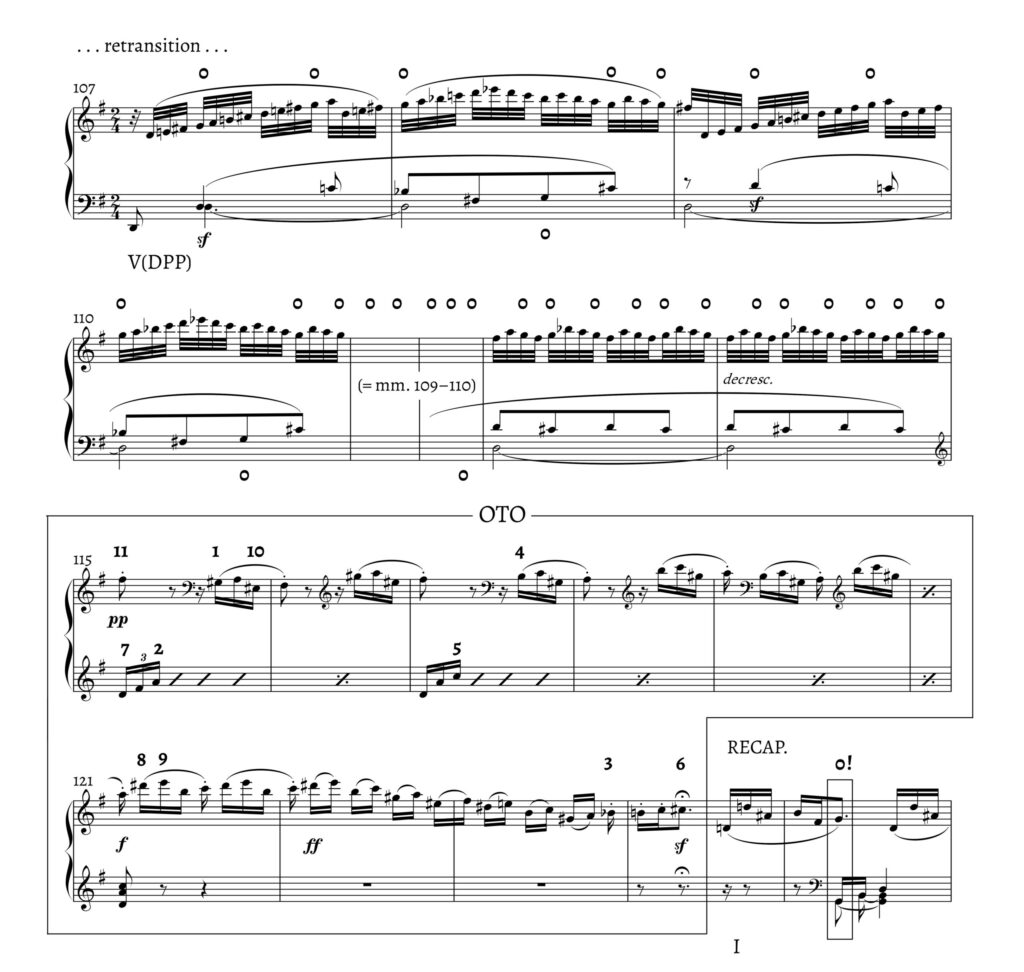
An OTO derived from a suppressed note in the first movement of Ludwig van Beethoven’s Piano Sonata in G Major op. 14, no. 2, is shown in Example 10. At the end of the development, the retransition concludes with a DPP. Here, the twelve PCs are labeled with the integers 0–11, with G as 0. The DPP is divided into two overlapping sections: from m. 107 to the onset of m. 115, and mm. 115–124 (framed in Example 10). The first section features rapid scalar passages that include all PCs except PC1 and PC10. Out of the 158 onsets in this section, the tonic note G appears 30 times (19%), more frequently than any other PC, including the dominant D (26 times, 16%) and the leading tone F$$\sharp$$ (23 times, 15%). Conversely, in the second section, Beethoven suppresses G entirely while including all other PCs, each labeled at its first appearance. Rather than weakening G’s representation in working memory, its suppression makes the absence itself perceptually salient and heightens the expectation for a tonic arrival. Its reappearance on the first strong beat of the recapitulation (m. 125) therefore lands with heightened force. Notably, this framed section is the only formal unit in the movement where G is suppressed, and it is the only extended dominant-function passage that omits the local tonic note. As such, this is an OTO that fulfills a similar role to those previously discussed: highlighting a structurally significant and formally pivotal moment.
5. OTO Constellations in Bach’s C-Minor Fugue
Bach’s Fugue in C Minor, WTC I, BWV 847, incorporates several OTOs that signal arrivals at significant structural and formal points (Example 11; the OTOs are enclosed in frames).17 This final analysis serves as a summary in that it includes previously identified OTO types and an additional OTO derived from the absence of a motive. The C-Minor Fugue features a binary division based on motivic criteria, consisting of the two almost equal sections A and B (14 and 14.5 measures, respectively), followed by a coda.18 In addition, the Fugue exhibits remarkable thematic unity, achieved by the episodes’ maximal adherence to the thematic material of the subject and two countersubjects (CS1 and CS2), and by the near-exhaustive use of triple counterpoint, as evidenced by the inclusion of five of the six possible permutations of triple counterpoint.19 Consequently, the Fugue’s main motive—marked as x in Example 11—is persistently present. In the expositions, this motive opens the subject and recurs twice with altered contour (e.g., mm. 11–13, soprano: x–x′–x′); it then reappears in immediate succession at the conclusion of CS2 (e.g., mm. 12–13, middle voice: x). Within the episodes, x frequently undergoes sequential patterning, as in the upper voices of mm. 9–11.
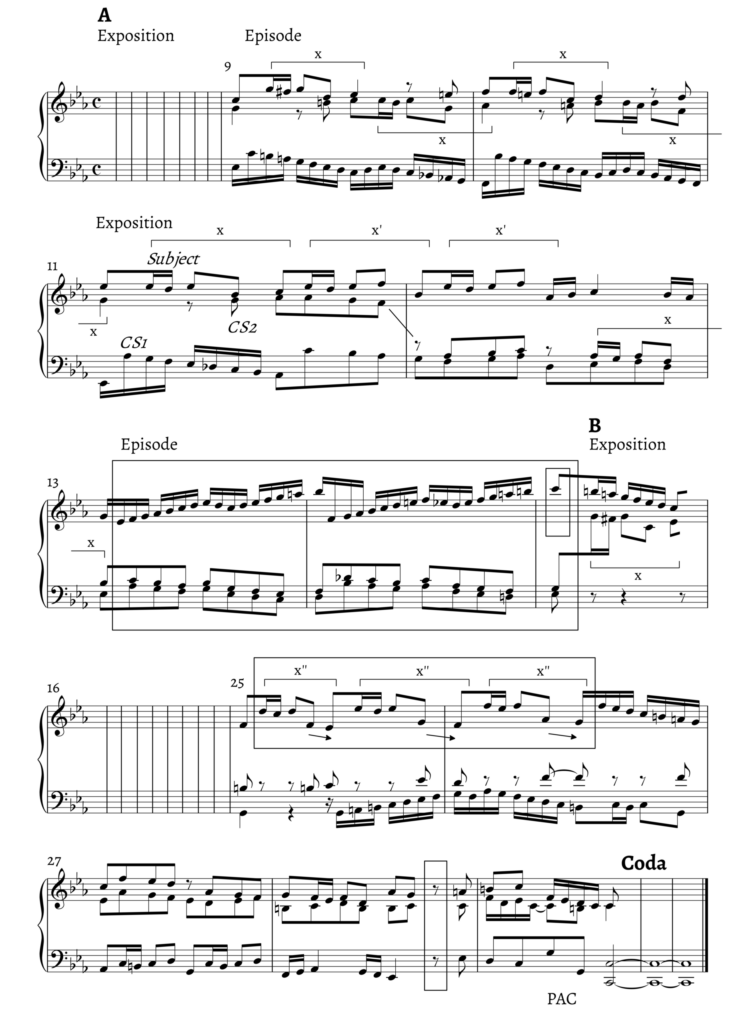
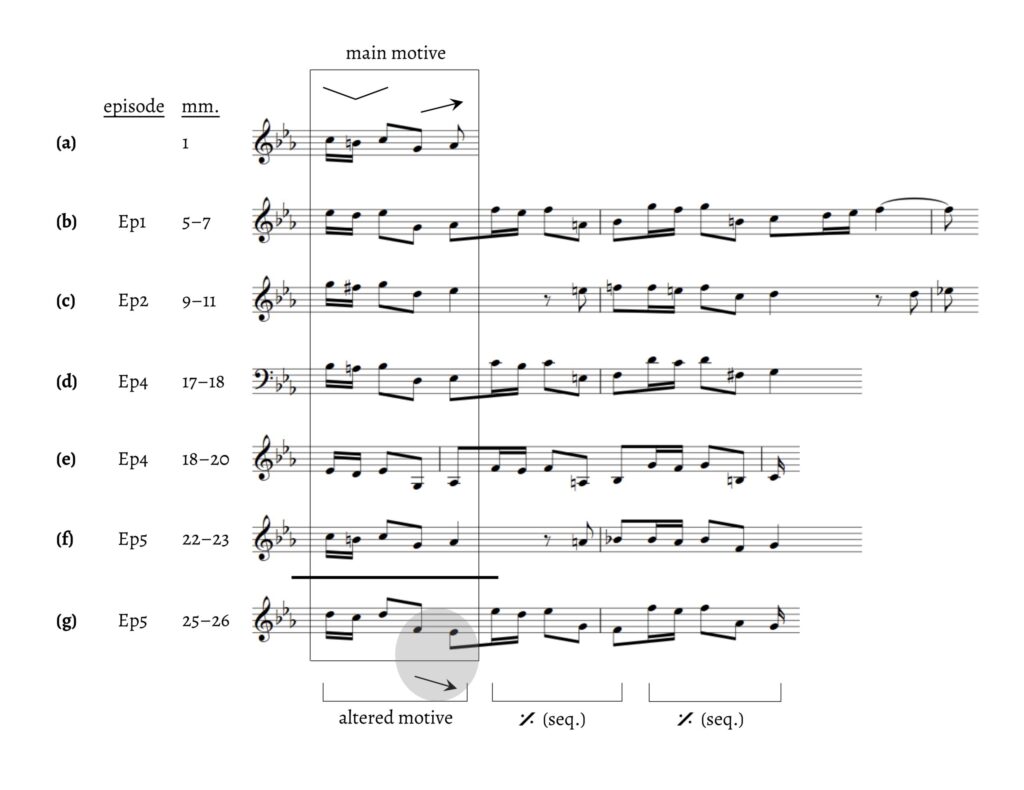
Toward the end of section B, Bach employs two OTOs of the types discussed above to signal the approach of the PAC at m. 29 (Example 11). The first OTO is the sequence of x″—a newly altered pitch contour of the main motive—appearing in mm. 25–26 and concluding the fifth episode. Example 12 illustrates this deviation. The main motive that opens the fugue’s subject (Example 12a) is constructed from a lower neighbor pattern followed by a descending leap and an ascending step. This patterning recurs at the beginning of each subject entry and is consistently maintained in the episodic melodies (Example 12b–f), except for the last one (Example 12g). Here, the descending leap is followed by a descending, rather than an ascending step, as indicated by the gray circle. Bach shifted this altered motive upward twice, thus creating a three-pattern sequence. Five factors highlight the deviation from the main motive’s standard contour and contribute to the tension it creates. First, the melody in Example 12g is the only one in which the opening main motive starts with D, whereas all other melodies (Example 12b–f) start with chord tones of the tonic triad: C, E$$\flat$$, or G. Second, only Example 12g begins with a lower neighbor pattern at the interval of a major second rather than a minor second. Third, the deviation in Example 12g occurs on the motive’s last note, thereby increasing the listener’s sense of surprise. Fourth, the altered contour increases tension by eliminating the compensatory ascending step that typically follows a descending leap. And fifth, the polyphony is almost suspended in the first half of m. 25 due to the long pause in the lower voice and the brief pause in the inner voice (see Example 11).20
The subsequent OTO in the C-Minor Fugue immediately precedes the cadence, with all three voices pausing simultaneously for one eighth note in m. 27 (Example 11). This is the only instance in the fugue where sound is absent. A GP is a rarity in the fugues of the WTC, appearing in only four other fugues;21 this infrequency enhances the element of surprise for the informed listener. Although GPs are inherently salient, particularly when functioning as OTOs, the brevity of the silence here reduces its perceptual prominence. As in the GP near the end of the double fugue in Mozart’s Requiem (Example 9), this sudden halt in sound may likewise evoke the image of pulling the emergency brake of a train. However, unlike that example, here in the C-Minor Fugue, the momentum persists into the cadential passage in the following measure, which liquidates the thematic material and culminates in a structural PAC and an exceptional coda.22
The two OTOs jointly articulate the momentum toward the cadence in the C-Minor Fugue. The first OTO (Example 11, mm. 25–26) sets the stage for the cadence, and the following subject in the bass (mm. 26–28) delays it, increasing the listener’s anticipation. Since the bass cannot simultaneously carry the subject and function as cadential, the interruption caused by the second OTO (GP) becomes necessary, allowing the bass to take a breath before resuming its role as cadential foundation.
Bach uses OTOs to signal not only the end of section B but also the end of section A. The final episode of section A (Example 11, mm. 13–15) constitutes an OTO due to the absence of the main motive (x, x′, or x″). The suppression of the highly recurring motive across an entire episode stands out against its repetition throughout the entire fugue. While listeners may not initially notice the motive’s absence, its reappearance at the next subject entry (m. 15, middle voice) draws attention and retrospectively highlights the omission. Although this episode omits the subject motive, the soprano inverts the bass of mm. 9–11—material that derives from CS1’s opening (m. 11, lower voice)—thereby preserving motivic continuity with the countersubject. The texture of this episode also qualifies as an OTO, as it features a rhythmically uniform texture with parallel thirds in the lower voices, thus deviating from the fugue’s characteristic polyphonic texture. The two ascending scale passages in the upper voice lead to an OTO resulting from extremity: C6, the fugue’s pitch climax in m. 15. This climax is located precisely at the boundary between the two sections of the thematic binary design. Placing a pitch climax in the exact middle is a rare compositional treatment of an already rare stimulus. Despite its inherent straightforward salience, the pitch climax has a weak structural status, as it is supported by a $$^{6}_{3}$$ apparent tonic.23
Conclusion
This study demonstrates that OTOs can play a vital role as structural and formal markers within diverse musical works drawn from the common practice period. Far from being incidental anomalies, OTOs—including deviations in motivic contour, exceptional harmonic progressions, extreme pitch events, and strategic absences—function as perceptually prominent signposts that highlight formal boundaries, cadential moments, and narrative transitions. OTOs may result from compositional strategies that manipulate presence and absence, illuminating musical elements that would otherwise remain implicit or taken for granted.
The rarity and uniqueness of OTOs amplify their perceptual impact, contributing to the listener’s experience of formal clarity and expressive intensity. As such, they deserve systematic consideration alongside more established analytical categories that address types of repetition. Integrating OTOs into structural, formal, and motivic analyses enriches our understanding of musical organization as a dynamic interplay between expectation and surprise.
Future research might explore how OTOs function in repertoires beyond the Western tonal tradition, where compositional strategies and listener expectations may vary significantly. For example, in post-tonal practice—from minimalist saturation of repetition to deliberate avoidance of recurrence—single breaches can likewise operate as salient formal markers. Mapping where such singularities articulate points of closure, sectional boundaries, or narrative pivots would test the broader applicability of this framework. Additionally, empirical studies of OTO perception could elucidate how listeners experience the affective and cognitive effects of these unique occurrences. Ultimately, integrating deviation, extremity, and omission as sources of marked singularity broadens the scope of formal analysis and clarifies how singular events articulate form and guide listening.
References
Almén, Byron. 2008. A Theory of Musical Narrative. Bloomington: Indiana University Press.
Baker, James M. 2003. “Chromaticism, Form, and Expression in Haydn’s String Quartet Op. 76, No. 6.” Journal of Music Theory 47 (1): 41–101.
Beach, David. 2008. “Bach’s Partita No. 1 in B$$\flat$$, BWV 825: Schenker’s Unpublished Sketches with Commentary and Alternative Readings.” Music Theory Spectrum 30 (1): 1–34.
Burnett, Henry, and Roy Nitzberg. 2007. Composition, Chromaticism and the Developmental Process: A New Theory of Tonality. Aldershot: Ashgate.
Cambouropoulos, Emilios. 2009. “How Similar Is Similar?” Musicae Scientiae 13 (1 suppl): 7–24.
Eitan, Zohar. 1997. Highpoints: A Study of Melodic Peaks. Philadelphia: University of Pennsylvania Press.
Gjerdingen, Robert O. 2007. Music in the Galant Style. New York: Oxford University Press.
Hanninen, Dora A. 2003. “A Theory of Recontextualization in Music: Analyzing Phenomenal Transformations of Repetition.” Music Theory Spectrum 25 (1): 59–97.
Harris, Ellen T. 2005. “Silence as Sound: Handel’s Sublime Pauses.” The Journal of Musicology 22 (4): 521–558.
Harrison, Daniel. 1988. “Some Group Properties of Triple Counterpoint and Their Influence on Compositions by J. S. Bach.” Journal of Music Theory 32 (1): 23–49.
Hatten, Robert S. 1994. Musical Meaning in Beethoven: Markedness, Correlation, and Interpretation. Bloomington: Indiana University Press.
———. 2004. Interpreting Musical Gestures, Topics, and Tropes: Mozart, Beethoven, Schubert. Bloomington: Indiana University Press.
Hepokoski, James A., and Warren Darcy. 2006. Elements of Sonata Theory: Norms, Types, and Deformations in the Late Eighteenth-Century Sonata. New York: Oxford University Press.
Ito, John Paul. 2013. “Hypermetrical Schemas, Metrical Orientation, and Cognitive-Linguistic Paradigms.” Journal of Music Theory 57 (1): 47–85.
Jeppesen, Knud. (1931) 1992. Counterpoint: The Polyphonic Vocal Style of the Sixteenth Century. New York: Dover Publications.
Kamien, Roger. 1993. “Conflicting Metrical Patterns in Accompaniment and Melody in Works by Mozart and Beethoven: A Preliminary Study.” Journal of Music Theory 37 (2): 311–348.
Krumhansl, Carol L. 1990. Cognitive Foundations of Musical Pitch. New York: Oxford University Press.
Lee, Ji Yeon. 2018. “Climax Structure in Late Romantic Opera.” PhD diss., City University of New York.
Lehman, Frank. 2014. “Schubert’s SLIDEs: Tonal (Non-)Integration of a Paradoxical Transformation.” Music Theory and Analysis 1 (1–2): 61–100.
Lerdahl, Fred, and Ray Jackendoff. 1983. A Generative Theory of Tonal Music. Cambridge, MA: MIT Press.
Margulis, Elizabeth Hellmuth. 2007. “Moved by Nothing: Listening to Musical Silence.” Journal of Music Theory 51 (2): 245–276.
———. 2014. On Repeat: How Music Plays the Mind. New York: Oxford University Press.
Meyer, Leonard B. 1989. Style and Music: Theory, History, and Ideology. Chicago: University of Chicago Press.
Mirka, Danuta. 2012. “Absent Cadences.” Eighteenth-Century Music 9 (2): 213–235.
Rothgeb, John. 1971. “Design as a Key to Structure in Tonal Music.” Journal of Music Theory 15 (1/2): 230–253.
Rothstein, William. 1989. Phrase Rhythm in Tonal Music. New York: Schirmer Books.
———. 1991. “On Implied Tones.” Music Analysis 10 (3): 289–328.
———. 1995. “Beethoven with and without Kunstgepräng’: Metrical Ambiguity Reconsidered.” In Beethoven Forum 4, edited by Christopher Reynolds, Lewis Lockwood, and James Webster, 165–193. Lincoln: University of Nebraska Press.
———. 2011. “Metrical Theory and Verdi’s Midcentury Operas.” Dutch Journal of Music Theory 16 (2): 93–111.
Salzer, Felix, and Carl Schachter. (1969) 1989. Counterpoint in Composition: The Study of Voice Leading. New York: Columbia University Press.
Schenker, Heinrich. (1926) 1996. “The Organic Nature of Fugue as Demonstrated in the C Minor Fugue from Bach’s Well-Tempered Clavier, Book 1.” In The Masterwork in Music: A Yearbook, Vol. 2, translated by Hedi Siegel, 31–54. Cambridge: Cambridge University Press.
———. (1932) 1969. Five Graphic Music Analyses. New York: Dover Publications.
Schoenberg, Arnold. 1967. Fundamentals of Musical Composition. London: Faber and Faber.
Suurpää, Lauri. 2022. “Continuous Exposition in Mozart’s Slow Chamber-Music Movements.” Music Analysis 41 (3): 394–439.
Wagner, Naphtali. 2004. “Fixing a Hole in the Scale: Suppressed Notes in the Beatles’ Songs.” Popular Music 23 (3): 257–269.
Wagner-Rubinstein, Inessa. 2016. “‘Betweenness’ in Wagner’s Works: Between Dreams and Reality, Between Sleep and Wakefulness.” PhD diss., Hebrew University of Jerusalem.
Zbikowski, Lawrence M. 1999. “Musical Coherence, Motive, and Categorization.” Music Perception 17 (1): 5–42.
Notes
- In this article, the delineation of a unit is constrained by at least one of three conditions: repetition, separation, or schema. Repetition groups several immediately successive events into a single perceptual unit when the same material is immediately repeated. Separation entails distinct contrast with surrounding material, often reinforced by internal unity. Schema refers to culturally or stylistically internalized patterns of musical organization. Such schematic patterns include components considered fundamental to Western art music, such as scales and rhythmic patterns (Krumhansl 1990; Meyer 1989); specific styles and genres, such as Galant style schemas (Gjerdingen 2007); and piece-specific schemas, such as idiosyncratic motives (Zbikowski 1999). In the context of the present article, which focuses on one-time occurrences, repetition is relevant primarily as a background condition: it establishes a field of recurrent material against the non-recurrence of a particular unit, rendering what does not return particularly salient.
- A comprehensive review of climax theories can be found in Lee (2018). The pitch climax in a species-counterpoint phrase exemplifies a rare curricular treatment of an OTO: Knud Jeppesen’s ([1931] 1992, 109–110) species-counterpoint pedagogy in the Palestrina style prescribes a single-pitch climax in didactic cantus firmi and species melodies, and subsequent counterpoint textbooks adopt this rule even beyond Palestrina-style counterpoint (e.g., Salzer and Schachter [1969] 1989, 4–5). Explicit discussion of the single-pitch climax as an analytical parameter is largely confined to such counterpoint pedagogy, with only a few attempts to integrate it into broader analytical models (e.g., Eitan 1997).
- Byron Almén’s (2008, 47–48) distinction between markedness (the evaluative imbalance within an opposition) and rank (the relative importance of features within a passage) helps clarify why only some singularities qualify as analytically significant OTOs. In the present context, among the many local deviations a work may contain, those granted higher rank in the unfolding chain of occurrences contribute most decisively to what is perceived as structural and formal articulation. In the case studies that follow, formal and structural salience and singular design features are treated as jointly shaping the analysis: independently motivated formal and voice-leading considerations provide the basis for assigning structural weight to a given passage, while the presence of a locally salient OTO—whether subtle or striking—can focus analytical judgment, support it, or at times tilt it between competing structural interpretations.
- John Rothgeb (1971, 231) argues that changes in surface design often coincide with important structural points and thus warrant particularly careful scrutiny when formulating or confirming an analysis. Working within a Schenkerian voice-leading framework, he shows how shifts in surface design—such as grouping, register, dynamics, and expression marks—can determine whether a harmony counts as structurally decisive or merely transitional, and they can clarify the placement of cadential goals. The present article is related to this concern with surface design, but it concentrates on occurrences whose singularity within a work heightens their function as structural markers, treating OTOs as a specific subclass of the surface changes that Rothgeb considers as potential evidence for structural weight.
- The voice-leading graph in Example 4 is after Ernst Oster and David Beach (Beach 2008, 30–34).
- In Example 4, m. 28 is duplicated to indicate the overlap between Rots. 2 and 3.
- Sonata-form terminology and abbreviations in this study follow Hepokoski and Darcy (2006).
- Hepokoski and Darcy (2006, 51–64) identify the continuous exposition in sonata form as lacking MC and S, proposing two subtypes. In the first subtype, the Expansion-Section, the transition (TR) begins after a P-idea but evolves into a restless Fortspinnung (FS) module (TR⇒FS), where motives “spin out” continuously without pausing for the MC and the subsequent launch of S, ultimately reaching the EEC. Hepokoski and Darcy discuss three strategies for TR⇒FS, with the first involving FS progressing beyond the S-point without the listener noticing. They regard this strategy as a pure instance of a continuous exposition, noting its rarity among the celebrated works of later eighteenth-century composers (53–54). Since the TR⇒FS in the second movement of Mozart’s Quintet in E$$\flat$$ Major follows this strategy, in both the exposition and the recapitulation, the circumstances surrounding the arrival at the ESC may be regarded as exceptional.
- Lauri Suurpää (2022) discusses the continuous exposition in Mozart’s late chamber-music slow movements and analyzes the exposition in the Quintet, K. 452.
- The following abbreviations are used in the presentation section of Example 6: b.i. = basic idea; c.i. = contrasting idea; c.b.i. = compound basic idea.
- The parallel tenths between the outer voices in mm. 100–108 (Example 6) operate on three levels: (1) the foreground level, shown by all soprano–bass pairings in these measures; (2) a middleground-level sequence in mm. 100–105, with one note per measure indicated by quarter and eighth note durations (in the soprano: G5–E$$\flat$$5 in mm. 101–102, F5–D$$\flat$$5 in mm. 103–104, E$$\flat$$5 in m. 105); and (3) a linear progression in a deeper middleground level, indicated by quarter notes and outer slurs (G5 in m. 101, F5 in m. 103, E$$\flat$$5 in m. 105, D$$\flat$$5 in m. 108, C5 in m. 109).
- Such hypermetric nonconcurrence between outer voices is an acknowledged feature in Mozart’s style (see Kamien 1993). The two hypermetric interpretations in Example 6 can be related to metrical preference rules that William Rothstein (1995, 172–173) adopts from Fred Lerdahl and Ray Jackendoff (1983, 347–348). For larger levels of meter (i.e., hypermeter), he singles out two such rules as especially weighty: the rule of harmonic rhythm, according to which strong beats in the meter tend to coincide with changes of harmony, here supporting hypermeter 2, and the rule of congruence, favoring congruence between melodic groups and their metrical time spans (Rothstein 2011, 97), here supporting the alignment of hypermeter 1 with melodic groups in the soprano.
- Frank Lehman (2014, 88–89) discusses this type of deceptive cadence as a SLIDE-based dominant transformation in Franz Schubert’s Fantasia for Piano Four Hands in F Minor, D. 940. Schubert employs this progression to both enter and exit the development section (mm. 63–66 and 89–92, respectively) in the sonata-form “movement” opening the four combined quasi-symphonic movements.
- Examples of analytic studies that foreground nonoccurrence as structurally meaningful include Rothstein (1991) on implied tones within a Schenkerian framework and Mirka (2012) on absent cadences in Joseph Haydn’s Symphony No. 64, analyzed through eighteenth-century rhetorical and formal theory.
- Ellen T. Harris (2005) discusses silences at cadential locations under the label pre-cadential silence, focusing on Handel; Elizabeth Hellmuth Margulis (2007, 260) adopts this label for similar general pauses and extends the discussion to their perceptual affordances in a broader repertoire.
- Similar theories were developed by James M. Baker (2003) and Henry Burnett and Roy Nitzberg (2007).
- The OTOs discussed in this section were first brought to my attention by Dalia Cohen.
- The binary division based on motivic criteria in the C-Minor Fugue features inherent nonconcurrence with a ternary division based on tonal criteria (as proposed in Schenker [1926] 1996, 33). The symmetry between sections A and B arises not only from the consistent alternation of theme entries and episodes (Ep) but also from specific parallelism at their beginnings: comes–Ep1–dux–Ep2 (mm. 3–11) in section A is mirrored by comes–Ep1′–dux–Ep2′ (mm. 15–24) in section B. Among the fugues of the WTC, binary symmetry is a feature of Book I, where it is found in six of its twenty-four fugues. The E-Minor Fugue is the most symmetrical (mm. 1–19 versus mm. 20–38): every unit in its first section is balanced by a corresponding unit in the second section (the overall equilibrium is broken by the coda, mm. 39–42). Prominent symmetry exists in the Fugues in C Minor (detailed in this article) and B Major (mm. 1–18 versus mm. 18–33). The D-Minor Fugue features symmetry between the second halves of its two sections (mm. 10–21 versus mm. 31–43). Weaker symmetry is featured in the Fugues in E$$\flat$$ Major (mm. 3–12 versus mm. 26–35) and C$$\sharp$$ Major (symmetry between beginning and ending: mm. 1–12 versus mm. 42–53).
- The realization of five out of the six possible permutations is considered extensive. Harrison (1988) analyzed two rare cases of all six possible permutations in Bach’s triple counterpoint pieces: the fugue-like D-Major Sinfonia for Clavier, BWV 789, and the F$$\sharp$$-Major Fugue, WTC II, BWV 882. The latter is not a triple counterpoint of subject and countersubjects, but rather of a non-thematic short unit appearing in episodes 1 and 3.
- Interestingly, Bach’s fugue-like D-Major Sinfonia for Clavier, BWV 789, which also features triple counterpoint, interchanges the relationship between the regular and altered motives in the C-Minor Fugue: the Fugue’s altered motive (x″) is similar to the Sinfonia’s regular motive, and vice versa. The main motives of the Fugue and the Sinfonia share the same rhythm but differ slightly in contour: in the Sinfonia, the first three notes move in ascending steps rather than outlining a lower neighbor pattern, and after the downward leap, the final two notes feature a descending rather than an ascending step. This patterning governs the Sinfonia; Bach deviates from it three times in an “episode” by altering the motive’s ending to an ascending step (lower voice in mm. 15–16 and m. 17; middle voice in m. 18).
- GPs appear in four other fugues of the WTC: in WTC I, the A-Minor Fugue (mm. 80 and 82); and in WTC II, the E-Minor Fugue (m. 70), G-Minor Fugue (mm. 73–74 and 78–79), and A$$\flat$$-Major Fugue (m. 46).
- This is the only coda in the forty-eight fugues of the WTC featuring a subject entry and a quasi-monodic texture. A subject entry in a coda is stylistically rare. Additionally, throughout this fugue, we have become accustomed to hearing the subject with two other independent voices simultaneously; however, here the independence of the lower voices is drastically reduced, and the subject sounds almost naked in the upper voice. Only two other fugues in WTC I have the subject in the coda over a pedal point (WTC II has none): the C-Major Fugue (mm. 24–26) and the A-Minor Fugue (mm. 83–87, with four incomplete entries, two of which are inverted). In these two fugues the polyphony is kept in the coda’s upper voices, in contrast to what occurs in the C-Minor Fugue.
- This chord is the sixth of III5–6 (III being the entry in E$$\flat$$ major, mm. 11–13), and it is reinterpreted as iv6 in G minor.